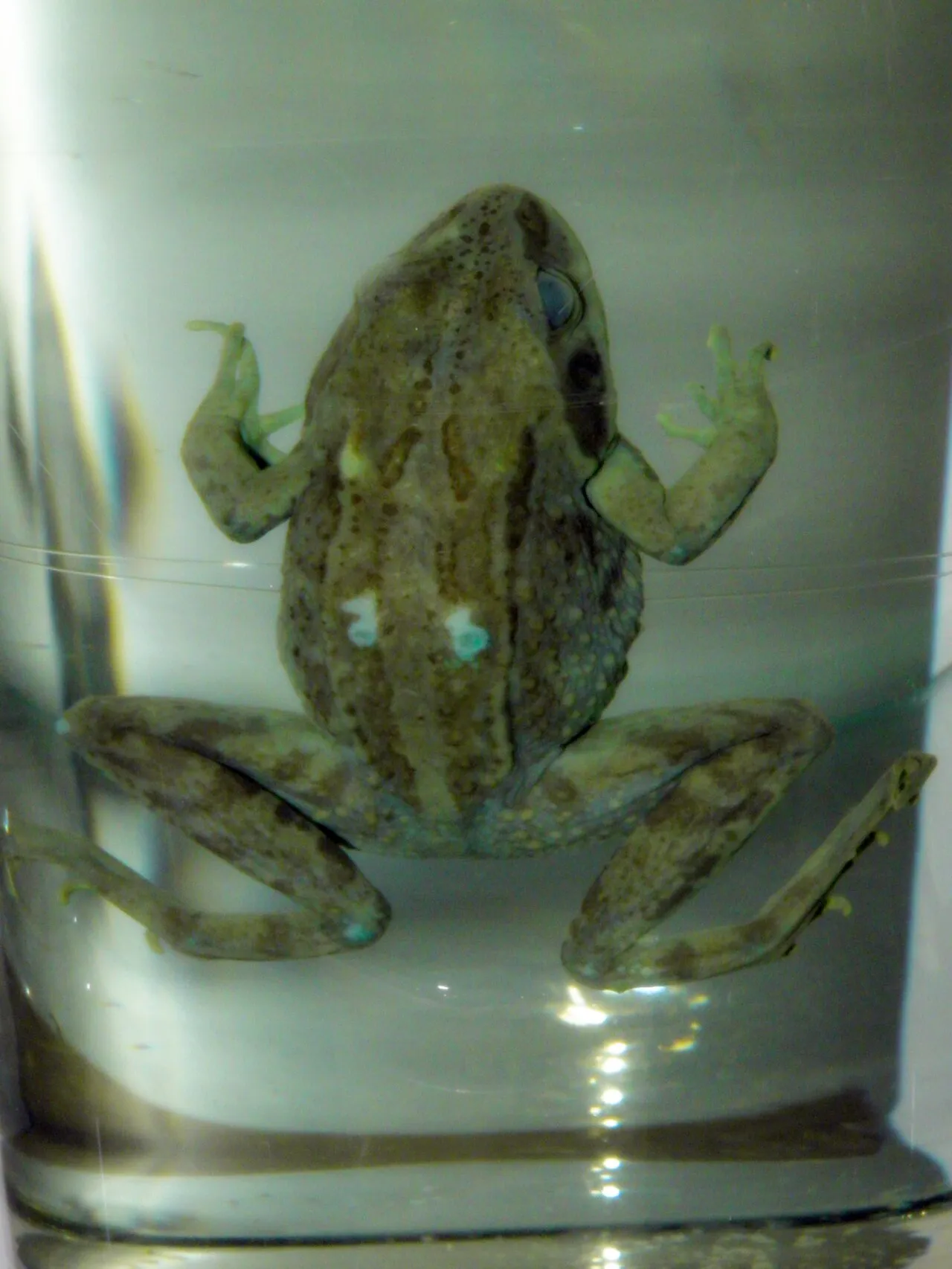
Rana amurensis carries several English common names, among them Khabarovsk frog, Siberian wood frog, Heilongjiang brown frog and Amur brown frog. It ranges across western Siberia, northeastern China, northeastern Mongolia, the northern Korean Peninsula and Sakhalin, reaching latitudes as high as 71° N, which makes it the northernmost wild amphibian species known. Adults are small, with a body length of about 20-25 mm.
Identification
The species shows light brown colouring with smooth skin marked by irregular dark brown and yellow stripes. At a maximum of around 2-2.5 cm in body length, it is one of the smaller true frogs in its range.
Habitat and range
Rana amurensis is a habitat generalist that favours open ground but is also found in both deciduous and coniferous forests. It favours lowlands and is rarely encountered above 600 m. Its range spans western Siberia, northeastern China, northeastern Mongolia, the northern Korean Peninsula and Sakhalin, and within that span it reaches as far north as 71° N, further than any other wild amphibian is known to live.
Behaviour and breeding
Outside the breeding season, the diet favours beetles, and an adult eats roughly 1.2-2.5 g of food per day. Breeding starts early for a cold-climate frog: in Korea the season begins in late February, as soon as conditions allow. Each female produces one egg sac holding 30-60 eggs. In winter the frog hibernates on pond bottoms rather than on land, sheltering under water until conditions warm again. The average lifespan is three years.
Conservation
The IUCN category for Rana amurensis is given in the facts box above. It is not considered threatened on a global scale, but the species does face habitat loss, and hunting pressure in Russia has increased since the 1990s.
Similar species
Rana coreana was previously included within Rana amurensis as a subspecies before being recognised as a distinct species, and the two remain the closest match for each other across the parts of their range that overlap in the Korean Peninsula and nearby parts of northeastern Asia. Elsewhere in its range, its small size and far-northern distribution rule out most other brown frogs.