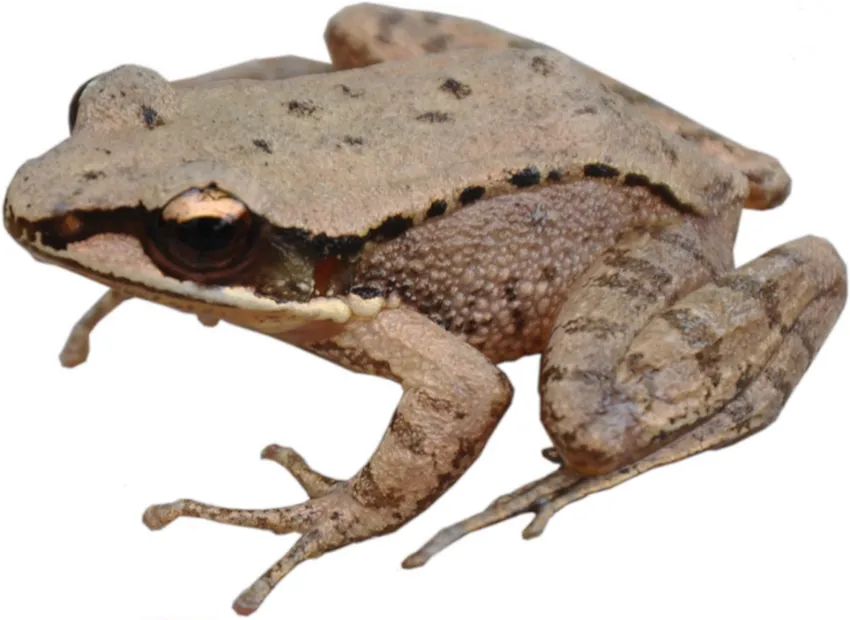
Odorrana tormota, the concave-eared torrent frog, is a true frog endemic to eastern China, where it survives beside some of the loudest background noise any frog has to call over. First described by Wu in 1977, it was originally placed in the genus Amolops, then moved into its own monotypic genus Wurana, before later being reclassified into Odorrana, where it sits today. What sets the species apart from every other frog studied so far is not its looks but its ears: it is the first frog, and the first non-mammalian vertebrate, confirmed to both produce and perceive ultrasonic calls, a discovery that reshaped assumptions about how small a hearing organ can be and still pick up frequencies far above human range.
Identification
The feature that gives the species its common name is its ears: Odorrana tormota has extremely thin eardrums recessed into cavities on the sides of its head, rather than the flat, exposed tympanum typical of most frogs, and correspondingly shorter, lighter middle-ear bones. That recessed, concave structure is the field mark behind the name “concave-eared,” and it is also the anatomical basis for the hearing described below. Detailed body measurements are not documented in the open sources checked for this page, so observers in the field are better served by habitat and behaviour than by size alone.
Habitat and range
The species is restricted to the Huangshan Mountains of Anhui province and to Jiande and Anji counties in northern Zhejiang province, a narrow range entirely within eastern China; the type locality from its original description lies in Anhui. Within that range it lives in and around fast-flowing mountain streams, where it also breeds. Those torrents generate constant low-frequency noise that would mask an ordinary frog call, and the species’ habitat choice is inseparable from the hearing adaptation that lets it be heard over exactly that racket. Unlike many stream-breeding frogs whose range straddles several provinces, Odorrana tormota’s entire known population is packed into this one cluster of mountain catchments, so a visit to any other part of eastern China, however similar the streams look, will not turn up this species.
Behaviour and breeding
Most frogs hear only up to about 12 kHz, well within human range, but Odorrana tormota has been recorded calling at frequencies up to 128 kHz, far into the ultrasonic range and beyond what any other frog is known to produce or detect. The recessed, thin-walled ears described above are thought to be what lets it single out those high-frequency calls against the rushing water it lives beside. Courtship adds a second unusual trait: female concave-eared torrent frogs blink their eyes at males to signal readiness to mate, the only documented use of eye-blinking as a courtship signal in any animal apart from humans and some primates. Together, an ultrasonic call few predators or rival species can intercept and a visual signal that needs no sound at all give this frog two ways to communicate that sidestep the torrent noise filling its habitat.
Conservation
The facts box gives the species’ IUCN category. A frog confined to a handful of counties across two provinces would ordinarily be a concern, but its mountain-stream habitat lies largely away from major agricultural or urban pressure, and no steep population decline has been flagged in current assessments, keeping it out of a more threatened category for now. Its extreme range restriction is nonetheless worth watching: a species with nowhere else to go has little buffer if its streams are disturbed. The same acoustic ecology that makes it scientifically notable also makes it a useful indicator: a species that depends this closely on clean, fast-flowing water for both habitat and communication is likely to register stream degradation earlier than frogs with less specialised needs.
Similar species
Odorrana tormota’s closest relatives within its own genus include Odorrana versabilis and the long-snout torrent frog, Odorrana nasica, both suggested as close kin in the scientific literature, though neither shares its confirmed ultrasonic hearing. Away from a laboratory or an acoustic survey, the recessed, concave ear structure described above remains the most reliable clue to this species’ identity, since no other frog in its range is known to share that trait.