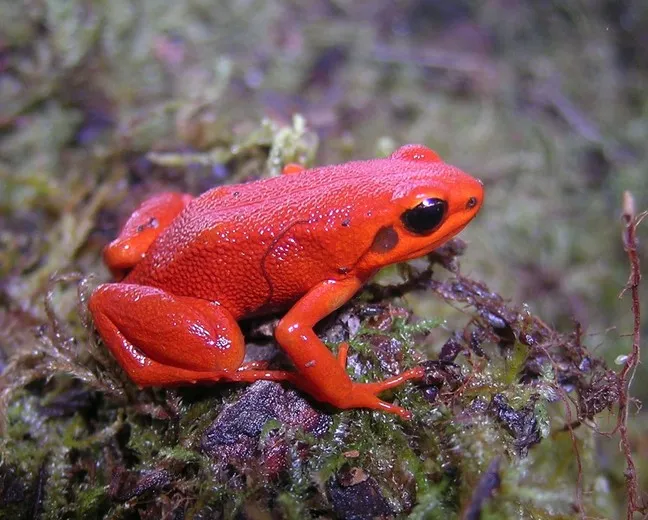
Mantella milotympanum, the black-eared mantella, is a small frog of the family Mantellidae, endemic to Madagascar, the island whose isolation has produced the entire genus Mantella and nowhere else. The genus numbers 16 recognised species in total, established by George Albert Boulenger in 1882 and known collectively as golden frogs or Malagasy poison frogs, a name earned by the same chemical defences that mark the black-eared mantella as a species of conservation concern. Mantella frogs are a textbook case of convergent evolution with the unrelated poison dart frogs (family Dendrobatidae) of Latin America: two frog lineages on opposite sides of the world independently evolved similar bright warning colours and toxic skin secretions in response to the same pressure from predators.
Identification
No measurements or colour description specific to Mantella milotympanum have turned up in an open source yet; this page will add them once one surfaces. The common name points to one likely field mark, a dark patch around the tympanum (ear region), but that has not been confirmed to species level in a source this page can cite. What can be said comes from the genus as a whole: Mantella species are small, ranging from 18 to 31 millimetres in length, with small angular heads, large eyes, distinct tympana, and slightly enlarged fingertips, and most carry bright aposematic markings in combinations of green, red, orange, yellow, blue, brown, white and black that warn predators of toxic skin secretions rather than camouflaging the frog. Markings vary a good deal from one Mantella species to the next, so this genus-wide pattern is a starting point for identification, not a substitute for a confirmed sighting of Mantella milotympanum itself.
Habitat and range
The black-eared mantella is endemic to Madagascar, living in subtropical or tropical moist lowland forest, subtropical or tropical moist montane forest, and swamps. That span from lowland to montane forest is broader than some of its relatives manage, though it stays within the genus’s wider pattern of forest and wetland dependency. Across the genus, Mantella species as a group occupy rainforests, swamps, bamboo forests, streambeds, grasslands and wet canyons, and the genus as a whole is endemic to Madagascar and its smaller coastal islands, never extending to the African mainland. The black-eared mantella’s reliance on forest and swamp habitat, rather than more disturbed or open ground, leaves it exposed wherever that forest is cleared.
Behaviour and breeding
No behaviour or breeding record specific to Mantella milotympanum has turned up in an open source yet. The genus it belongs to is better documented: Mantella frogs are diurnal and terrestrial, active by day on the ground rather than at night or in the water column, and they acquire the alkaloids behind their chemical defence from the arthropod prey they eat, as shown by stomach-content analysis, rather than manufacturing those toxins themselves. Those alkaloid profiles vary between individual frogs and persist in the skin for years, even in frogs kept in captivity away from their wild diet. Whether the black-eared mantella follows this pattern exactly has not been confirmed by a source specific to the species, but nothing in the record suggests it differs from its relatives.
Conservation
The facts box above carries the species’ current IUCN Red List category, Critically Endangered, the same rank held by only the most imperilled frogs in the genus. The clearest pressure on the black-eared mantella is habitat destruction, and unlike some of its relatives, none of its habitat is currently protected, leaving the entire species without a reserve or park to fall back on. Alongside that, the species carries a history of large-scale collection for the pet trade, a pressure that has eased since but previously removed significant numbers of wild animals.
The pressures bearing on the black-eared mantella match the pattern across its genus. Mantella species in general are threatened by habitat loss driven by subsistence agriculture, timber extraction, charcoal production, fires and the draining of wetlands, as well as mining, hybridisation between species and over-collection for the international pet trade, and genus-wide IUCN status ranges from Least Concern to Critically Endangered depending on how restricted and how disturbed each species’ habitat is. The black-eared mantella sits at the most imperilled end of that range, with no protected habitat to anchor its recovery.
Similar species
Mantella milotympanum shares its genus with several other species already profiled here, including the golden mantella, Mantella aurantiaca, the brown mantella, Mantella baroni, Mantella cowanii, the eastern mantella, Mantella crocea, the blue-legged mantella, Mantella expectata, the climbing mantella, Mantella laevigata, the Madagascan mantella, Mantella madagascariensis, and the green mantella, Mantella viridis. Without a confirmed description of its own colouring on record, the surest way to tell the black-eared mantella apart from those relatives in the field is its combination of forest and swamp habitat spanning lowland to montane elevations and its lack of any protected range, rather than markings alone.