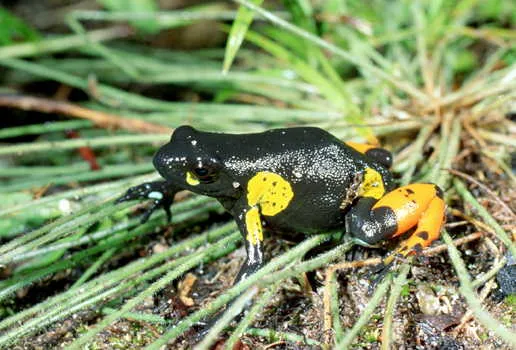
Mantella cowanii, Cowan’s Mantella, is a small frog of the family Mantellidae, endemic to Madagascar and first described by the herpetologist George Albert Boulenger in 1882. It belongs to the genus Mantella, a group of 16 species endemic to Madagascar and nearby coastal islands whose bright warning colours have earned them the nickname “Malagasy poison frogs,” despite no close relation to the true poison dart frogs of Central and South America.
Identification
In a verified photograph of the species, an individual shows mostly black, finely granular skin broken by bright yellow blotches on the flanks and thighs, with the legs and feet a vivid orange marked with black, a pattern typical of the strongly contrasting colour combinations the genus uses as a warning to predators. Like other mantellas, Cowan’s Mantella is diurnal and terrestrial, active by day rather than at night, and its bold colouring most likely signals the same kind of chemical defence seen across the genus: mantellas are known to sequester at least some of their skin alkaloids from arthropod prey rather than producing the toxins themselves, and to retain those alkaloids in their skin for long periods. The genus as a whole ranges from 18 to 31 mm in length, with females typically larger than males, though no species-specific measurement for M. cowanii could be confirmed from a source open to verification this run.

Habitat and range
Cowan’s Mantella’s natural habitats are subtropical or tropical moist montane forest, subtropical or tropical high-altitude grassland, and rivers, placing it among the mantellas found at higher elevations on Madagascar’s central plateau rather than in the island’s lowland rainforest. As with the rest of the genus, its range is confined entirely to Madagascar, and it depends on the rivers and streams that run through its montane grassland and forest habitat, both as a water source and, in all likelihood, as the setting for breeding, in common with the pattern seen across Mantella species that breed near flowing or standing water.
Behaviour and breeding
Detailed, species-specific behavioural and breeding data for Cowan’s Mantella could not be confirmed from a source open to verification this run: the specialist amphibian databases that typically carry that level of detail blocked automated access. What can be said with confidence, from the genus it belongs to, is that Cowan’s Mantella shares the diurnal, terrestrial habits and warning colouration of its relatives, and that its montane forest, grassland and river habitat places its likely breeding activity near the watercourses that run through that habitat, the pattern typical of mantellas generally.
Conservation
The facts box above carries the species’ current IUCN Red List category, Endangered. Cowan’s Mantella is threatened by habitat loss, and collection for the pet trade has also been identified as a threat, a combination common to several range-restricted mantellas whose striking colouring makes them a target for exotic-pet collectors even as the montane forest and grassland they depend on is cleared for agriculture and other uses. International trade in the species is restricted: Cowan’s Mantella is listed on CITES Appendix II, meaning exports require a permit intended to ensure the trade does not threaten the species’ survival in the wild.
Similar species
Cowan’s Mantella’s black base colour broken by bright yellow flank blotches and orange, black-marked legs sits within the broad pattern of bold, contrasting warning colouration shared across the genus Mantella, which makes individual species easiest to tell apart by the precise combination and placement of colours rather than by a single diagnostic mark. The golden mantella, Mantella aurantiaca, is a useful contrast: it is near-uniformly bright orange over its whole body, without the black base and patterned yellow and orange blotches of Cowan’s Mantella, and the two species do not share a range, since the golden mantella is confined to a small cluster of wetlands around Moramanga while Cowan’s Mantella occupies higher-elevation forest and grassland elsewhere on the island.