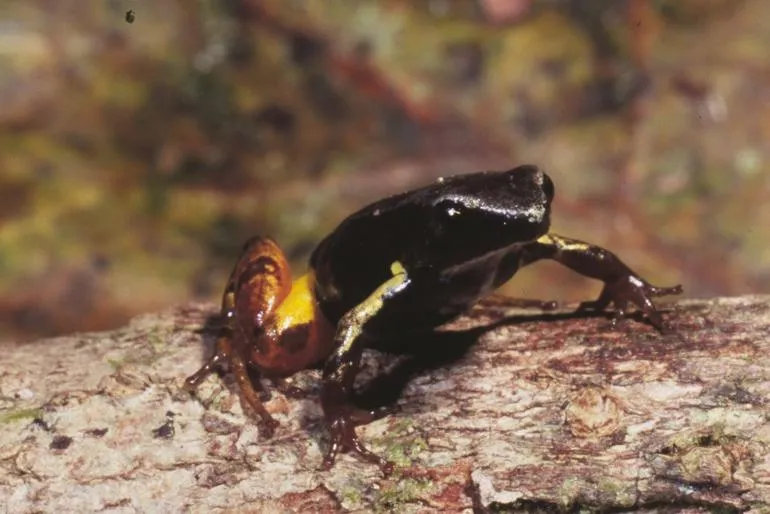
Mantella bernhardi, Bernhard’s mantella, is a small frog of the family Mantellidae, endemic to Madagascar, the island whose isolation has produced the entire genus Mantella and nowhere else. It was described by Vences, Glaw, Peyrieras, Böhme and Busse in 1994, one of 16 recognised species in a genus that George Albert Boulenger established in 1882. Mantella frogs are known collectively as golden frogs or Malagasy poison frogs, a name earned by chemical defences that place Bernhard’s mantella among the same group of toxic-skinned, brightly marked frogs that evolved its warning colouring through convergent evolution with the unrelated poison dart frogs (family Dendrobatidae) of Latin America, rather than through shared ancestry.
Identification
No adult measurements or colour description specific to Mantella bernhardi have turned up in an open source yet; what is on record is a description of its tadpole, taken from a specimen at Gosner stage 35 collected in Vevembe forest: a body length of 9.2 mm, body height of 4.7 mm, body width of 5.5 mm and a tail 17.7 mm long, giving a total length of 26.9 mm, with a mouth that opens anteroventrally, rounded papillae in a single row along the lower lip, and a thin, fully pigmented, finely serrated jaw sheath. For the adult frog, what can be said comes from the genus as a whole: Mantella species are small, ranging from 18 to 31 millimetres in length, with small angular heads, large eyes, distinct tympana, and slightly enlarged fingertips, and most carry bright aposematic markings in combinations of green, red, orange, yellow, blue, brown, white and black that warn predators of toxic skin secretions rather than camouflaging the frog. Those markings vary a good deal from one Mantella species to the next, so this genus-wide pattern is a starting point for identification, not a substitute for a confirmed description of the adult.
Habitat and range
Bernhard’s mantella is endemic to south-eastern Madagascar, documented from roughly 21.00 to 24.15 degrees south and 47.00 to 48.00 degrees east, at elevations of about 60 to 629 m above sea level, with populations known from several scattered localities, including Vevembe forest and sites within Ranomafana National Park and Manombo Special Reserve. Its habitat is subtropical and tropical moist lowland forest, including rivers, swamps and heavily degraded former forest; the tadpole collection site itself was small puddles in a swampy area near a lowland rainforest stream in Vevembe forest, at 581 m above sea level. Habitat across its range is fragmented, leaving populations relatively small and isolated as primary vegetation is lost. That pattern matches the genus as a whole, which is endemic to Madagascar and its smaller coastal islands and occupies a wide range of microhabitats across its various species, from rainforests and swamps to bamboo forests, streambeds, grasslands and wet canyons.
Behaviour and breeding
No breeding record specific to Mantella bernhardi has turned up in an open source yet, beyond the discovery of its tadpoles in shallow puddles near a rainforest stream, which points to still, shallow water as a larval habitat rather than the stream itself. The genus it belongs to is better documented: Mantella frogs are diurnal and terrestrial, active by day on the ground rather than at night or in the water column, and they acquire the alkaloids behind their chemical defence from the arthropod prey they eat, as shown by stomach-content analysis, rather than manufacturing those toxins themselves. Those alkaloid profiles vary between individual frogs and persist in the skin for years, even in frogs kept in captivity away from their wild diet. Whether Bernhard’s mantella follows this pattern exactly has not been confirmed by a source specific to the species, but nothing in the record suggests it differs from its relatives.
Conservation
The facts box above carries the species’ current IUCN Red List category, Vulnerable. The clearest pressure on Bernhard’s mantella is ongoing habitat destruction across its south-eastern Madagascar range, which has left its remaining populations fragmented and, in many cases, isolated from one another. Collection for the pet trade compounds that pressure: researchers have put the figure at up to around 3,000 specimens taken per year, prompting strict limits on how much collection the species can bear, since unchecked collection for the pet trade could pose a threat to it. Two of its known populations fall within protected areas, Ranomafana National Park and Manombo Special Reserve, though most of its scattered localities sit outside that formal protection.
The pressures bearing on Bernhard’s mantella match the pattern across its genus. Mantella species in general are threatened by habitat loss driven by subsistence agriculture, timber extraction, charcoal production, fires and the draining of wetlands, as well as mining, hybridisation between species and over-collection for the international pet trade, and genus-wide IUCN status ranges from Least Concern to Critically Endangered depending on how restricted and how disturbed each species’ habitat is. Bernhard’s mantella’s own Vulnerable rating sits in the middle of that range, worse off than the genus’s most adaptable, widespread species but not yet among its most imperilled.
Similar species
Mantella bernhardi shares its genus with several other species already profiled here, including the golden mantella, Mantella aurantiaca, the brown mantella, Mantella baroni, Mantella cowanii, the eastern mantella, Mantella crocea, Mantella expectata, the golden-mantled climbing mantella, Mantella laevigata, the Madagascar mantella, Mantella madagascariensis, and the green mantella, Mantella viridis. Without a confirmed description of its own adult colouring on record, the surest way to tell Bernhard’s mantella apart from those relatives in the field is locality and elevation rather than markings: it is the species documented between roughly 60 and 629 m above sea level across a handful of scattered forest sites in south-eastern Madagascar, including Vevembe forest, Ranomafana National Park and Manombo Special Reserve.