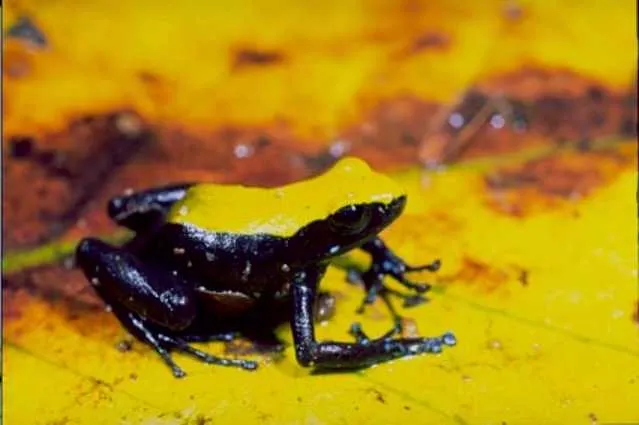
Mantella laevigata, the climbing mantella, is a small frog of the family Mantellidae, endemic to the northeast coastal region of Madagascar, where it lives in lowland rainforest and bamboo groves. Like its relatives in the genus Mantella, it carries bright warning colours and toxic skin secretions, but it stands apart from them in one respect: it is the only member of the genus to breed in phytotelmata, the small pools of water that collect in tree holes and broken bamboo stalks, rather than in open ponds or streams.
Identification
Adults are small, 24-30 mm in length and weighing 1.2-2.0 g, with males noticeably smaller than females though the two sexes are difficult to tell apart by sight alone; males are identified instead by their mating calls. The frog’s anterior back is bright yellow or pale green, while the arms, legs, abdomen and posterior regions are black, with blue spots marking the limbs and the eyes entirely black. Both sexes have webbed digits with expanded discs at the tips, an adaptation suited to climbing the bamboo and trees it depends on for breeding. The species was described by Methuen and Hewitt in 1913, and its closest relative is thought to be the green mantella, Mantella viridis.
As in other mantellas, the bright colouring is a warning signal backed by genuine toxicity: 41 different potent alkaloids have been found in the climbing mantella’s skin. The frog does not manufacture these itself; they are lipophilic compounds drawn from its arthropod diet, and captive frogs lose their toxicity over time once that wild diet is no longer available — the same pattern seen in the unrelated poison dart frogs of Central and South America, which arrived at similar colouring and chemistry through convergent evolution rather than shared ancestry.
Habitat and range
The climbing mantella is confined to the northeast coastal region of Madagascar, in lowland rainforest and bamboo groves, including Mananara-Nord, Marojejy and Masoala National Parks, as well as the Nosy Mangabe Special Reserve and Betampona Natural Reserve. Within that range it favours humid, warm conditions, with optimal humidity of 80-100% and temperatures of 17-30°C, with 20-26°C as the preferred range. Its distribution is shaped directly by its unusual breeding habits: the species needs a supply of water-filled bamboo internodes or tree holes, so its range tracks the bamboo groves and old-growth forest that provide them rather than open water.
Behaviour and breeding
Males are highly territorial, claiming an area of roughly 2 square metres around a water-filled well in a tree hole or broken bamboo stalk, and they defend it against rival males with fighting bouts that range from about 10 seconds to more than an hour and a half, involving wrestling, chasing and leaping. A male attracts females with a two-tone advertisement call, then switches to a softer single-note courtship call once a female approaches; females are largely silent and choose a mate based on the quality of his well rather than the quality of his call.
Breeding itself is unusual for the genus. A female typically lays a single large egg, 3-3.5 mm across, at the side of the well or just above the waterline rather than in the water itself. She also practises trophic egg-laying: she deposits additional unfertilised eggs that her own tadpole eats, a behaviour known as oophagy, and the tadpoles consume only eggs of their own species while ignoring mosquito larvae and other arthropod larvae sharing the well. The male’s territorial defence doubles as parental care, since he guards the well against other frog species and against land crabs, both of which will eat the eggs.
Outside the breeding season, adults feed on ants, insect larvae, mites and other small insects, with the diet shifting markedly between seasons: ants make up about 84% of the diet in the dry season but only 35% in the wet season, and more than half of the ants eaten belong to the genus Pheidole.
Conservation
The facts box above carries the species’ current IUCN Red List category, Least Concern, assigned in 2016 on the strength of its wide distribution and presumed large population; the species had carried a Near Threatened rating in 2004 and 2008 before that reassessment. Even so, its population is suspected to be declining, and the main pressure is deforestation outside protected areas for cattle grazing, farmland and urban development, which removes the bamboo groves and tree holes the species needs for breeding even where the forest itself is not entirely cleared. The exotic-pet trade, by contrast, is not currently considered a serious threat under proper regulation.
Similar species
Three other Mantella species overlap in range or appearance: M. betsileo, M. viridis and M. expectata resemble the climbing mantella but differ in coloration and spot placement, typically showing blue spots on the throat rather than on the limbs, along with a faint line along the upper lip. The clearest field clue for the climbing mantella remains its lifestyle: its climbing habit and its attachment to tree-hole and bamboo-stem wells, rather than ponds or streams, set it apart from most of its ground- and pond-breeding relatives.