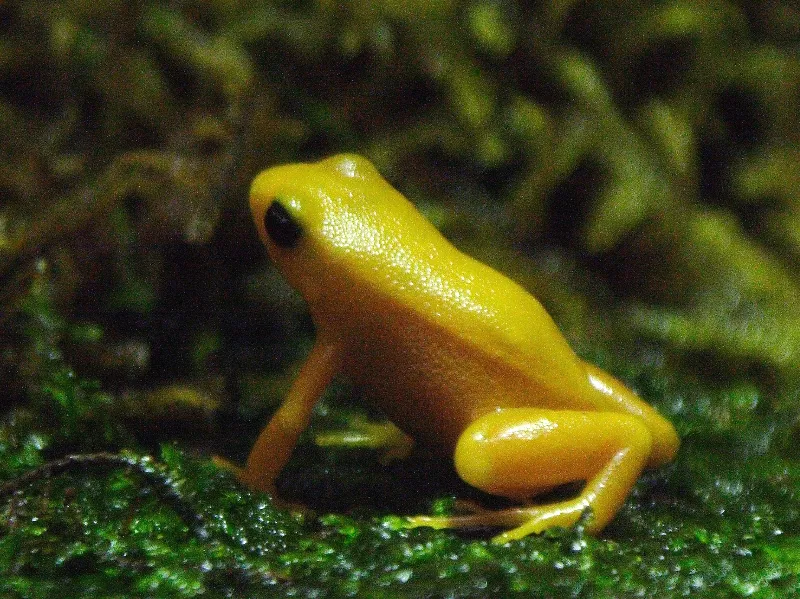
Mantella aurantiaca, the golden mantella, is a small, vividly orange frog of the family Mantellidae, endemic to Madagascar with an extremely restricted range in three areas around the town of Moramanga: the Beparasy and Ambohibary communes, the Torotorofotsy wetland, and the Ambakoana area. Despite its resemblance to the unrelated poison dart frogs of Central and South America, it belongs to an entirely separate family that evolved its warning colours through convergent evolution, not shared ancestry.
Identification
Adults are small, measuring 20–26 mm in snout-vent length, with the bright, saturated orange skin that gives the species its common name, though colouring can shift toward yellow or red rather than a fixed orange, and red flash marks often show on the inner legs. That colouring functions the same way it does in the dart frogs it superficially resembles: a visual warning to predators that the frog is unpalatable, backed by defensive skin secretions rather than true venom. Those secretions are not manufactured by the frog itself: they come from alkaloids the frog sequesters from small invertebrate prey such as mites, ants, flies and springtails, the same dietary route poison dart frogs use to become toxic. The species was first described by the French naturalist François Mocquard in 1900, from a male specimen a little over 21 mm long; the scientific name comes from the Latin for “gold”.
Habitat and range
The golden mantella is confined to small lentic, or still-water, wetlands in central-eastern Madagascar, where adults gather to breed once the seasonal rains arrive. Its known range is unusually narrow even by the standards of range-restricted Madagascar amphibians, limited to the Beparasy and Ambohibary communes, the Torotorofotsy wetland, and the Ambakoana area near Moramanga. That concentration in a handful of wetlands leaves the species exposed to any single event, such as drainage or pollution of one of those sites.
Behaviour and breeding
The golden mantella’s activity tracks Madagascar’s seasons closely, and it is largely inactive through the cooler months from roughly May to October, then becomes active by day once the rains and warmer temperatures of the wet season arrive. Breeding is tied closely to the wetlands the species depends on, and adults move into small still-water pools after seasonal rains to mate, and calling males, which typically outnumber females roughly two to one at breeding sites, advertise from concealed spots near the water with a repeated clicking call. Unlike frogs that lay their eggs directly in water, golden mantellas lay their eggs on land, in moist leaf litter near the water’s edge, and the hatching tadpoles make their way, or are washed, into the adjacent pool, where they complete metamorphosis into frogs in about seventy days. Despite its toxic skin, the golden mantella is not immune to predation: the snake Thamnosophis lateralis and Zonosaurus skinks have both been recorded preying on it.
Conservation
The facts box above carries the species’ current IUCN Red List category, Endangered. Its combination of a tiny, fragmented range around Moramanga and a specific breeding habitat of small wetlands and adjacent leaf litter leaves it vulnerable to local habitat loss in a way that few wider-ranging frogs are. Its entire known distribution sits within those few named sites, so their condition largely determines the species’ outlook. Beyond habitat pressure, the golden mantella has long been sought after by exotic-pet collectors and zoos, and over-collection for that trade has been identified as a pressure on wild populations alongside habitat degradation; proposals have been raised to launch a legal, regulated collection programme as one response. Captive-bred animals are not simply a substitute for wild ones: a 2017 study found captive-bred golden mantellas responded faster to stimuli than wild-caught animals.
Similar species
The golden mantella’s bright, near-uniform orange colouring is distinctive within its genus and its Madagascar range, where other Mantella species tend toward more mixed or patterned colouring rather than a single saturated hue. Its resemblance to unrelated poison dart frogs of the Americas is only superficial: geography alone rules out confusion, since the two groups do not share any range, and the golden mantella’s small size and restricted wetlands around Moramanga are the clearer identifiers in the field.