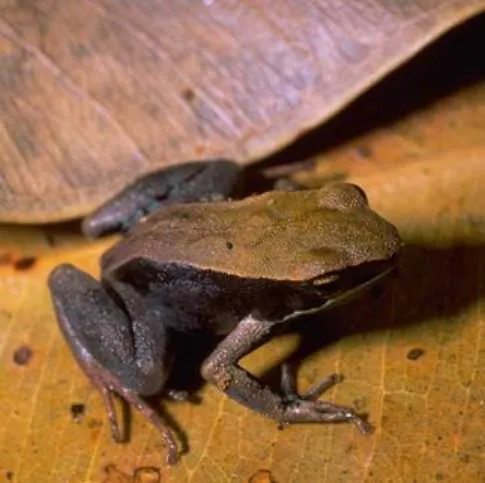
Mantella betsileo, the brown mantella, is a small frog of the family Mantellidae, endemic to Madagascar. It is the type species of Mantella, the frog around which the whole genus was built. Alfred Grandidier first described it in 1872, along with the Malagasy mantella (Mantella madagascariensis), placing both in the genus Dendrobates on account of their close resemblance to those South American frogs; only in 1882 did George Albert Boulenger separate them into a new genus, Mantella, named using this species as its reference point. Despite that formal distinction, the brown mantella is also known by the alternate common names Betsileo golden frog and bronze mantella.
Identification
No species-specific measurements for Mantella betsileo have turned up in an open source yet, but the genus it founded is well described: Mantella species run from 18 to 31 millimetres in length, with small angular heads, large eyes, a very distinct tympanum, and slightly enlarged fingertips, on bodies with four fingers on each forelimb and five toes on each hindlimb. The brown mantella’s own colouring is described in plainer terms than many of its brightly marked relatives: it shows a dull, plain upperside contrasted with conspicuously marked underparts, a pattern that puts its warning colours on the belly rather than the back. It belongs to the Mantella betsileo species group, a cluster of four species that share this general look.
Habitat and range
The brown mantella is endemic to Madagascar, with a distribution centred on the western and central parts of the island. Its recorded habitats run from subtropical or tropical dry forest, dry and moist savanna, and dry shrubland to rivers, freshwater marshes (including ones that dry up part of the year), ponds, canals and ditches, rural gardens and heavily degraded former forest, a broader spread of ground than most of its relatives use, including rural gardens and heavily degraded former forest close to people.
Behaviour and breeding
No breeding record specific to Mantella betsileo has turned up in an open source yet, but as the type species it shares the genus’s basic habits: Mantella frogs are diurnal and terrestrial, foraging on the ground by day rather than hunting at night or from the water. Their chemical defences come from what they eat rather than from their own metabolism: stomach-content analysis shows that Mantella frogs acquire the alkaloids behind their toxic skin secretions from the arthropod prey they consume, and those alkaloids persist in the skin for years, even in frogs kept in captivity away from their wild diet. Whether the brown mantella’s own breeding behaviour matches the diurnal, ground-foraging pattern typical of the genus has not been confirmed by a source specific to the species, but nothing in the record suggests it differs.
Conservation
The facts box above carries the species’ current IUCN Red List category, Least Concern, reflecting its wide range and its unusual tolerance of disturbed and human-altered habitat. It is also listed on CITES Appendix II, which regulates international trade in the species. Even so, it is threatened by habitat loss, though its own habit of turning up in canals, ditches and rural gardens suggests it absorbs that pressure better than most of its relatives. Across the genus as a whole, Mantella species face habitat loss driven by subsistence agriculture, timber extraction, charcoal production, fires and the draining of wetlands, as well as mining, hybridisation between species and over-collection for the international pet trade, with genus-wide IUCN status ranging from Least Concern to Critically Endangered depending on how restricted and how disturbed each species’ habitat is. The brown mantella, with its broad range and tolerance for degraded ground, sits at the least urgent end of that spectrum.
Similar species
The brown mantella shares its species group with Mantella expectata, the blue-legged mantella of southwestern Madagascar, Mantella viridis, the green mantella of the north, and Mantella ebenaui, Ebenau’s mantella of the northeast, which is not yet profiled here. It is also linked historically to the Malagasy mantella, Mantella madagascariensis, the other species Grandidier originally described alongside it in 1872 before both were moved into Mantella. No source consulted for this page sets out the specific field marks that separate the brown mantella from these relatives. Its broad, plain-backed colouring and its tolerance of disturbed, human-altered habitat across western and central Madagascar are the best distinguishing clues available.