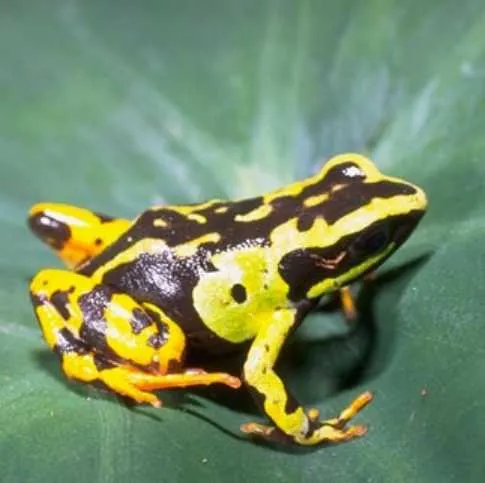
Mantella madagascariensis, the Madagascan mantella, is a small, stoutly built frog of the family Mantellidae, endemic to east-central Madagascar in upland forest from near Niagarakely south to Ranomafana, at elevations of 700–1,050 m above sea level. It was first described in 1872 by the French naturalist Alfred Grandidier, originally as Dendrobates madagascariensis, a name later shown to belong with the unrelated dart frogs of the Americas before the species was placed in its current genus. Like other mantellas, it is sometimes known by alternate common names, including the Malagasy painted mantella and the Madagascar golden frog.
Identification
The “golden frog” nickname sometimes applied to the species undersells its colour: it is a tiny but stout frog with irregular black and yellow streaking across a blackish body and dark dorsum, set off by a green or yellowish stripe running along the snout. The limbs carry their own pattern, with the femur and humerus usually yellow-green and the tibia, tarsus and foot reddish-orange with blackish patches, and yellow-green blotches extending toward the flanks near the forelimbs. Adults are small, males reaching 21–22 mm in snout-vent length and females slightly larger at 24–25 mm. Like every member of its genus, the skin carries several toxic alkaloids, the same kind of chemical defence that makes the unrelated poison dart frogs toxic.
Habitat and range
The species occupies a band of upland Madagascar running from near Niagarakely south to Ranomafana, at elevations of 700–1,050 m, placing it higher on the island’s eastern escarpment than many lowland mantellas. Its habitat is subtropical or tropical moist lowland and montane forest, together with the rivers that run through it, and within that forest it keeps close to water: the frogs are terrestrial and active on the ground by day, favouring forest and forest edge especially along streams.
Behaviour and breeding
The Madagascan mantella is diurnal, moving over the forest floor during daylight hours and sheltering in leaf litter and ground cover rather than climbing into the canopy. Its breeding is tied directly to the streams of its forest habitat: females lay their eggs on land, while the larvae that hatch from them develop in the adjacent streams. That pattern, eggs on land but tadpoles in running water, is a common strategy among mantellas.
Conservation
The facts box above carries the species’ current IUCN Red List category, Vulnerable. Its range is not as narrowly confined as some of its relatives, but it is still restricted to a limited upland band of eastern Madagascar’s forests, and its breeding depends specifically on the streams within that forest. The two pressures most often linked to its decline are habitat loss and potential commercial collection, the same combination that threatens much of Madagascar’s amphibian diversity: clearance of the forest removes both the ground cover the adults need and the stream habitat its larvae depend on, while collection for the exotic pet trade adds further pressure.
Similar species
The Madagascan mantella is closely related to Mantella pulchra and very similar to Mantella baroni; some authors treat Mantella madagascariensis itself as a complex of cryptic species rather than a single uniform population, so reliable identification in the field often rests on locality as much as on colour pattern. Its combination of black-and-yellow body streaking with reddish-orange limb patches sets it apart from the more uniformly coloured mantellas elsewhere on the island.