Espadarana callistomma: Unveiling the Beauty and Mystery of the Emerald Glass Frog#
Tucked beneath the lush canopies of Central and South America’s cloud forests, a diminutive gem shimmers silently, reflecting the earthy shadows and filtered sunlight of its forest home. This tiny jewel is the exquisitely named Espadarana callistomma, affectionately dubbed the Emerald Glass Frog. Renowned for its translucent skin, mesmerizing green hues, and hauntingly beautiful eyes, Espadarana callistomma offers us a fascinating window into nature’s wonders.
Known scientifically as Espadarana callistomma, this species belongs to the family Centrolenidae—a group renowned for their glassy transparency. Like tiny living crystals, glass frogs captivate wildlife lovers and scientists alike, offering insights into the delicate equilibrium of vibrant tropical ecosystems.
Taxonomy and Classification#
Espadarana callistomma belongs to the order Anura—the vast and diverse group that includes all frogs and toads. Within this order, it is part of the family Centrolenidae, familiarly known as glass frogs due to their distinctive translucent underbellies, allowing internal organs to be observed clearly in living specimens. The genus Espadarana distinguishes itself with strikingly brilliant coloration and eyes rimmed in striking metallic hues.
Originally described by researchers Duellman and Schulte in 1993, Espadarana callistomma was initially grouped within the genus Centrolene. Recent genetic studies led taxonomists to revise classifications, positioning it within Espadarana. This adjustment reflects ongoing scientific efforts to accurately map the incredible biodiversity of the Neotropics, deepening our understanding and appreciation for these remarkable amphibians.
Natural Habitat#
A Home among the Clouds#
Espadarana callistomma is typically found inhabiting humid, mountainous regions throughout Costa Rica, Panama, Colombia, and Ecuador. In these mist-covered slopes, at altitudes ranging from about 500 to 2,000 meters, these frogs find refuge amidst the verdant foliage and trickling mountain streams.
Their preference for cloud forests is no mere coincidence. These humid, ecologically rich environments offer a stable climate and abundant leaf cover, crucial ingredients for the frog’s unique blend of camouflage and moisture-reliant lifestyles. A world of epiphytes, ferns, moss-laden branches, and gently dripping leaves shapes their daily existence, sheltering the frog within a microhabitat perfectly suited for its delicate biology.
Wet Leaves and Whispering Streams#
Glass frogs rely closely on clear, flowing streams, usually choosing perches overhanging water bodies. Espadarana callistomma shelters by day beneath broad plant leaves, their bodies flattened against leafy undersurfaces, blending seamlessly with their environment. By nightfall, they venture slightly above these streams to hunt and mate, demonstrating the rich relationship between amphibian biology and aquatic ecosystems.
Physical Characteristics#
Seldom exceeding lengths of just about 2 to 3 centimeters, Espadarana callistomma embodies nature’s refined artistry at its most subtle. Their minute form belies their impressive adaptations, tailor-made for survival amongst dense rainforest foliage.
Emerald Beauty on Translucent Wings#
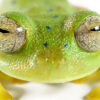
The Emerald Glass Frog’s most striking feature unquestionably lies in its remarkable transparency. Ventral skin layers are clear enough to reveal organs, lungs, heart pulsations, and even circulating blood. This transparency, animals scholars suspect, provides camouflage against lurking predators—from snakes to birds—making Espadarana callistomma nearly invisible when poised motionless on its leafy refuge.
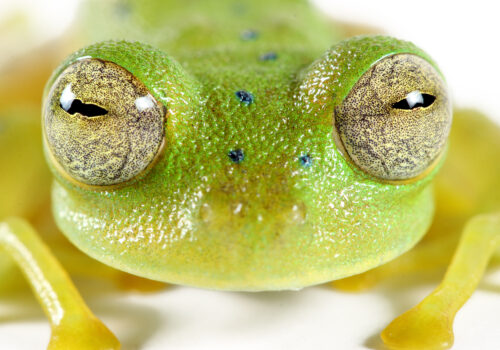
Atop this translucent base, the dorsal surface of Espadarana callistomma shimmers vibrantly green, mimicking rain-drenched leaves or algae-coated branches. This coloration is further accentuated by fine flecks of gold and silver, occasionally glinting under moonlit skies and effectively scattering reflected light—a disguise so perfect it mirrors the rich plant life around it.
Eyes of Liquid Gold#
Perhaps the most hypnotizing trait of this species, its eyes—once eloquently described as “windows of gold”—appear disproportionately large and mounted prominently on the frog’s head. Encircled by metallic, golden-silver irises, their eyes capture ambient light, facilitating agile nocturnal activities and enhancing their vision for precision hunting through the forest undergrowth.
Behavior and Life Cycle#
An Evening Ballet Beneath the Leaves#
Espadarana callistomma maintains a predominantly nocturnal existence. During daylight hours, these frogs remain still and hidden, their flattened, translucent bodies adhering neatly to the underside of leaves. Evening heralds activity, as males spring to life—exuding soft, melodious calls to attract passing females. Their mating call, a delicate piqued melody, drifts gently through forest nights amidst echoes of nocturnal insects and distant running water.
Dedicated Guardians of the Next Generation#
Espadarana callistomma females deposit their clutch of around 15 to 40 eggs onto leaves hanging directly above streams. Egg masses are meticulously arranged in gelatinous masses that hold moisture and shield embryos. Surprisingly, parental care is notable in these tiny frogs: males often remain near the eggs to guard against predacious insects and fungi, regularly hydrating the clutch with delicate sprays of water from their hind limbs during dry spells.
Tadpoles hatch and subsequently drop directly into water below, beginning their fascinating aquatic phase. Experienced swimmers, the tadpoles adapt quickly, feeding on algae and organic matter common in flowing streams. This transition from arboreal egg clusters to aquatic larval biology underscores the frog’s intricate relationship with the forest and its waters, showing the interconnectedness critical for survival.
Ecological Role#
Though small, Espadarana callistomma plays an integral ecological role beyond its physical presence. Predominantly insectivorous, their diet includes ants, flies, and other insects which would otherwise overpopulate and disrupt local flora. Their role as prey in turn sustains larger rainforest predators, forming part of an intricate food web whose integrity ultimately preserves forest biodiversity.
Furthermore, as sensitive amphibians tied exquisitely to specific habitat conditions, glass frogs like Espadarana callistomma serve as vital indicators of habitat health. Changes in population dynamics reflect wider ecological struggles—precious signals warning conservationists of looming dangers born from habitat degradation, climate shifts, or contamination.
Threats and Conservation Status#
Espadarana callistomma currently holds classification as Least Concern according to the International Union for Conservation of Nature (IUCN). Yet, despite this comforting official category, growing threats demand vigilant conservation monitoring. Habitat loss, notably from deforestation, logging, agricultural expansion, and infrastructure projects, poses significant risks to localized populations.
Climate change increasingly emerges as an existential threat, altering moisture patterns and cloud cover essential for cloud forests’ survival. Long-term drying, warming, or unpredictable weather episodes jeopardize delicate breeding seasons, egg viability, and overall population stability.
Active Steps Toward Preservation#
Conservation programs across its range actively recommend creating reserves and corridors connecting existing protected forest areas, promoting sustainable forest use, and continuous scientific population assessments. Raising public awareness remains key, helping local communities appreciate the ecological intricacy and beauty embodied by small creatures like Espadarana callistomma.
Cultural and Scientific Significance#
Espadarana callistomma embodies the beauty and fragility of tropical ecosystems. Its unique transparency continues to captivate scientists studying internal physiology, embryonic development, predator avoidance strategies, and evolutionary adaptations. Insights gleaned from such research illuminate our understanding of biodiversity, evolution, and environmental sensitivity.
Culturally, glass frogs symbolize the hidden wonders and mystery of tropical forests across indigenous communities. Their presence enriches local folklore, emphasizing harmony with the natural world they’re intricately part of.
Conclusion#
The delicate and captivating Espadarana callistomma, with its glass-like body, emerald beauty, and ecological sensitivity, provides a compelling window into rich tropical biodiversity. Understanding, protecting, and cherishing this species underscores a broader mission—to safeguard the extraordinary tapestry of life within our treasured forests.
Let us see through the eyes of this emerald amphibian and commit ourselves to protecting its cloud forest home. Active engagement through science, conservation awareness, and advocacy ensures the continued existence of Espadarana callistomma—a testament to our role as stewards of Earth’s unmatched biological heritage.