- Introduction: An Enigmatic Jewel of the Rainforest
- The Distinctive Taxonomy of Cochranella xanthocheridia
- An Exclusive Haven: Natural Habitat and Distribution
- Vivid Appeal: Physical Characteristics and Adaptations
- A Secretive World: Behavior and Life Cycle
- Ecological Significance of Cochranella xanthocheridia
- A Fragile Existence: Threats and Conservation Status
- Cultural and Scientific Relevance
- Conclusion: Guardians of the Forest Canopy
Introduction: An Enigmatic Jewel of the Rainforest#
The rainforest canopy shimmers with life in a thousand shades of green, alive with whispers of wings and rustling leaves. Against this lush backdrop, shimmering subtly within the nocturnal foliage, lives a unique and elusive creature: Cochranella xanthocheridia, a remarkable member of the glass frog family. Transparent as a crystal droplet and delicate enough to seem crafted from fine porcelain, this species seems almost ethereal. Yet despite its ghostly appearance, the presence of Cochranella xanthocheridia resonates powerfully, telling nuanced stories of ecological balance, survival, and the pressing importance of conservation.
Belonging to the family Centrolenidae, Cochranella xanthocheridia captivates biologists and nature enthusiasts alike with its translucent skin, allowing a glimpse directly into its beating heart, internal organs, and flowing bloodstream. This intriguing feature, combined with its specialized habitat requirements, makes this creature both fascinating and vulnerable.
So take my hand, reader, as we journey together through dense tropical forests in search of a frog whose very presence remains simultaneously subtle yet critically important. Let us explore deeply the life, environment, and survival story of Cochranella xanthocheridia.
The Distinctive Taxonomy of Cochranella xanthocheridia#
The species Cochranella xanthocheridia is classified scientifically within the Centrolenidae family—more commonly known as glass frogs due to their transparent underbellies—as part of the genus Cochranella. Glass frogs are predominantly arboreal amphibians, specialized for a life spent perched high amidst forest vegetation near pristine freshwater streams.
Discovered by scientists in the relatively recent past, Cochranella xanthocheridia has drawn special attention due to certain morphological characteristics that set it apart from closely related species. Specialists continue to deliberate among themselves over subtle taxonomic distinctions that separate members of Cochranella; nevertheless, distinct physical traits and genetic markers securely position Cochranella xanthocheridia as a separate and important species within this intriguing genus.
An Exclusive Haven: Natural Habitat and Distribution#
Cochranella xanthocheridia occupies specialized habitats, typically restricted to humid montane and subtropical forests along pristine streams and tributaries. Found prominently within the remote, rugged terrain of northwestern Ecuador, this glass frog relies heavily upon habitats characterized by dense canopy cover, consistent moisture, and abundant leaf litter to sustain its sensitive life cycle.
These frogs are predominantly spotted along the western slopes of the Andes, between elevations of roughly 1000 to 2000 meters. In habitats shrouded by consistent mist and frequent rainfall, Cochranella xanthocheridia lives a predominantly arboreal lifestyle, making use of large broadleaf plants, ferns, bromeliads, and mosses nestled within trees.
Remarkably sensitive to environmental change, its very presence often signifies exceptional water quality and pristine habitats; consequently, it serves as a valuable bio-indicator for assessing habitat health.
Vivid Appeal: Physical Characteristics and Adaptations#
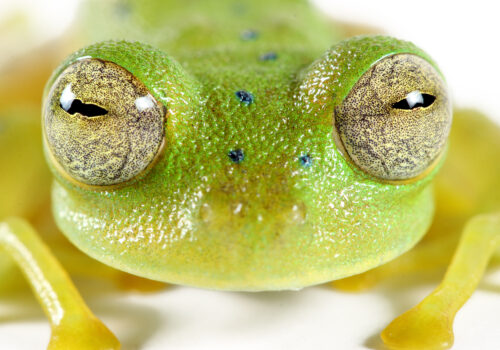
No words can do true justice to the ethereal, even surreal, appearance of Cochranella xanthocheridia. At first glimpse, these tiny creatures—typically only 2.5 to 3 centimeters in size—seem crafted from blown glass. Their translucent, lime-green to pale yellow skin delicately reveals internal organs, veins, and even tiny bones.
The species’ eyes are distinctly large and mesmerizingly silver or golden, a feature effective for nocturnal hunting. Their limbs are slender and elongated, culminating in adhesive toe pads designed precisely for a stable arboreal existence in the upper forest strata.
To protect themselves from potential predators such as birds and snakes, these glass frogs rely heavily upon their nearly invisible appearance. Snuggled beneath broad, damp leaves, their transparent bodies blend beautifully with the lush greenery. This superb camouflage mechanism safeguards them by making detection extraordinarily challenging, even for predators with keen eyesight.
A Secretive World: Behavior and Life Cycle#
Nocturnal Pursuit and Diet#
Like most glass frogs, Cochranella xanthocheridia emerges as dusk envelops the rainforest canopy. Nighttime heralds the start of their hunting pursuits. Small insects and invertebrates—such as moths, flies, spiders, and ants—comprise their diet. Using precise, agile leaps, tongue flicks, and keen eyesight, these frogs effectively hunt among leaves and branches of their arboreal territories.
A Serenade in Shadows: Breeding and Reproduction#
During rainy seasons, males of the species call melodiously from elevated perches, positioned strategically above water sources. These gentle yet persistent calls resonate softly through the humid forest, attracting receptive females to hidden rendezvous among lush foliage and misty banks.
After selection, female frogs lay small batches of translucent eggs upon leaves hanging over streams. Here emerges one of nature’s greatest spectacles—parent frogs guard their egg clusters vigilantly, protecting them against predators such as insects and larvae, occasionally hydrating them with droplets of water from their own bodies to maintain moisture.
Tadpoles hatch after a few weeks, dropping directly into flowing streams where they continue their development securely hidden among submerged leaves, sticks, and vegetation, consuming algae and organic detritus until ready to emerge as miniature translucent juveniles.
Ecological Significance of Cochranella xanthocheridia#
The ecological importance of Cochranella xanthocheridia cannot be overstated. As both predator and prey, it plays crucial roles within the intricate food web of its rainforest ecosystem. These small insects voraciously consume various arthropods, regulating their populations and preventing outbreaks of insect pests.
Conversely, glass frogs become vital prey items for larger predators including snakes, birds, and mammals, thus playing part in sustaining larger predatory organisms within their rich ecosystem niches.
Moreover, the extreme sensitivity of this species to habitat perturbation, pollution, and climate fluctuations turns it into a powerful ecological indicator. Presence or absence of this frog often provides scientists invaluable early warnings regarding environmental degradation and ecosystem health.
A Fragile Existence: Threats and Conservation Status#
Unfortunately, this magnificent creature, deeply intertwined into its ecosystem fabric, faces considerable pressure from human activity. Habitat loss due to agriculture, logging, road construction, and mining directly threatens its fragile population. Additionally, chemical pollution and climate instability have indirect impacts, further deteriorating delicate forest streams upon which this frog depends.
According to the IUCN Red List, Cochranella xanthocheridia is currently classified as “Endangered,” signifying a significant risk of extinction in the wild. Recognizing this concerning status, organizations, conservationists, and local communities have initiated targeted efforts aimed at habitat protection, monitoring, and restoration. Local reforestation initiatives, educational outreach to surrounding communities, and biologically informed policies represent a crucial triad of actions aimed towards fostering sustainable coexistence with this remarkable amphibian species.
Cultural and Scientific Relevance#
While cultural tales in indigenous Ecuadorian communities seldom single out glass frogs directly, their habitats—lush cloud forests and pristine streams—embody vital symbolic significance and spiritual reverence in indigenous mythologies and cosmologies.
Scientifically, Cochranella xanthocheridia provides invaluable data regarding amphibian biology, genetic diversity, medicinal potential, and climate-sensitive organisms. Its intriguing transparency fascinates physiologists seeking greater understanding of organ functions, disease processes, and vascular research. In essence, this small amphibian opens doors to limitless scientific discoveries and exploration.
Conclusion: Guardians of the Forest Canopy#
In this fragile and rapidly changing world, the story of Cochranella xanthocheridia stands as both wondrous marvel and a sobering indicator of environmental vulnerability. As passionate stewards of our planet’s biodiversity, we hold responsibility not only to admire nature’s fascinating creativity but also to protect the delicate tapestry of life contributing richly to our world’s biodiversity.
By fostering awareness, supporting conservation initiatives, and promoting responsible human interactions with the natural world, we make tangible strides toward safeguarding Cochranella xanthocheridia and the verdant ecosystems of Ecuador. The time for action is now, while these glassy creatures continue their mesmerizing nocturnal dances, serenading us into awe and contemplation.