- Cochranella resplendens: The Enigmatic Jewel of the Andean Cloud Forests
- Taxonomy and Classification of Cochranella resplendens
- A Symphony of Mist: The Natural Habitat of Cochranella resplendens
- Marvelously Transparent: Physical Characteristics of Cochranella resplendens
- Dances in the Dark: Behavior and Life Cycle
- Role in the Complex Web of Life
- Hidden Threats and Conservation Challenges
- Cultural and Scientific Importance
- A Call to Conservation: Protecting Nature's Emerald Jewel
Cochranella resplendens: The Enigmatic Jewel of the Andean Cloud Forests#
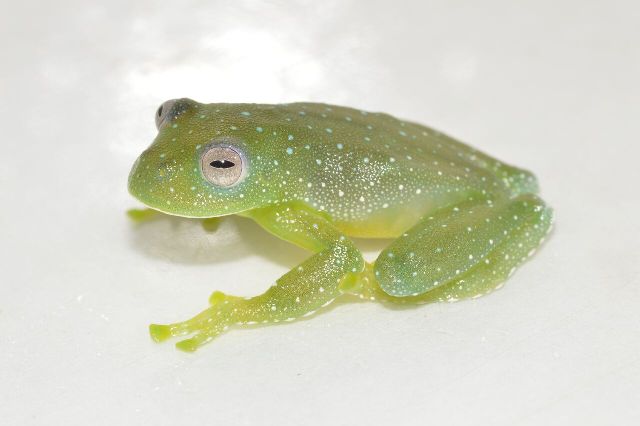
High amidst the densely misted forests of the Andean foothills, a fragile, translucent creature perches delicately upon dew-speckled foliage, gleaming emerald in the filtered mountain sunlight. This is Cochranella resplendens, a captivating glass frog species whose very existence embodies the wonders and mysteries harbored within the lush ecosystems of northwestern South America. Cloaked in dazzling green hues and a ghostly transparency that reveals the delicate beat of its heart, this species remains a mesmerizing marvel of evolution, drawing fascination from naturalists and conservationists alike.
The scientific name, Cochranella resplendens, fittingly conveys the species’ spectacular beauty (“resplendens” meaning shining or resplendent). Yet, despite its dazzling appearance, this frog remains little-known, often hidden away among the shadowy leaf layers of its cloud-blanketed habitat. As we journey deeper into the intimate life and intricate ecology of this species, we’ll uncover why it’s not only a stunning natural jewel but also an essential member of its unique and delicate ecosystem.
Taxonomy and Classification of Cochranella resplendens#
Belonging to the family Centrolenidae, Cochranella resplendens is a proud member of the renowned group known commonly as glass frogs—amphibians celebrated for their translucent undersides through which internal organs can be shockingly visible. Within genus Cochranella, it shares lineage with other intriguing species, many equally as enigmatic and delicate.
The taxonomic journey of Cochranella frogs sheds genuine insight into evolutionary narratives shaped by isolation and habitat specialization. Glass frogs like Cochranella resplendens are exemplary organisms that reveal meaningful ecological patterns, from diversification within montane ecosystems to responses to climatic shifts over geological timescales.
A Symphony of Mist: The Natural Habitat of Cochranella resplendens#
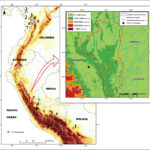
Cochranella resplendens thrives within the humid jungles emboldened by the constant embrace of clouds that typify tropical Andes biodiversity hotspots. Documented primarily in Ecuador and Colombia, these frogs persist at mid-to-high elevation cloud forests between 1,000 to 2,000 meters above sea level, amid fern-laden slopes, cascading streams, and emerald-green canopy layers.
A Fragile World in the Clouds#
Every leaf, every droplet collected on forest epiphytes serves as both sanctuary and hunting ground to this secretive species. It prefers riparian vegetation along crystal-clear mountain streams, favoring broad leaves shielded from direct sunlight. The rainforest’s perpetual moisture is critical, not only in sustaining hydration but also in ensuring adequate conditions for laying eggs.
Adapted meticulously to this realm of constant drizzle and perpetual moisture—where mist rises softly with the dawn and settles silently at dusk—Cochranella resplendens depends closely upon its aquatic and arboreal habitats, delicate ecosystems sensitive to even the subtlest environmental shifts.
Marvelously Transparent: Physical Characteristics of Cochranella resplendens#
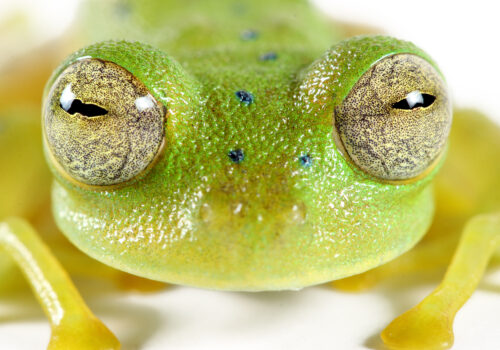
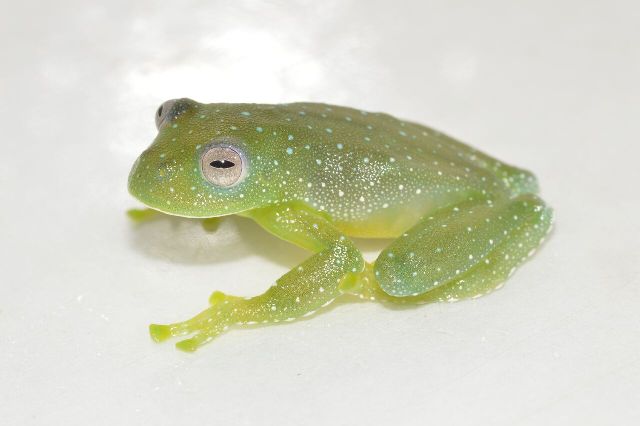
Much of Cochranella’s fame comes from its astonishing physical transparency. Adults typically measure between 25 to 30 millimeters, compact yet striking organisms whose small size belies their ecological significance. The upper body shimmers a vivid emerald-green, punctuated by specks of brighter flecks reminiscent of scattered starlight in a mossy twilight scene.
Glass-like Underbellies: An Evolutionary Mystery#
The translucent ventral side serves as a hallmark; beneath the frog’s delicate skin, one can clearly observe the heart pumping and the intricate arrangement of internal organs. This transparency represents an evolutionary adaptation, potentially aiding camouflage within their green, sunlight-dappled habitat, confusing predators by breaking outlines against leafy surroundings.
With slender limbs and rounded toe pads adeptly suited for gripping slippery foliage, this frog navigates its vertical habitats expertly. Skin moisture and slipperiness are equally tactical, deterring predation attempts by larger rainforest predators such as birds, snakes, and predatory insects.
Dances in the Dark: Behavior and Life Cycle#
Each evening, as daylight retreats into twilight, these frogs emerge into activity, their nocturnal habits adapted to evade diurnal predators and increase the efficiency of hunting insect prey. Feeding primarily on small insects such as gnats, mosquitoes, and moths, Cochranella frogs elevate agile ambush to an art form, utilizing swift, calculated leaps to capture unwary prey.
A Serenade in the Mist: Reproduction and Parental Care#
During wet seasons, male Cochranella resplendens frogs position themselves strategically and commence a melodious chorus—soft, rhythmic clicking reminiscent of raindrops echoing through a quiet forest night. The males’ persistent vocalizations invite females to their carefully chosen territories, typically leaves hanging precariously above rapid streams.
Egg deposition occurs shortly thereafter; transparent egg masses adhere directly to leaves dangling precariously several meters above water, where fathers remain fiercely protective. Unique among amphibians, male Cochranella exhibit attentive paternal behaviors, staying close to their developing offspring to guard against predators or parasites. Once hatched, tadpoles drop directly into the stream below, completing their complex life cycle immersed in aquatic safety.
Role in the Complex Web of Life#
Within its cloud forest home, the glass frog maintains integral ecological roles as both predator and prey. By feeding intensively on small insects, this species conserves delicate ecological balances, particularly controlling insect populations integral to forest health. Simultaneously, as prey, they supply valuable nourishment to a diverse array of forest inhabitants, thus linking terrestrial and aquatic components of this ecological mosaic.
Indicator Species Status#
The sensitivity of Cochranella resplendens to ecological degradation grants scientists an important indicator of forest ecosystem health. Clear correlations exist between population declines and environmental stressors such as habitat alteration, climate shifts, pollution, and disease—making the presence or absence of Cochranella frogs a critical biological measure of landscape vitality and integrity.
Hidden Threats and Conservation Challenges#
Sadly, the spectacular natural beauty of Cochranella resplendens belies the fragility of its survival amidst mounting pressures. Habitat destruction due to expansion of agriculture, logging, and urban encroachment threatens the small, isolated populations scattered across their limited geographic range.
IUCN Conservation Status#
Currently, the International Union for Conservation of Nature (IUCN) lists this species as “Near Threatened.” Degradation of primary habitats and climate-associated shifts in precipitation patterns and temperature regimes pose significant long-term threats. Amphibian diseases such as chytridiomycosis represent equally grave threats, further complicated by the frog’s small population sizes and fragmented distribution.
Efforts and Conservation Strategies#
Conservationists emphasize habitat protection and sustainable land-use practices to secure Cochranella populations. Collaborative endeavors between local communities, governments, and conservation NGOs are increasingly vital, emphasizing ecological education, habitat fragility awareness, and strategic restoration programs. Protecting streamside vegetation and ensuring ecological corridors linking fragmented habitats has become key priorities for the long-term survival of this fragile species.
Cultural and Scientific Importance#
Indigenous communities throughout these frogs’ mountainous range often recognize local frogs in rich cultural narratives, associating them with renewal, rain, fertility, and good fortune. Scientifically, the intricate life histories and transparent anatomies of Cochranella species continue to intrigue biologists, providing insight into amphibian evolution, forest dynamics, and environmental health.
A Call to Conservation: Protecting Nature’s Emerald Jewel#
As climate change, habitat destruction, and disease threats encroach upon amphibian habitats worldwide, the need to appreciate—and actively protect—species like Cochranella resplendens becomes imperative. Each population extirpation represents irreplaceable biological artistry lost forever, a silent extinction robbing ecosystems both scientifically and spiritually.
Only through combined vigilance, ecological stewardship, and passionate advocacy can we ensure that the ghostly twinkling of transparent skin and delicate nocturnal melodies of Cochranella resplendens continue to grace the mist-shrouded forests of the Andes—speaking volumes of humanity’s resolve to live harmoniously with nature, embracing the richness of life it harbors.