- Centrolene marcoreyesi: Discovering the Enigmatic Marcoreyes' Glass Frog
Centrolene marcoreyesi: Discovering the Enigmatic Marcoreyes’ Glass Frog#
Cloaked in the lush mist and emerald shadows of South American cloud forests, a tiny amphibian thrives unnoticed. Its glass-like skin and delicate build seem almost ethereal, as if fashioned from transparent emerald crystal. The Centrolene marcoreyesi, known commonly as Marcoreyes’ Glass Frog, is an elusive species whose ghostly transparency reveals the silent pulse of its heart and viscera, hypnotizing all who are fortunate enough to witness it firsthand.
Despite its small size and discreet presence, this frog carries immense ecological significance, serving as an indicator of ecosystem health amid rapidly vanishing habitats. Join me in exploring the enigmatic life, captivating biology, and conservation story of one of nature’s most mesmerizing creations—Centrolene marcoreyesi.
Taxonomy and Classification#
Marcoreyes’ Glass Frog belongs to the extensive amphibian order Anura, within the family Centrolenidae. This intriguing family encompasses glass frogs known for their transparent underside—an evolutionary novelty seemingly designed by nature to intrigue and mystify.
More specifically, Centrolene marcoreyesi falls within the genus Centrolene, containing nearly two dozen recognized species. First described scientifically in 2009 by researchers Cisneros-Heredia and Valarezo, this iconic amphibian carries the name of the Ecuadorian conservationist Marco Reyes, honoring his dedicated advocacy for amphibian conservation in South America.
Natural Habitat and Distribution#
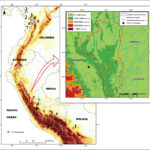
The evocative call of Centrolene marcoreyesi enlivens the dense and humid subtropical cloud forests of the Andes Mountains. This species finds solace and safety within the lush vegetation shrouded in clouds, favoring elevations between 1,500 and 2,000 meters above sea level.
Endemic to southern Ecuador, specifically found in limited and isolated mountain zones within the Andes, the frog’s habitat indicates a preference for pristine, minimally disturbed ecosystems. It seeks untouched streams and humid ravine corridors often cloaked in perpetual fog, a testament to the sensitive ecological balance required for its survival.
Habitat Preferences and Microhabitat Use#
What sets apart this glass frog from several of its relatives is not solely geographical isolation, but also particular habitat preferences. The species is closely associated with riparian ecosystems, especially pristine and clear mountain streams fringed by leafy vegetation and dense epiphytes.
Adult frogs adopt arboreal lifestyles, primarily inhabiting low-hanging branches, broad leaves, and moss-covered vegetation directly above flowing streams. This placement provides a vital ecological advantage—protection from ground-dwelling predators and convenient sites for egg-laying, ensuring safety and high humidity optimal for developing offspring.
Distinctive Physical Characteristics#
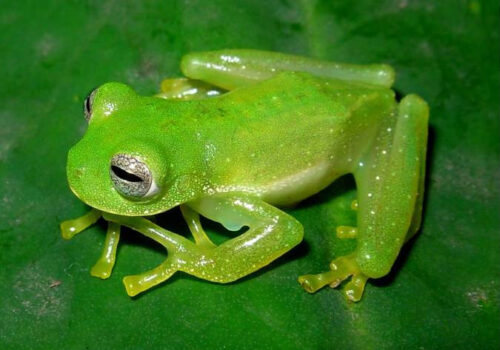
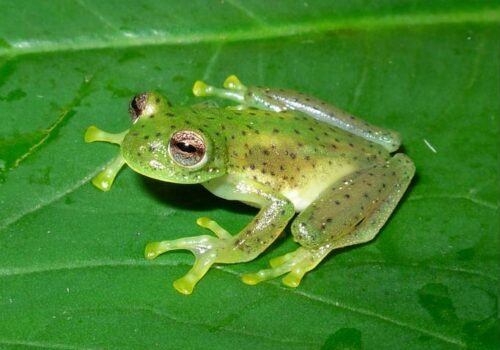
True to glass frog form, Centrolene marcoreyesi displays striking translucent green skin that sets it uniquely apart. Adults measure a mere 22–28 millimeters in length, their delicate frames rendering them jewel-like against their leafy habitats.
Their dorsal surface strikes observers as a captivating mossy green, adorned with fine white specks shining like tiny stars scattered across an emerald sky. Their hands and feet, equipped with prominent adhesive toe pads, reflect anatomical adaptations designed for adept climbing and precise movements across slick, wet vegetation.
Transparency and Internal Visibility#
What is astonishing about glass frogs, and especially Centrolene marcoreyesi, is their partially transparent ventral surface revealing a fascinating glimpse into the workings beneath their skin—heartbeats, digestive functions, and veins all observable beneath diaphanous tissue.
This translucent underside both captivates nature enthusiasts and provides researchers a rare and intimate view into amphibian physiology; its transparency can aid scientists in noninvasively assessing health, stress, and parasites within populations.
Behavior and Life Cycle#
The glass frog is largely nocturnal, spending daylight hours sheltered beneath foliage beside rushing streams, concealing its transparent body against predators. But nightfall triggers lively activity—a chorus of soft, cricket-like mating calls echoes through the forest, with males occupying leafy perch positions positioned strategically over water.
Feeding and Hunting Strategies#
Small insects and arthropods, particularly ants, spiders, moths, and flies, comprise the primary diet of the glass frog. With acute visual acuity and agile movements, they pick prey deftly from vegetation or ambush them with quick leaps. Their camouflage ensures minimal detection by prey, offering them significant predatory efficiency in their crowded ecological niche.
Mating, Egg-Laying, and Parental Care#
During mating seasons—typically coinciding with the rainy months—males vocalize to advertise their presence and fitness to potential mates. Once a female selects a partner, they deposit small gelatinous egg masses—usually fewer than two dozen examples—directly on leaves overhanging swiftly flowing mountain streams.
These egg clusters are beautifully transparent, resembling small droplets of rain, and positioned perfectly so that emergent tadpoles drop directly into the safety of the flowing waters below. Notably, male frogs vigilantly guard their egg clutches, fending off insects and predators to ensure successful hatching.
The Ecological Significance of Centrolene marcoreyesi#
Glass frogs, including Centrolene marcoreyesi, aren’t merely captivating; their presence indicates ecological conditions necessary for biodiversity and ecosystem health. They regulate insect populations through predation, supporting ecological balance within the delicate rainforest microhabitat.
Additionally, their sensitivity to climatic conditions, stream pollutants, and habitat disturbances renders them invaluable as indicator species. Their decline frequently serves as early warning signs of deeper environmental malaise, prompting urgent systemic intervention and ecosystem analysis.
Current Threats and Conservation Status#
Disturbingly, the future of the Marcoreyes’ Glass Frog appears uncertain. Habitat destruction from agriculture, deforestation, timber extraction, and climate change-driven drought threatens its delicate ecological balance. Additionally, chytridiomycosis, an aggressive fungal disease affecting amphibians globally, has been detected in Ecuador’s Andean region, posing yet another critical threat.
IUCN Status and Conservation Initiatives#
Due to limited distribution, fragmented populations, and declining habitats, the International Union for Conservation of Nature (IUCN) has categorized Centrolene marcoreyesi as Near Threatened. Immediate conservation measures include habitat protection, ecological research facilitation, and captive breeding programs geared particularly towards the preservation of genetic diversity and disease resilience.
Cultural and Scientific Significance#
Marcoreyes’ Glass Frog honors Marco Reyes—an Ecuadorian conservationist devoted to amphibian plight—and represents the intersection between science, conservation, and cultural identity. Indigenous folks and local naturalists praise the species as a symbol of clean water and forest preservation, often regarding sightings as indicators of environmental health.
Scientifically, transparent amphibians such as Centrolene marcoreyesi continue to fascinate researchers interested in amphibian skin biology, visual communication, and physiological adaptation to environmental pressures.
Conclusion: Preserving Ecuador’s Emerald Phantom#
The captivating Centrolene marcoreyesi is a symbol of South American biodiversity and ecological fragility, a tiny yet potent reminder of our collective environmental responsibilities. Its transparent elegance and intriguing behaviors represent not just a mesmerizing piece of nature’s tapestry, but an invaluable ecological barometer crucial to forest health and balance.
Let our admiration translate into understanding, and understanding into actionable conservation. Support organizations working tirelessly to conserve the fragile cloud forest ecosystems; educate yourself and others on amphibian conservation; and appreciate the rich biodiversity that includes these enigmatic emerald phantoms—before we lose another jewel from nature’s ornate crown forever.