- Unveiling the Glass Frog: Exploring the Enigmatic World of <em>Centrolene lemniscatum</em>
- Taxonomy and Classification: What Makes <em>Centrolene lemniscatum</em> Unique?
- The Mystical Realm of the Glass Frog: Natural Habitat and Ecosystem
- The Remarkable Appearance of <em>Centrolene lemniscatum</em>
- Behavior and Life Cycle: An Intimate Look at Glass Frog Lives
- Ecological Importance: Indicator of Forest and Stream Health
- Threats Facing <em>Centrolene lemniscatum</em> and Conservation Efforts
- Cultural Significance and Scientific Relevance
- A Fragile Jewel Worth Protecting: Conclusion and Call to Action
Unveiling the Glass Frog: Exploring the Enigmatic World of Centrolene lemniscatum#
High among the lush rain-soaked forests of South America, hidden amidst verdant leaves and gentle streams, lives a species both captivating and mysterious—the glass frog Centrolene lemniscatum. With transparent skin and enigmatic behaviors, this remarkable amphibian beckons scientists and nature enthusiasts alike, offering a window into the intricate dynamics of our planet’s rainforests. If ever an animal embodied the delicate balance between visibility and secrecy, fragility and resilience, it would be this ethereal nocturnal dweller.
As we journey deep into the cloud forests of southern Ecuador and northwestern Peru, we enter a world that feels almost magical, animated by the nighttime choruses of hidden amphibians and the soft rustle of leaves brushing against unseen creatures. It is within this vibrant yet vulnerable ecosystem that the Centrolene lemniscatum thrives, performs its delicate rituals, and voices the subtle whispers that remind us why understanding and conserving Earth’s biodiversity is more urgent than ever.
Taxonomy and Classification: What Makes Centrolene lemniscatum Unique?#
Centrolene lemniscatum, commonly known as the banded glass frog or sometimes adorned with poetic titles like “ribbon-patterned glass frog,” belongs to the family Centrolenidae. This intriguing group of amphibians is distinguished by their delicate frames, emerald hues, and, most notably, translucent ventral skin, giving them their common name, “glass frogs.”
The genus name, Centrolene, points directly to this group’s unique centralized webbing on their toes, a characteristic adaptation allowing them superb arboreal agility. Closely related species within this genus often share habitats that span mist-laden montane forests and pristine freshwater streams, environments that are rapidly disappearing across Central and South America.
The Mystical Realm of the Glass Frog: Natural Habitat and Ecosystem#
A Narrow Range in the Cloud Forests#
Centrolene lemniscatum is known to occur only within a limited geographical scope—primarily in the Andean foothills and cloud forests of southern Ecuador and northwestern Peru. These regions are characterized by persistent cloud coverage, heavy rainfall, and moderately cool temperatures. This unique microclimate creates the ideal humid and foggy conditions required by this species for survival and reproduction.
Elevated Sanctuaries and the Vitality of Streams#
The life of this small amphibian is deeply tied to clean, flowing streams and riparian vegetation where it spends most of its existence. Dwelling primarily in trees and bushes alongside these freshwater arteries, the banded glass frog relies heavily on leaves overhanging gentle currents to lay its eggs. Ensuring proximity to flowing water safeguards their delicate offspring, who will hatch and fall safely into the stream below, embarking immediately upon their aquatic larval journey.
Immersing oneself in this frog’s environment reveals a world shrouded in mist, richly scented with damp moss and fragrant vegetation. Orchids bloom gently from moss-covered branches, and bromeliads fill pockets of canopy spaces, dripping with moisture. As nocturnal creatures, glass frogs become active as twilight transitions into darkness, their quiet domain illuminated only by the sparse moonlight penetrating through dense foliage and occasional flickering fireflies.
The Remarkable Appearance of Centrolene lemniscatum#
A Living Jewel: Colors and Transparency#
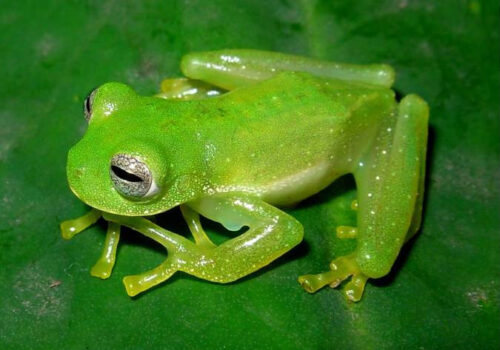
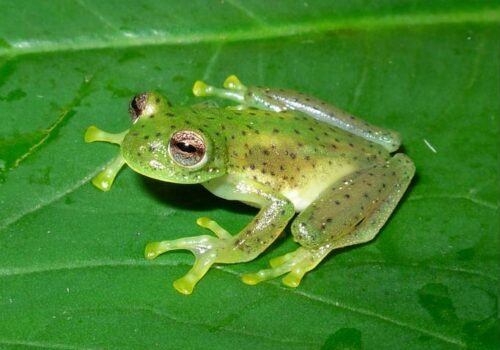
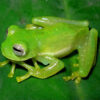
At first glance, members of Centrolene lemniscatum impress with their delicate beauty and charming elegance. Reaching an adult size that rarely exceeds 3 centimeters, the species boasts a remarkably vivid emerald or bright green coloration on the dorsum, often accented by striking whitish bands or lines that crisscross the back and limbs. This banding, fascinating and pronounced, earned them the descriptor “lemniscatum,” derived from Latin and meaning “adorned with ribbons.”
Perhaps what most captivates observers, however, is their transparent ventral skin. With bellies that lend full visibility to internal organs—beating hearts, fine bones, and intestines included—they embody the intricate transparency that characterizes their glass frog relatives. This unusual adaptation remains a compelling enigma among biologists. Hypotheses suggest that transparency may offer camouflage against nocturnal predators perched below, such as spiders, snakes, and other opportunistic predators.
Adaptations for Life in the Trees#
Long, slender hind limbs equipped with pronounced toe pads make Centrolene lemniscatum expert climbers. Their sticky toe disks act as biological suction cups, attaching effortlessly to slippery, wet foliage and branches. Their bodies, agile yet fragile in appearance, have evolved specifically for a lifestyle both arboreal and riparian—a characteristic combination offering protection and reproductive success in their lush, humid habitats.
Behavior and Life Cycle: An Intimate Look at Glass Frog Lives#
Nocturnal Serenades of Courtship#
As day fades into evening’s cool embrace, serenity transforms into symphony. Male glass frogs begin their delicate, peeping calls, subtle yet persistent, adding ethereal music to the nighttime rainforest. These soft, metallic chirps serve to announce territory, with determined males perched strategically on leaves directly above streams. Each call is an invitation and a challenge, luring females and deterring rivals, shaping social dynamics in an otherwise mysterious community.
Breeding and Benevolent Guardianship#
After successful mating, females carefully attach clusters of gelatinous eggs to the undersides of leaves hovering above water. These leaves will serve as nurseries, protected from aquatic predators yet close enough to ensure hatchlings safely enter the waters below. One of the most endearing traits of Centrolene lemniscatum is the vigilant care provided by males, who dutifully defend their precarious offspring from potential threats—an insect predator here, a fungal parasite there.
Upon emerging from eggs, the tadpoles drop into the streams beneath, where they continue developing as fully aquatic larvae. Water purity is paramount, emphasizing the tight ecological bond between these amphibians and pristine montane streams.
Ecological Importance: Indicator of Forest and Stream Health#
True sentinel species, glass frogs signal the overall vitality of their rainforest ecosystems. Highly sensitive to environmental toxins, pollutants, and habitat disturbances, the presence—or absence—of Centrolene lemniscatum provides immediate feedback on the health of both forest and aquatic environments. As predators and prey in their own right, glass frogs help maintain ecological balances in food webs, consuming insects and, in turn, nourishing larger nocturnal predators like bats, birds, and small snakes.
Threats Facing Centrolene lemniscatum and Conservation Efforts#
Despite their remote habitats, these beautiful amphibians do not live isolated from global environmental change. Rapid deforestation driven by agriculture, mining, and infrastructure development poses significant threats, fragmenting precious habitats. Climate change exacerbates these pressures, altering rainfall patterns, temperature regimes, and the delicate ecological balance these frogs require.
Currently evaluated by the International Union for Conservation of Nature (IUCN) as Vulnerable, protection of the habitats housing this buoyantly translucent creature has never been more crucial. Conservation organizations actively work towards habitat preservation, environmental education, and raising awareness in both local communities and global audiences. Strengthening protected landscapes, limiting harmful agricultural practices, and safeguarding freshwater ecosystems are essential steps in securing their survival.
Cultural Significance and Scientific Relevance#
Glass frogs like Centrolene lemniscatum occupy a meaningful place in local folklore, symbolizing purity, transparency, and cleansing rains. They remind those around them of the purity essential to all living systems. Scientifically, these frogs offer key insights into developmental biology, toxicology, and environmental stress responses. Studying their adaptations, especially transparency and sensitivity to pollutants, has sparked remarkable research that deepens our understanding of amphibian conservation and ecosystem health.
A Fragile Jewel Worth Protecting: Conclusion and Call to Action#
Exploring the enigmatic life of Centrolene lemniscatum brings us face-to-face with the beauty and vulnerability of nature itself. As guardians of their delicate habitats, we hold an immense responsibility. It is incumbent upon all of us—students, scientists, naturalists, and citizens alike—to advocate for conservation practices, support preservation initiatives, and deepen our understanding of the interconnected systems sustaining life on Earth.
Together, we can ensure that the gentle nocturnal chorus of the banded glass frog continues singing softly through the night, a quiet but resilient testament to the richness of our planet’s astonishing biodiversity.