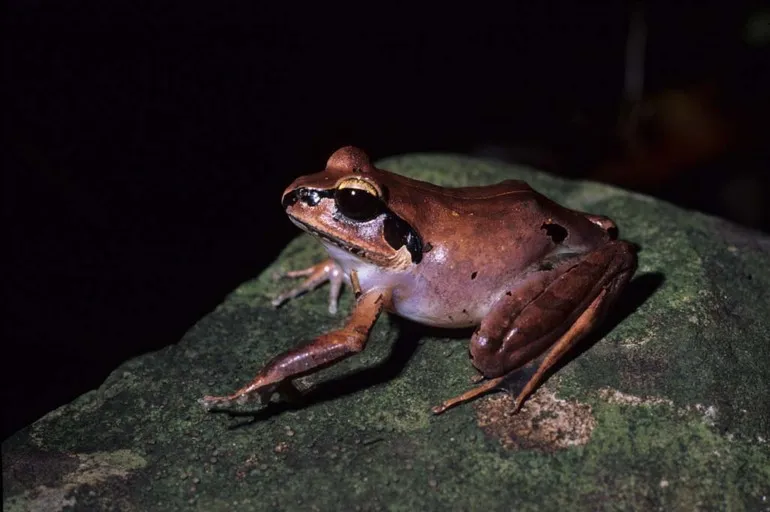
Aglyptodactylus securifer is a member of the family Mantellidae, endemic to Madagascar, where it is restricted to low-altitude western and northern regions, with documented localities including Kirindy Forest, Ankarana, Tsingy de Bemaraha, Manongarivo and Forêt d’Ambre. It belongs to the genus Aglyptodactylus, a group of six currently recognised species found nowhere outside Madagascar and known collectively as Madagascar jumping frogs. The wider family it sits within is one of the island’s great evolutionary success stories: Mantellidae counts at least 237 recognised species, found only on Madagascar and the nearby island of Mayotte, after its ancestors reached the island from Asia roughly 76-87 million years ago and diversified there ever since. Aglyptodactylus falls within the family’s Laliostominae subfamily of large-bodied, terrestrial frogs, distinct from the smaller, more colourful mantellines and the arboreal Boophinae tree frogs with which it shares the forests of Madagascar.
Identification
Upper surfaces are silver-grey to beige, with grey bands crossing the legs, while the underside is yellow with a white belly and the eyes are golden yellow with black pupils. Colouration is notably variable across the species’ range, and during breeding aggregations males turn yellow while females appear brown, a seasonal shift that can make the sexes easy to tell apart without close inspection. No published body-length measurement specific to this species could be confirmed from an openly accessible source at the time of writing, but the genus it belongs to gives a useful frame: Aglyptodactylus frogs are generally medium-sized, with a snout-to-vent length of 35-60 mm, larger than many of the diminutive, brightly coloured frogs that make up most of Mantellidae. Their tadpoles are by contrast small, morphologically similar across species, feed on detritus, and complete metamorphosis at 7-15 mm.
Habitat and range
The species lives in forest at low-altitude localities in western and northern Madagascar, with records from Kirindy Forest, Ankarana, Tsingy de Bemaraha, Manongarivo and Forêt d’Ambre, a spread of localities that tracks the island’s western and northern forests rather than any single reserve. Its tadpoles develop in river bed pools rather than the still ponds many other mantellids rely on. That distribution sits inside a much larger pattern: the whole family Mantellidae is endemic to Madagascar and Mayotte, and the dense concentration of single-island endemics it has produced since arriving is part of why Madagascar’s forests matter so much for frog conservation generally.
Behaviour and breeding
Aglyptodactylus securifer is an explosive breeder: mating aggregations with numerous pairs in axillary amplexus (males yellow, females brown) have been documented, including at Kirindy Forest, the pattern typical of species that concentrate their reproduction into a short, intense window rather than spreading it across the year. Males calling at Ankarana produce an advertisement call lasting about 474-509 milliseconds, made up of 2-3 distinctly pulsed notes, with a dominant frequency of roughly 2000-3500 Hz peaking near 3000 Hz, a short, buzzy, high-pitched call suited to carrying over a crowded, noisy breeding aggregation.
Conservation
The IUCN category is shown in the facts box above. Least Concern reflects a species found across several protected and unprotected localities in western and northern Madagascar; no specific threats to the species are detailed in the available sources at the time of writing.
Similar species
Aglyptodactylus securifer is one of six species currently recognised in the genus Aglyptodactylus, all endemic to Madagascar and historically grouped together as Madagascar jumping frogs; none of the other five has a profile on this site yet.