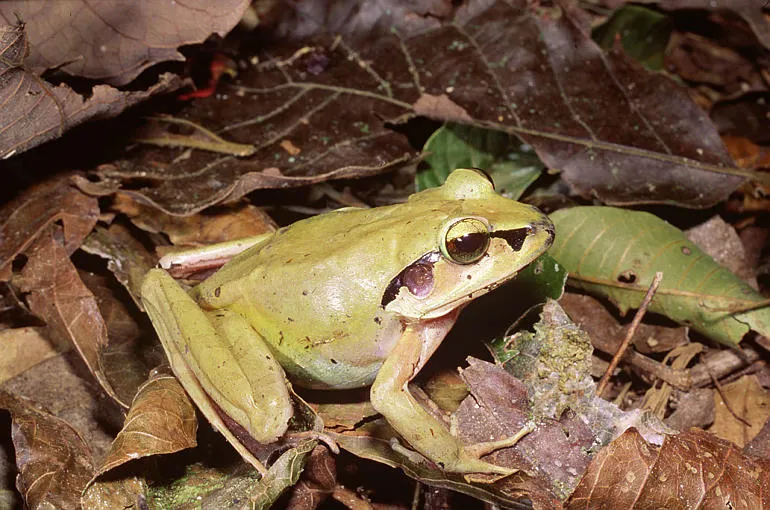
Aglyptodactylus madagascariensis, the Madagascar jumping frog, is a member of the family Mantellidae, described by Duméril in 1853 and endemic to Madagascar, where it has a wide distribution across the eastern side of the island. It sits in the genus Aglyptodactylus, a group of six currently recognised species found nowhere outside Madagascar and sometimes known collectively, like this species, as Madagascar jumping frogs. What is filed under this one scientific name is not necessarily a single uniform population: researchers treat it as a complex of forms occupying different elevational ranges across different areas of eastern Madagascar, a pattern that has prompted taxonomic revisions of the whole genus, most recently in 2015. The wider family it belongs to is a Madagascar success story in its own right: Mantellidae counts at least 237 recognised species, found only on Madagascar and the nearby island of Mayotte, after its ancestors reached the island by dispersing from Asia roughly 76–87 million years ago and diversified there ever since. Aglyptodactylus falls within the family’s Laliostominae subfamily of large-bodied, terrestrial frogs, distinct from the smaller, more colourful mantellines and the arboreal Boophinae tree frogs that share the same forests.
Identification
No published body-length measurement specific to this species could be confirmed from an openly accessible source at the time of writing, but the genus it belongs to gives a useful frame: Aglyptodactylus frogs are medium-sized, with a snout-to-vent length of 35–60 mm, larger than many of the diminutive, brightly coloured frogs that make up the rest of Mantellidae and are often likened, in looks and ecological role, to the unrelated poison dart frogs of Latin America. Their tadpoles are by contrast small, morphologically similar across species, feed on detritus, and complete metamorphosis at 7–15 mm. Because the species is understood as a complex spanning several elevational bands, individuals from different parts of its eastern Madagascar range may not look perfectly uniform, which is part of why later taxonomic work has kept revisiting the group.
Habitat and range
The species is restricted to Madagascar, with a wide distribution across the eastern side of the island. It lives in the leaf litter of tropical forest habitat, and can also make use of disturbed habitat and plantations, a tolerance for altered ground that sets it apart from forest-floor specialists found only in pristine habitat. Its tadpoles, following the pattern seen across the genus, develop in standing or slow water such as temporary pools, pools in river beds, or other stagnant water bodies, depending on what is available within its eastern forest and plantation range. That broad eastern distribution sits within a much larger pattern on the island: the whole family Mantellidae is endemic to Madagascar and Mayotte, and the dense concentration of single-island endemics it has produced since arriving is part of why Madagascar’s eastern forest belt matters so much for frog conservation generally.
Behaviour and breeding
Aglyptodactylus madagascariensis is described as a common species that forms large groups during its mating season and breeds explosively, the pattern typical of frogs that concentrate their reproduction into a short, intense window triggered by seasonal rain rather than spreading it across the year. That burst of activity brings large numbers of frogs together at once, after which eggs and the resulting small, detritus-feeding tadpoles develop in whatever still or slow-moving water is on hand, from forest-floor pools to disturbed plantation ground.
Conservation
The IUCN category is shown in the facts box above. The species is treated as common and its tolerance of disturbed habitat and plantations, alongside intact forest, likely helps it persist across a broad range of eastern Madagascar even where forest cover has been altered. No specific threats to the species are detailed in the available sources at the time of writing.
Similar species
Aglyptodactylus madagascariensis is one of six species currently recognised in the genus Aglyptodactylus, all endemic to Madagascar and historically grouped together as Madagascar jumping frogs; none of the other five has a profile on this site yet. Because the species itself is understood as a complex of forms split across different elevational ranges in eastern Madagascar, frogs identified under this name in different parts of its range may eventually be separated further as taxonomic work on the genus continues.