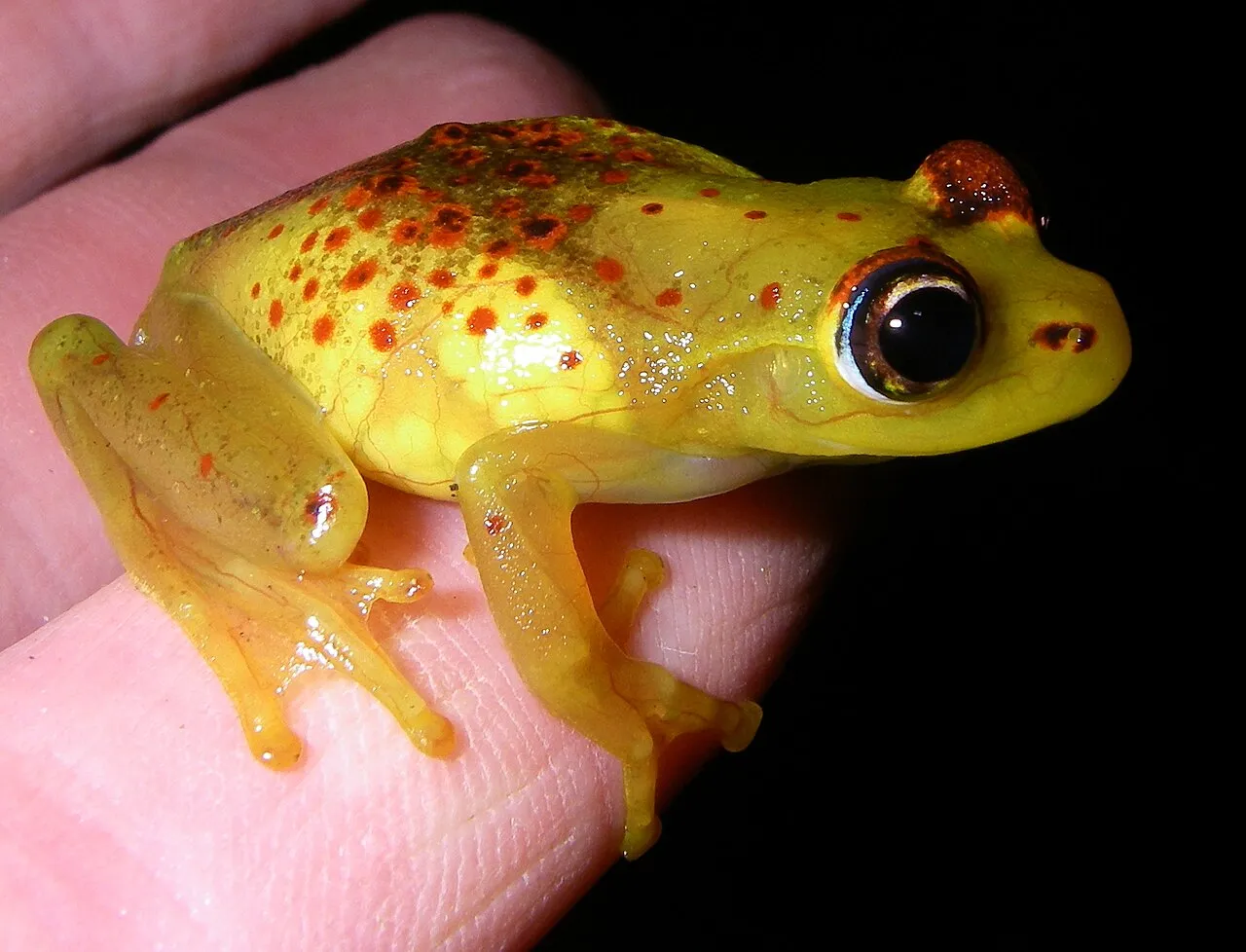
Boophis bottae is a tree frog of the family Mantellidae, described by Vences & Glaw in 2002 and endemic to the eastern rainforest belt of Madagascar, at elevations of about 800–1,000 m. Mantellidae is Madagascar’s most diverse frog family, with at least 237 recognised species found only on Madagascar and the nearby island of Mayotte, and Boophis bottae sits within its subfamily of arboreal tree frogs, Boophinae, named for the genus Boophis and sharing more physical and behavioural traits with true tree frogs elsewhere in the world than with the smaller terrestrial mantellids. The genus itself is known as Madagascar’s “bright-eyed frogs”, a group of nearly 80 recognised species found only on Madagascar and Mayotte.
Identification
Like other members of its genus, Boophis bottae can be expected to show the expanded toe discs, long hindlimbs and large eyes typical of arboreal tree frogs, along with vividly patterned irises, often green or blue at the centre with red, purple or yellow toward the rim, the trait that gives the genus its “bright-eyed frog” name. Many Boophis species also have skin translucent enough to reveal internal anatomy, a feature that has earned the genus the alternate nickname “skeleton frogs”; a photographed female of this species shows eggs visible through her translucent skin, consistent with that trait. The wider family, too, is built along these lines: Mantellidae frogs are generally small and colourfully patterned, often compared in appearance and ecological role to the unrelated poison dart frogs of Latin America, though as an arboreal Boophinae member Boophis bottae keeps to the trees and streamside vegetation rather than the forest floor. No published body-length measurement for the species could be confirmed from an openly accessible source at the time of writing.

Habitat and range
The species is endemic to Madagascar, restricted to the eastern rainforest belt at elevations of roughly 800–1,000 m. Within that belt it lives along forest streams, where it is assumed to breed, and can be found at the forest edge but never fully outside the rainforest, tying it closely to intact forest cover even where it tolerates some disturbance at the margins. That restriction to Madagascar is typical of its whole family: Mantellidae reached the island roughly 76–87 million years ago by dispersing from Asia and has diversified there ever since, producing the dense concentration of single-island endemics, Boophis bottae among them, that makes Madagascar’s eastern rainforest belt so important for frog conservation.
Behaviour and breeding
Males are best told apart from other Boophis by voice: the species has a unique call made up of long trills of double clicks, each note built from one longer and one shorter click pulse. Calling activity centres on the forest streams that the species is assumed to use as breeding sites, the typical pattern for stream-breeding Boophis species, though the full breeding sequence has not been described in an openly accessible source.
Conservation
The IUCN category is shown in the facts box above. The species is described as locally abundant, but populations are nonetheless considered to be in decline because of habitat destruction through agriculture, logging, charcoal production and invasive species. Chytridiomycosis, the fungal disease that threatens amphibians elsewhere, does not currently appear to affect frogs in Madagascar, sparing the species that particular pressure for now.
Similar species
Boophis bottae is one of close to 80 described species in its genus, nearly all of them restricted to Madagascar and Mayotte and sharing the same bright, patterned eyes, long hindlimbs and partly translucent skin, which makes many Boophis species difficult to separate on looks alone. Its call, a trill of paired double clicks with one longer and one shorter pulse per note, is the most reliable field character for distinguishing it from stream-breeding relatives that share its rainforest habitat at similar elevations.