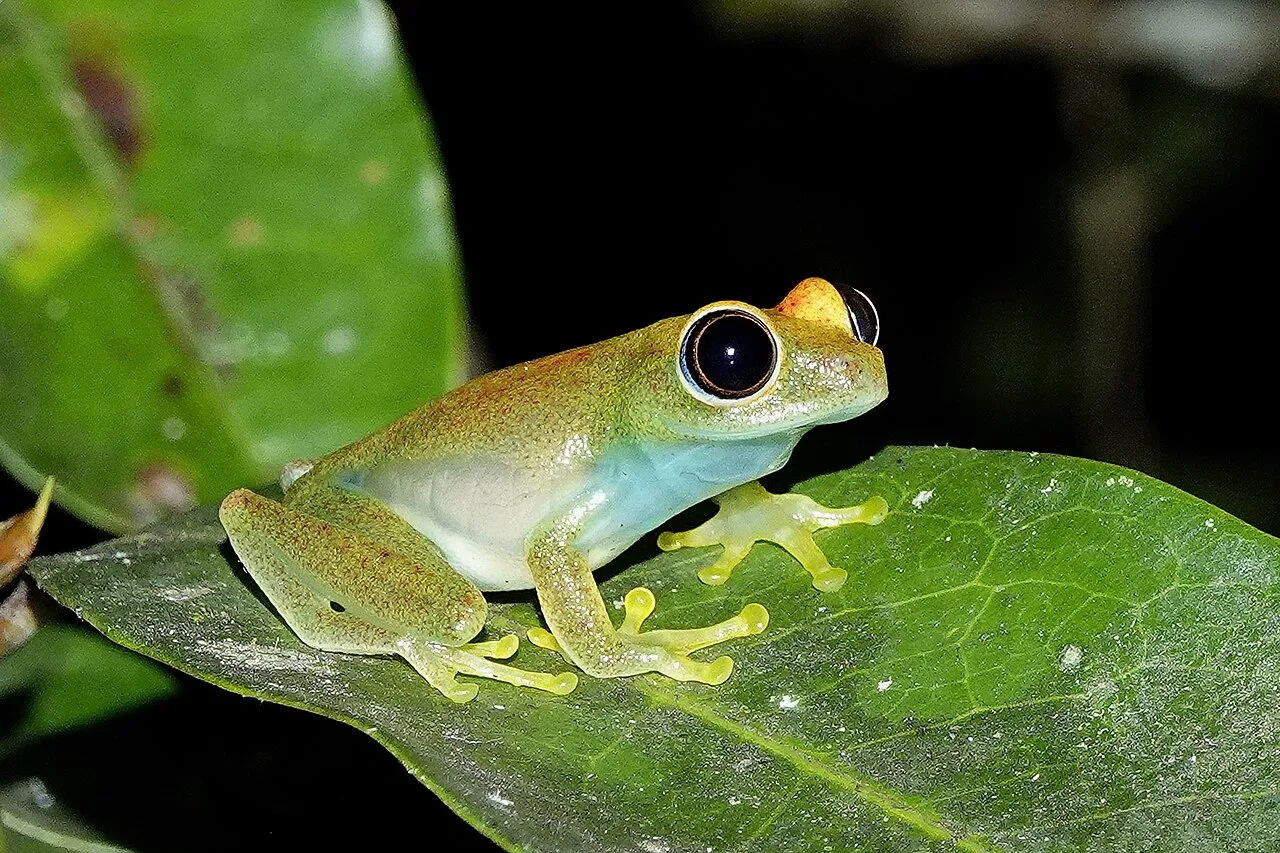
Boophis viridis, the green bright-eyed frog, is a small tree frog of the family Mantellidae, first described by the herpetologist Renée Blommers-Schlösser in 1979 and endemic to Madagascar. It belongs to Mantellidae, a family of at least 237 recognised species found only on Madagascar and the nearby island of Mayotte, within the arboreal subfamily Boophinae, whose members share far more physical and behavioural traits with true tree frogs elsewhere in the world than with the family’s terrestrial or semi-aquatic relatives. Its genus, Boophis, is Madagascar’s “bright-eyed frogs”, a group of nearly 80 recognised species found only on Madagascar and Mayotte, with new species still being described every few months.
Identification
Boophis viridis is one of the smaller members of its genus: males average about 29-30 mm and females about 32-35 mm snout-vent length. It has webbed hands and feet and smooth skin on the back, and its blue inner and outer irises give it the bright, patterned eye typical of the genus, a group whose eyes are often green or blue toward the centre with red, purple or yellow toward the rim. As its common name suggests, the dorsal surface is mostly green, though individual frogs can show reddish spots and are able to shift towards a more reddish-brown colour. That colour-changing ability sets it apart from genus relatives with fixed, uniform dorsal colour.
Habitat and range
The species is endemic to Madagascar, where it is found near streams and ditches. Males call at night from vegetation about 1-2 metres above the ground along these watercourses, occasionally as high as 5 metres during dry weather, a pattern consistent with the strictly nocturnal habits recorded for the species. That restriction to a single island is typical of its whole family: Mantellidae is estimated to have colonised Madagascar 76-87 million years ago by dispersing from Asia, producing the dense concentration of single-island endemics, Boophis viridis among them, that makes Madagascar’s streams and forest margins so important for frog conservation.
Behaviour and breeding
Boophis viridis is nocturnal, with males calling after dark from streamside vegetation rather than during the day. The advertisement call is made up of a long note repeated in short pulses, together with a shorter note consisting of three repeated notes, used to attract mates to the stream edge. Breeding itself takes place in streams, where a pair can produce as many as 154 dark-brown eggs, a clutch size on the modest end for a stream-breeding frog of its size.
Conservation
The facts box above gives the IUCN category: Least Concern. That rating does not mean the species is free of pressure: it faces potential habitat loss from deforestation, agricultural intensification and urbanization, the same pressures that affect much of Madagascar’s forest-dependent wildlife.
Similar species
Boophis viridis is one of close to 80 described species in its genus, nearly all of them restricted to Madagascar and Mayotte and sharing the same bright, patterned eyes and partly webbed limbs, which makes many Boophis species difficult to separate on looks alone. Among described pages, Boophis bottae is a similarly small, stream-calling relative, while Boophis albilabris and Boophis madagascariensis are larger forest and river-dwelling relatives in the same genus; all are told apart mainly by size, call and fine details of colour pattern rather than by looks alone.