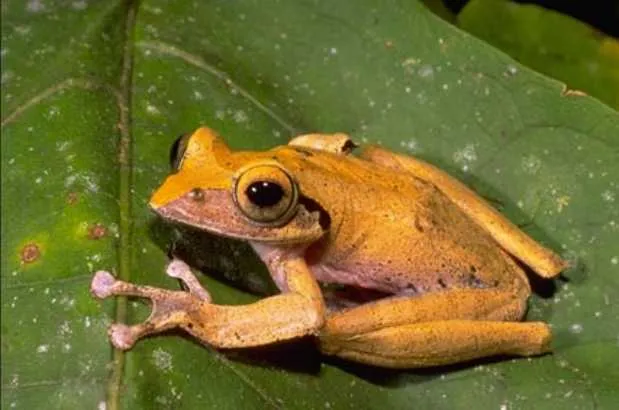
Boophis brachychir, the Nosy Be bright-eyed frog, is a tree frog of the family Mantellidae, first described by Oskar Boettger in 1882 and endemic to Madagascar. It belongs to Mantellidae, a family of at least 237 recognised species found only on Madagascar and the nearby island of Mayotte, within the arboreal subfamily Boophinae, whose members share far more physical and behavioural traits with true tree frogs elsewhere in the world than with the family’s terrestrial or semi-aquatic relatives. Its genus, Boophis, is Madagascar’s “bright-eyed frogs”, a group of nearly 80 recognised species found only on Madagascar and Mayotte, with new species still being described every few months. Boophinae itself was only recognised as a subfamily in 2001, when the genus was moved out of the African and Asian family Rhacophoridae and into Mantellidae.
Identification
No published body-length measurement or detailed physical description for Boophis brachychir itself could be confirmed from an openly accessible source at the time of writing, and the species is often confused with the similarly patterned Boophis madagascariensis, which makes a confident field identification difficult without comparing the two directly. As a member of its genus, it can nonetheless be expected to show the expanded toe discs and vividly patterned iris typical of Boophis, often green or blue toward the centre with red, purple or yellow toward the rim, the trait behind the genus’s “bright-eyed frog” name. Many Boophis species also have skin translucent enough to reveal internal anatomy, earning the genus the alternate nickname “skeleton frogs”, a trait that converges on the unrelated glass frogs of Latin America.
Habitat and range
The species is endemic to Madagascar, where it occupies an unusually broad range of habitats for its genus: subtropical or tropical dry forests, subtropical or tropical moist lowland and montane forests, moist savanna, rivers, and heavily degraded former forest. That tolerance of dry forest, savanna and degraded land alongside intact moist forest is broader than many forest-interior relatives in its genus, which typically depend more narrowly on rivers within closed canopy. That restriction to a single island is typical of its whole family: Mantellidae is estimated to have colonised Madagascar 76–87 million years ago by dispersing from Asia, producing the dense concentration of single-island endemics, Boophis brachychir among them, that makes Madagascar’s forests, savanna and rivers so important for frog conservation.
Behaviour and breeding
No description of the species’ call, breeding behaviour or seasonal activity could be confirmed from an openly accessible source at the time of writing. Its recorded habitat includes rivers, consistent with the stream-breeding habit typical of many Boophis species, but that link has not itself been documented for this species in an open source. As in other Boophinae, males most likely rely on an advertisement call to attract mates near water, since the subfamily’s members are arboreal frogs that behave more like typical tree frogs than like their ground-dwelling mantellid relatives; no recording or description of that call for Boophis brachychir itself, however, could be confirmed from an open source.
Conservation
The IUCN category is shown in the facts box above: Vulnerable. The species is threatened by habitat loss for agriculture, timber extraction, charcoal manufacturing, invasive eucalyptus, livestock grazing, fire and expanding human settlements. It occurs in some protected areas, but no species-specific conservation measures are known, leaving it dependent on broader habitat protection across its range.
Similar species
Boophis brachychir is one of close to 80 described species in its genus, nearly all of them restricted to Madagascar and Mayotte and sharing the same bright, patterned eyes and partly translucent skin, which makes many Boophis species difficult to separate on looks alone. It is most often confused with Boophis madagascariensis, a relative whose page is not yet published on this site. Among described pages, Boophis albilabris and Boophis bottae are forest relatives in the same genus, though all are told apart mainly by range, elevation and call rather than by overall appearance.