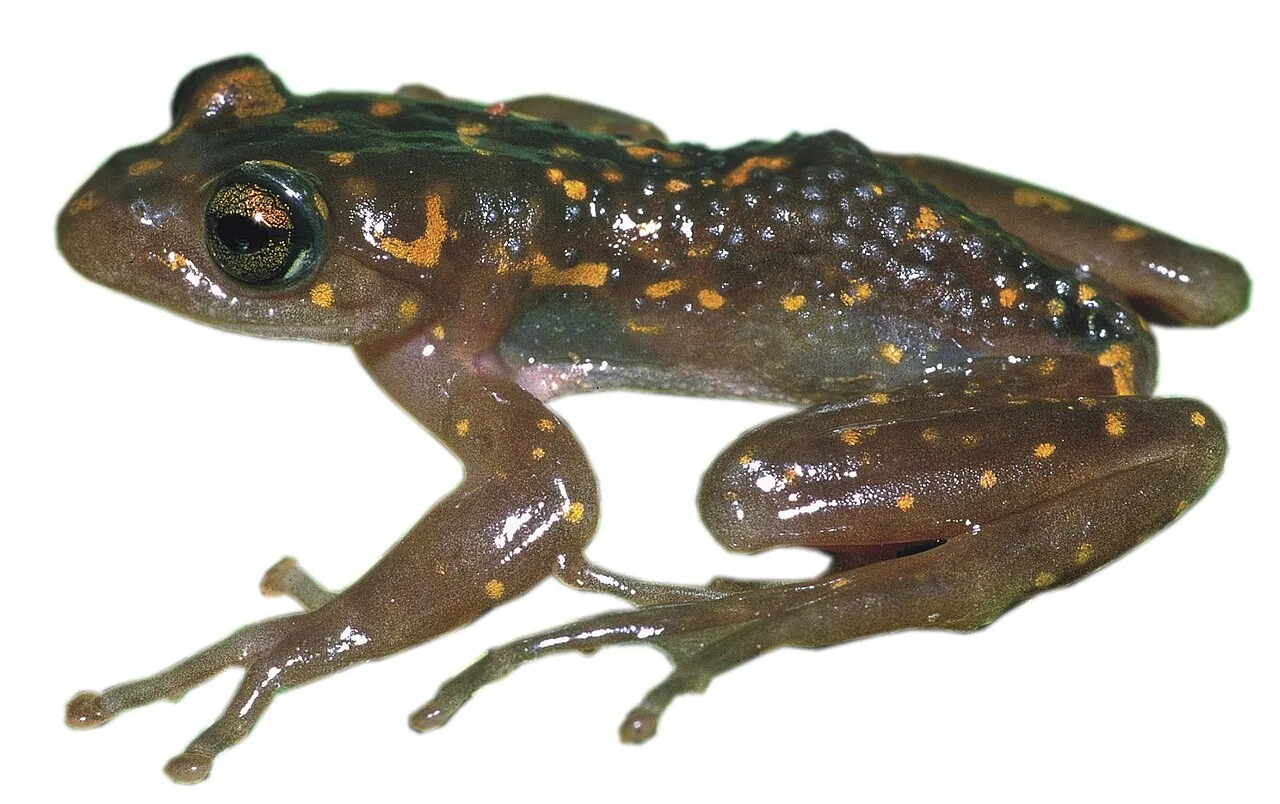
Boophis williamsi, Williams’s bright-eyed frog, is a tree frog of the family Mantellidae, described in 1974 by the French herpetologist Jean Guibé and endemic to Madagascar. It belongs to Mantellidae, a family of at least 237 recognised species found only on Madagascar and the nearby island of Mayotte, within the arboreal subfamily Boophinae, whose members share far more physical and behavioural traits with true tree frogs elsewhere in the world than with the family’s terrestrial or semi-aquatic relatives. Its genus, Boophis, is Madagascar’s “bright-eyed frogs”, a group of nearly 80 recognised species found only on Madagascar and Mayotte, with new species still being described every few months. Of those, Boophis williamsi is one of the rarest: it is restricted to a small area of the Ankaratra Massif in Madagascar’s central highlands, confirmed at only seven localities within an area of a few square kilometres.
Identification
As a member of its genus, Boophis williamsi can be expected to show the expanded toe discs and long hindlimbs typical of arboreal tree frogs, along with a vividly patterned iris, often green or blue toward the centre with red, purple or yellow toward the rim, the trait behind the genus’s “bright-eyed frog” name. Many Boophis species also have skin translucent enough to reveal internal anatomy, earning the genus the alternate nickname “skeleton frogs”, a trait that converges on the unrelated glass frogs of Latin America. That arboreal build sets the genus apart from the family’s other two subfamilies: Mantellinae, which is mostly terrestrial or semi-aquatic, and Laliostominae, a group of relatively large, terrestrial frogs. An openly accessible source giving a published body-length measurement for Boophis williamsi could not be found at the time of writing; what distinguishes the species in practice is less its appearance than its life stages’ split use of habitat, described below.
Habitat and range
The species is endemic to Madagascar, where it is restricted to a small area of the Ankaratra Massif in the central highlands, confirmed at seven localities within an area of only a few square kilometres, one of the most geographically confined ranges of any Boophis species. Its two life stages occupy different parts of that range: tadpoles favour shaded, rocky streams in humid montane forest, while adults favour rocky streams in open savanna. The streams they occupy are shallow, at 0.18-0.83 metres deep, cool, at 7.70-17.80 degC, and slightly alkaline, with a pH of 6.70-8.26. Wikipedia broadens that picture slightly, giving the species’ habitat as moist montane forest, high-altitude grassland, rivers and heavily degraded former forest, consistent with a frog that moves between forest streams and more open savanna habitat over its life. That restriction to a single highland massif is an extreme case of a pattern typical of its whole family: Mantellidae is estimated to have colonised Madagascar 76-87 million years ago by dispersing from Asia, producing the dense concentration of single-island, and in this case single-massif, endemics that makes Madagascar’s highland streams so important for frog conservation.
Behaviour and breeding
No open source available at the time of writing describes the species’ call or courtship behaviour in detail. What is documented is seasonal activity: in surveys across four stream transects in 2018-2019, frogs were most detectable in December, at the start of the rainy season, while tadpoles were detectable at a relatively constant rate across September, December and March. That pattern suggests breeding activity concentrated around the rains, while tadpoles persist in the streams across most of the year. Those same surveys produced one of the few population estimates available for any Boophis species: across the four transects, researchers counted fewer than 600 individuals, tadpoles and frogs combined, a small figure that reflects how narrow the species’ known range is rather than necessarily a precise count of every individual alive.
Conservation
The facts box above gives the IUCN category: Critically Endangered, the highest threat category before extinction in the wild. The species is threatened by habitat loss, and the 2018-2021 survey work identifies the main drivers as deforestation and fire affecting its small highland range, both of which can degrade the rocky montane streams tadpoles depend on. The same research notes that the species likely persists in part thanks to recent conservation efforts, a rare note of cautious optimism for a species confined to such a small area.
Similar species
Boophis williamsi is one of close to 80 described species in its genus, nearly all of them restricted to Madagascar and Mayotte and sharing the same bright, patterned eyes and partly translucent skin, which makes many Boophis species difficult to separate on looks alone. Among described pages, Boophis madagascariensis is a forest, river and marsh-dwelling relative with a far wider range, while Boophis albilabris and Boophis bottae are likewise forest and stream-dwelling relatives in the same genus; all are told apart mainly by range, elevation and fine details of colour pattern rather than by looks alone.