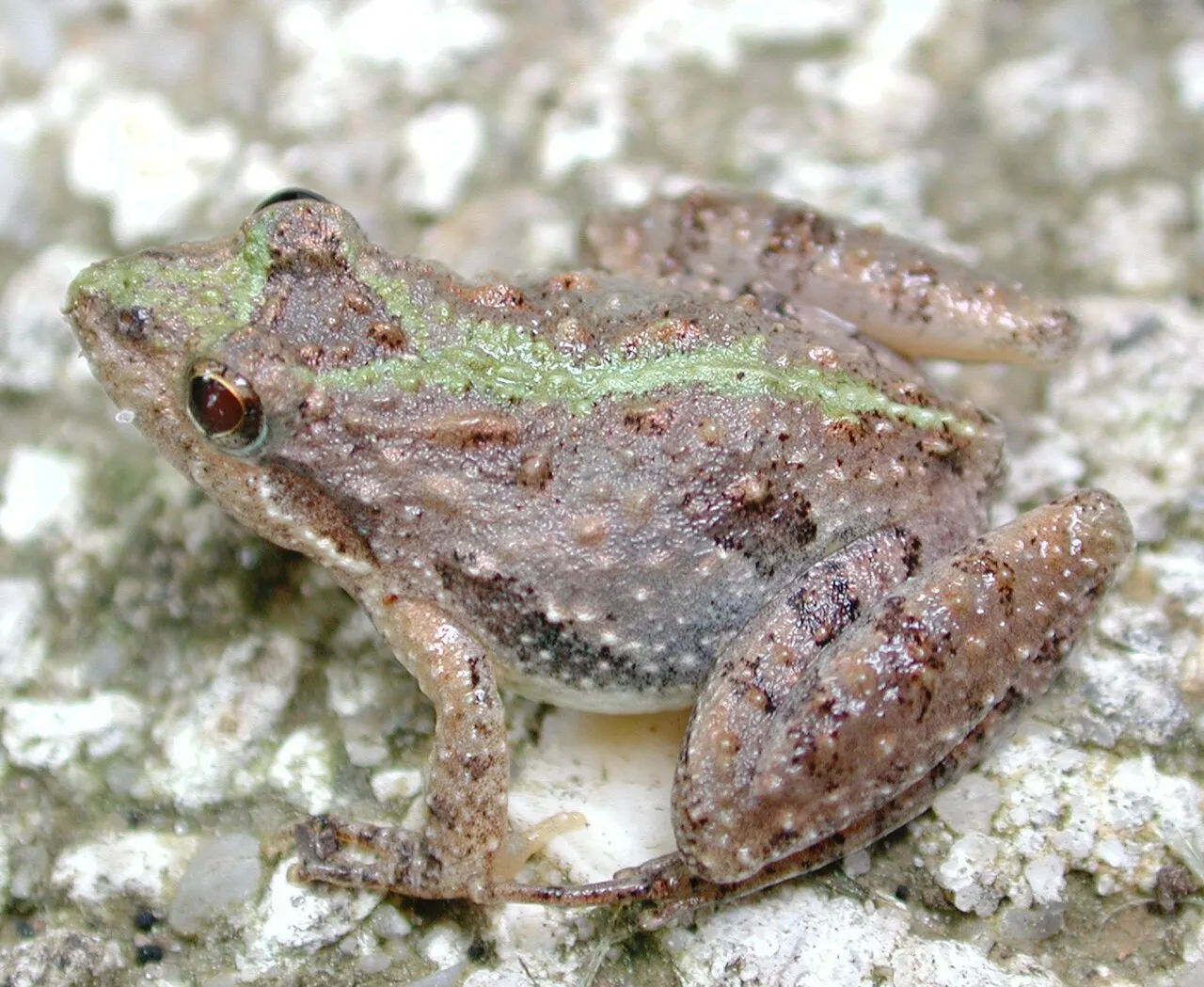
The southern cricket frog, Acris gryllus, is a small, fast-jumping hylid of the American Southeast, better heard than seen: its rapid, clicking call carries across still water from spring well into autumn. It ranges across the southeastern United States, from southeastern Virginia through North and South Carolina, Georgia, Alabama and Mississippi, with records in southwestern Tennessee, mostly below 500–1,000 m elevation, staying close to the shallow, vegetated water it needs to breed and feed.
Identification
Adults are small: males measure 15–29 mm and females 16–33 mm snout-vent length, with newly metamorphosed juveniles about 14 mm; the facts box carries the full range. Colour is variable rather than diagnostic: individuals range from black, brown or reddish brown to bright green or gray, but most show a contrasting stripe running from the snout along the back, a triangular marking between the eyes whose corners connect to that back stripe, and a darker stripe along the rear thigh. Males and females look alike at rest, but males have darker throats and a single subgular vocal sac, while females have white throats. Compared with its close relative the northern cricket frog, A. gryllus is smaller and more slender, with a markedly more pointed snout, proportionally longer legs, and less webbing between the toes: the first toe is only partly webbed and the last three joints of the fourth toe are free of webbing, and it carries fewer, less prominent warts, especially around the vent.
Habitat and range
The species keeps to shallow, sunlit freshwater sites with vegetation — ponds, meadows, creeks, marshes and coastal plain bogs, as well as roadside pools and ditches. It is active through most of the year but enters dormancy from mid-December to mid-February across the cooler parts of its range, sheltering through the coldest weeks before returning to open water as temperatures rise.
Behaviour and breeding
A. gryllus is a powerful jumper for its size, capable of a long-distance jump of 8 feet, and is thought to orient using the moon’s movement and stellar patterns. It is largely solitary outside the breeding season but gathers into loud choruses of calls during breeding season, which runs February through October. The call itself is the frog’s most recognisable trait: a rapid click-click-click, as if two small stones were being struck together, repeated at about one call per second with a steady rhythm and pitch.
Females lay eggs singly or in small groups of 7–10, sometimes depositing clumps of up to 150 eggs at one time, attaching them to underwater vegetation or the pond bottom rather than building a nest. Eggs can hatch in as little as four days, and tadpoles take 90–100 days on average to complete metamorphosis. A female may breed two to three times in a single year, giving the species several chances to replace a clutch lost to drying ponds or predators.
Conservation
The species’ facts box carries its current IUCN Red List category, Least Concern, reflecting its wide coastal plain range and the absence of a single dominant threat. Animal Diversity Web lists it as not currently threatened and reports no known negative impacts on humans.
Similar species
The northern cricket frog (Acris crepitans) is the closest look-alike and shares much of the same general range and habitat, but A. gryllus is smaller and more slender, with a more pointed snout, proportionally longer legs and less webbing between the toes — differences best checked by looking closely at the hind foot rather than at colour, which varies widely in both species.