- Introduction: A Glimpse into the Invisible World of Savage's Glass Frog
- Taxonomy and Classification: Navigating the Family Tree
- Natural Habitat: A Living Jewel of the Andean Cloud Forests
- Physical Characteristics: Seeing Through Nature's Masterpiece
- Behavior and Life Cycle: Nocturnal Serenades in the Mist
- Ecological Role: Guardians of Streamside Equilibrium
- Threats and Conservation Status: Navigating Disappearing Forests
- Cultural and Scientific Significance: Tales Through Transparent Flesh
- Conclusion: Preserving an Invisible Marvel for Future Generations
Introduction: A Glimpse into the Invisible World of Savage’s Glass Frog#
Hidden among the lush cloud forests of the northern Andes, shrouded in mist and mystery, an extraordinary creature keeps itself discreetly invisible. Known scientifically as Centrolene savagei, commonly called Savage’s Glass Frog, this delicate amphibian seems to belong to another world altogether. Sporting translucence reminiscent of fragile glass sculptures, its outlines dissolve seamlessly into rainforest foliage, challenging even the keenest observer to spot it.
Named to honor the renowned herpetologist Jay M. Savage, who significantly expanded our understanding of neotropical amphibians, Centrolene savagei offers us valuable glimpses into the secretive lives and finely tuned adaptations of rainforest-dwelling amphibians. Striking features like its transparent belly, through which its tiny heart visibly pulses, draw admirers from across the globe. But Savage’s Glass Frog is more than just an aesthetic marvel—it represents a fragile thread in a rich tapestry of biodiversity, integral to the health of rainforests where conservation priorities continue to rise.
Taxonomy and Classification: Navigating the Family Tree#
Savage’s Glass Frog (Centrolene savagei) belongs to the family Centrolenidae—an enchanting group of small arboreal amphibians commonly known as glass frogs due to their translucent undersides. Within its taxonomic classification, Savage’s Glass Frog falls under the genus Centrolene, itself containing a wealth of glass frog species sharing similar morphological traits and habitats.
Originally described scientifically in the late 20th century, Centrolene savagei has since become a notable representative among glass frogs due to its well-defined characteristics and intriguing ecology. Related closely to species such as Centrolene prosoblepon and Cochranella granulosa, this species collectively forms part of a vast and fascinating clade of mid-to-high elevation amphibians, principally found inhabiting cloud and montane forests along South America’s vibrant neotropical regions.
Natural Habitat: A Living Jewel of the Andean Cloud Forests#
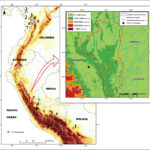
The natural habitat of Savage’s Glass Frog stretches across northeast regions of Colombia, particularly concentrated in the Andes mountains’ humid, tropical cloud forests. These moisture-rich habitats, characterized by perpetually swirling mists and dense vegetation, provide Centrolene savagei with ideal climatic conditions and abundant resources necessary for survival.
Within this habitat mosaic, they are commonly found perched delicately upon broad leaves—often near pristine mountain streams and cascading waterfalls. The elevation typically ranges between 1,500 and 2,300 meters above sea level, where temperatures remain moderate year-round, providing the perfect microclimate for a creature whose life is inherently tied to water availability and stable humidity.
Interaction with Surroundings and Environmental Adaptations#
Adaptation is key to Centrolene savagei’s survival in such dynamic environments. The rainforest canopy and its understory offer these glass frogs both refuge and hunting grounds. Their transparent bodies enable exquisite camouflage, absorbing the leaf’s color beneath them and rendering predators oblivious to their presence.
Moreover, these environments foster rich biodiversity: insects, spiders, and small arthropods populate the damp foliage, providing consistent nourishment. This intricate balance, carefully maintained over endless evolutionary cycles, emphasizes the profound reliance of Savage’s Glass Frog upon these specialized habitats—habitats which, in turn, depend upon conservation attention and action.
Physical Characteristics: Seeing Through Nature’s Masterpiece#
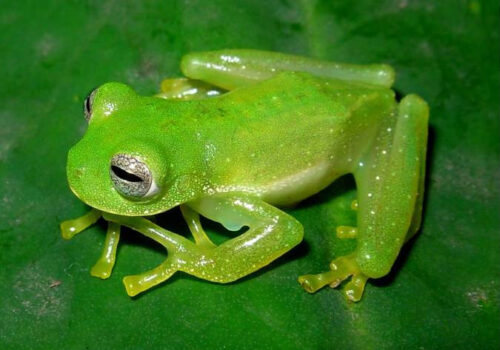
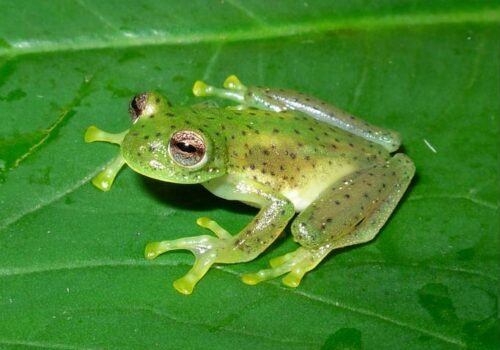
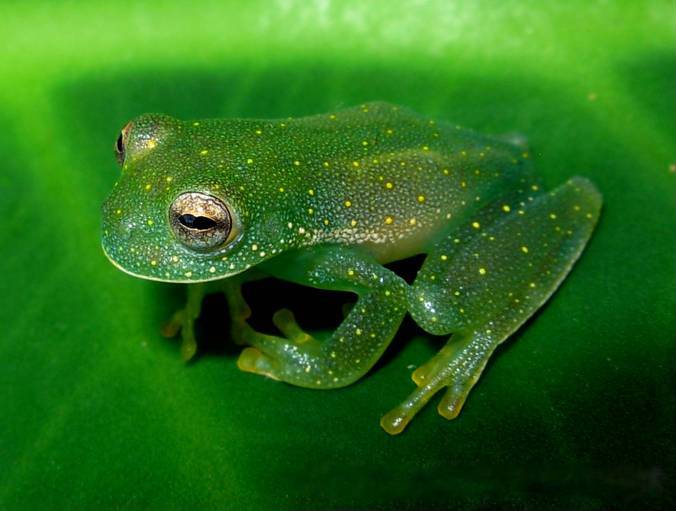
Gazing upon Centrolene savagei provides an experience almost dreamlike in quality—its physical form demonstrating the masterstroke artistry of evolution. Adults typically measure around 2 to 3 centimeters, with females slightly larger than males. They exhibit remarkably delicate frames, slender limbs adapted superbly for arboreal living, and gently splaying digits ending in expansive, disc-like pads perfect for securely gripping leafy surfaces amidst wet foliage.
The characteristic transparency of their ventral surfaces puzzles and fascinates scientists and enthusiasts alike. Beneath smooth abdominal skin, one sees internal organs, blood vessels, and even the rhythmic pulsation of the beating heart—a living anatomical display. Above their translucent undersides, dorsal coloration shades gently from vivid emerald greens towards paler yellow or lime tones, crowned occasionally with small, subtle yellowish spots blending seamlessly into their leafy habitat.
Survival Through Transparency#
This particular trait of transparency offers a form of defensive camouflage, helping Savage’s Glass Frog evade predators such as snakes, birds, and nocturnal mammals. When viewed from below, they practically vanish against moonlit leaves, effectively marauding hungry eyes and allowing them to move freely in their nocturnal journeys in search for prey or mates.
Behavior and Life Cycle: Nocturnal Serenades in the Mist#
When darkness blankets their forest home, Centrolene savagei comes alive, softly chirping across steep ravines and rushing streams. Males—known for their hushed, bell-like calls—occupy established territories upon leaves overhanging water. Here, through nocturnal serenades, they beckon prospective mates and assert dominance over competitors.
Mating typically occurs amidst heavy rains, with courtship involving specific call patterns and heightened territorial behavior. After successful courtship, female Savage’s Glass Frogs carefully deposit gelatinous clusters of bright, translucent eggs upon the undersides of leaves directly above gentle streams or pools.
Extraordinary Parental Attentiveness#
Unlike many amphibians, males remain surprisingly attentive post-egg laying—a behavior showcasing fascinating parental care. Even in harsh weather conditions, they vigilantly guard their fragile offspring against opportunistic predators and fungal infections until the tadpoles safely drop into streams beneath to commence their underwater development.
Ecological Role: Guardians of Streamside Equilibrium#
Savage’s Glass Frog plays an understated yet critical role within its ecosystem. Primarily insectivorous, they help manage insect populations, which plays a significant part in forest health, directly impacting plant pollination dynamics and decaying matter decomposition.
They also represent invaluable prey items for birds, snakes, and other larger predators, their populations acting as indicators of environmental health and stability. Ecologically sensitive to habitat degradation, Centrolene savagei additionally serves as an early warning system, their decline quietly signaling environmental disruptions and habitat degradation.
Threats and Conservation Status: Navigating Disappearing Forests#
Unfortunately, the Savage’s Glass Frog faces numerous environmental threats, ranging from accelerated habitat loss due to agricultural expansion and deforestation, pollution, and climate change to emergent fungal diseases such as chytridiomycosis. These pressures culminate in the gradual disappearance, fragmenting habitats, and isolating populations from one another.
Currently categorized by the International Union for Conservation of Nature (IUCN) as “Near Threatened” specifically due to its limited geographical distribution and specialized habitat needs, conservationists emphasize safeguarding remaining cloud forest habitats, establishing protected reserves, and supporting local education and awareness campaigns to ensure its survival.
Cultural and Scientific Significance: Tales Through Transparent Flesh#
Beyond ecological importance, the Centrolene savagei captures human imagination, symbolizing hidden wonders and bio-inspired innovation. Scientifically, understanding their translucent skin inspires advancements in glass manufacturing and novel biomedical techniques. Traditionally, indigenous communities living near these forests view glass frogs as mystical symbols of rainforest purity and health, celebrating their presence as emblems of ecological harmony.
Conclusion: Preserving an Invisible Marvel for Future Generations#
Savage’s Glass Frog—a delicate glass jewel seemingly pulled from mythical forests—reminds us of biodiversity’s fragile beauty and the urgent need for preserving the intricate web of life we barely understand. Each frog resting quietly beneath mist-laden leaves symbolizes a complex interaction, sustained equilibrium, and continues to call humanity towards conscious stewardship of nature.
Let the invisible beauty of Centrolene savagei inspire us to act with conviction. Conservation initiatives depend on everyday choices and collective support; by learning about and advocating for this exceptional frog, we become thoughtful guardians entrusted with preserving the priceless rainforest treasures hidden right before our eyes.