Centrolene muelleri: Exploring the Enchanting World of Mueller’s Glass Frog#
Amid the lush, misty forests of South America, perched delicately upon translucent rainforest leaves, lives an amphibian that captures the essence of wilderness wonder: the Mueller’s Glass Frog (Centrolene muelleri). With its delicate, crystal-clear skin, allowing a window into the beating heart and intricate organs within, this fascinating creature embodies both beauty and biological artistry. As we delve into the captivating realm of Centrolene muelleri, we uncover a story that seamlessly intertwines evolutionary wonders, ecological interdependencies, and the urgent call for conscientious stewardship of our natural world.
Nature has always had a penchant for intrigue and wonder, but few creatures elicit astonishment quite like the Mueller’s Glass Frog. As translucent as polished glass, these extraordinary amphibians offer observers a glimpse into their internal biology—a living anatomy lesson in vibrant clarity. Indeed, this unique adaptation alone has positioned Centrolene muelleri as an icon among tropical biodiversity. Yet, the allure of Mueller’s Glass Frog extends far beyond visual novelty; they serve as critical keystone indicators, highlighting the delicate balance and health of their rainforest habitats.
Taxonomy and Classification#
The Mueller’s Glass Frog, scientifically known as Centrolene muelleri, belongs to a fascinating family known as Centrolenidae, a lineage commonly referred to as “glass frogs” due to their remarkable semi-transparent skin. Glass frogs comprise several genera and numerous species distributed primarily throughout Central and South America. Within this rich family tree, Centrolene muelleri stands as an intricate member of the genus Centrolene, recognized for certain ecological and physiological adaptations that distinguish it even among the uniqueness of its cousins.
The formal description of Centrolene muelleri can be traced back to early naturalists exploring Andean foothills, forests, and riparian habitats. Today, modern genetic sampling confirms their unique evolutionary lineage; although closely related to others in the genus (such as Centrolene buckleyi and Centrolene heloderma), subtle genetic differences confirm Centrolene muelleri as distinct and worthy of focused ecological examination and conservation efforts.
Natural Habitat#
Geographic Range and Distribution#
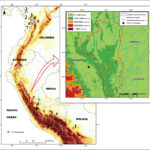
Centrolene muelleri predominantly inhabits the montane and submontane cloud forests of northwestern South America, notably within the verdant reaches of Ecuador and Colombia. This region, characterized by towering canopies and mist-covered foliage stretching along the Andean foothills, offers precisely the humid, sheltered, and biologically dynamic conditions these frogs require.
Typically observed in elevations ranging from approximately 800 to 2,500 meters above sea level, Centrolene muelleri thrives in dense, moisture-laden microhabitats near clear flowing mountain streams and waterfalls. Here, amidst carpets of moss and broad-leafed, overhanging vegetation, the frog finds both refuge from predators and prime real estate from which to orchestrate its unique existence.
Microhabitat Preferences#
In these habitats, the smooth rocks, gently swaying leaves, and cascading waters form a symphony—a serene backdrop instrumental to the survival of glass frogs. Mueller’s Glass Frog participates in complex ecological choreography; its reliance on pristine water quality and dense vegetal coverage marks it as an ecological sentinel—a species whose presence signifies rich biodiversity and minimally disturbed ecosystems.
The thick foliage protects them from drying winds and predators while providing the moisture vital to their sensitive amphibian skin. In the pristine drapery of epiphytes hanging loosely from branches above forest streams, Centrolene muelleri establishes its territories and staging grounds, engaging in intricate breeding behaviors that ensure the continuation of its translucent lineage.
Physical Characteristics#
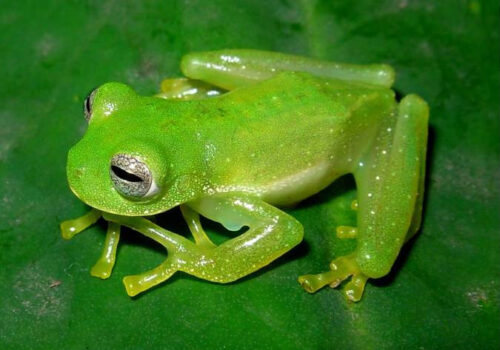
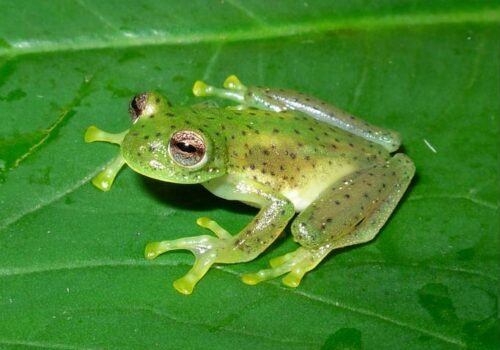
A true marvel of adaptation and evolution, Centrolene muelleri captivates the imagination with its remarkable appearance. Adults typically measure between two to four centimeters, their delicate bodies precisely adapted for life upon slender twigs and broad leaves. Yet, at first glance, their size is scarcely their defining feature. Instead, observers are instantly drawn to their striking translucent skin, which grants an unparalleled glimpse into their internal workings—beating hearts, pulsating blood vessels, and digestive organs appear as if delicately sketched behind clear glass.
Mueller’s Glass Frog exhibits a pale, gentle green coloration on its dorsal side, serving as perfect camouflage among leaves particularly when viewed from above. This coloration, combined with faint speckling or patterns resembling forest foliage, allows them to blend seamlessly into their surroundings—a masterful exercise in evolution-driven design. Their rounded, protruding eyes add a mesmerizing quality, an adaptation superbly suited for spotting minute insect prey among the shifting shadows of lush jungle canopies.
The ventral surface reveals the true marvel of Mueller’s Glass Frog anatomy, offering an unfiltered window into their intimate biology. This transparency is not merely an aesthetic wonder—this incredible trait likely serves important ecological roles in predator avoidance and thermal regulation, helping them blend with their leafy environment even more seamlessly from below.
Behavior and Life Cycle#
Feeding and Hunting Habits#
Centrolene muelleri is an active, nocturnal hunter, seizing opportunities in the darkness of the rainforest canopy. Equipped with sensitive eyes capable of discerning subtle vertical and horizontal movements in dim conditions, they snipe agilely on unsuspecting prey including a diverse array of small insects and arthropods. Employing rapid tongue strikes, Mueller’s Glass Frog demonstrates unmatched predatory efficiency, an adaptation crucial for survival within their fiercely competitive ecological niche.
Breeding and Reproductive Phenomena#
The breeding habits of Centrolene muelleri reveal an elaborate and fascinating narrative of rainforest life. Males emit a delightful yet subtle call—a melodic chorus resonating gently among evening forest canopy layers—to attract potential female mates. Courtship displays occur amidst the delicate choreography of rainforest leaves twisting gently above clear-flowing streams, often carefully selected by the males as ideal oviposition sites.
After successful courtship, females deposit clusters of gelatinous eggs on undersides of leaves, strategically placed above running water bodies. The parental strategies of Mueller’s Glass Frog demonstrate a paramount devotion; males vigilantly guard egg clusters, defending them persistently from predators and fungal infections. Upon hatching, larvae gracefully drop into the water below, joining the richness beneath—tadpoles shifting to a fully aquatic stage, swiftly adapting to nuanced stream ecologies until metamorphosis and ascent back into the terrestrial canopy as delicate miniaturized adults.
Ecological Role#
By predating on various insect populations, Mueller’s Glass Frog plays a valuable role in maintaining ecological balance. Simultaneously acting as prey, it intersects critical trophic relationships, nourishing a suite of predators—birds, reptiles, and even large invertebrates—therefore contributing directly to maintaining biodiversity stability.
Most importantly, Mueller’s Glass Frog is a highly sensitive bioindicator species; its health and population dynamics promptly reflecting broader environmental conditions and ecosystem integrity. Scientists closely monitor populations to detect ecological disturbances such as water contaminants, climate-induced changes, or habitat degradation, illustrating vividly that the welfare of Centrolene muelleri profoundly mirrors the overall health of rainforest ecosystems.
Threats and Conservation Status#
Sadly, Mueller’s Glass Frog faces numerous anthropogenic threats, including habitat destruction due to deforestation, pollution from agricultural runoff, climate change, and potentially devastating fungal infections, such as chytrid fungus (Batrachochytrium dendrobatidis). Increasing evidence suggests that rapid urban expansion and agricultural transformations throughout Ecuador and Colombia are placing enormous strain upon their fragile ecological niches.
Currently, Centrolene muelleri is classified on the IUCN Red List as Near Threatened, underscoring the immediate need for ongoing monitoring, research, and dedicated conservation efforts. Sustained conservation strategies and protected areas expansion, coupled with meaningful local community engagements, will prove paramount to preserving these uniquely transparent jewels of the rainforest.
Cultural and Scientific Significance#
Beyond their ecological merit, glass frogs, including our beloved Mueller’s Glass Frog, offer potent symbolic appreciation in local cultures. Indigenous communities across the Andes have long revered amphibians as indicators of environmental balance or spiritually significant beings representing renewal and transformation.
Moreover, Centrolene muelleri has increasingly become the focus of scientific explorations. Uncovering their evolutionary adaptations and medical potential, scientists glean valuable insights, inspiring innovations in diverse fields such as medicine, ecology, and biodiversity conservation.
Conclusion and Call to Action#
Centrolene muelleri connects scientific wonder with conservation urgency, underscoring our collective stewardship responsibilities toward Earth’s extraordinary biodiversity. As we marvel at the transparent beauty and ecological vitality of Mueller’s Glass Frog, we must advocate vigorously for their preservation, inspiring actions towards habitat conservation, supporting sustainable practices, and spreading appreciation for amphibians in ecosystems worldwide. Let the translucent window of Centrolene muelleri guide our path toward environmental understanding, sustainable coexistence, and a brighter, biodiverse future.