Unveiling the Delicate World of Centrolene huilense: Colombia’s Precious Glass Frog#
Hidden among the lush and humid forests of Colombia’s central Andes, a tiny, translucent creature clings silently beneath verdant leaves, motionless yet vigilant. Known scientifically as Centrolene huilense, this rare amphibian goes by many common names, often referred to simply as the Huila Glass Frog—named poetically for its transparent belly that gives onlookers an enchanting view right through its fragile skin. If you peer closer, you’ll see not just bones and muscles but even the gentle beat of its heart. Beautiful, mysterious, and awe-inspiring, the Huila Glass Frog represents a living jewel nestled unobtrusively within its rainforest kingdom.
Despite its captivating appearance and unique biology, Centrolene huilense remains relatively understudied, quietly captivating conservationists and biologists alike. A deeper understanding and appreciation for these frogs not only broadens our knowledge of amphibian ecology but highlights the subtle beauty that is endlessly rich in Colombia’s biodiverse habitats.
Taxonomy and Classification#
The elegant glass frog known as Centrolene huilense belongs to the family Centrolenidae, renowned worldwide for the nearly transparent skin distinctive to its members. Within Centrolenidae, the genus Centrolene hosts several remarkable species, each uniquely adapted to its reign high in the Andean cloud forests.
Originally identified and formally described by biologists Harvey and Noonan in 2005, Centrolene huilense derives its species epithet from Huila, the Colombian department where it was first discovered. Situated within an increasingly dense family tree, its closest relatives—such as Centrolene geckoideum and Centrolene buckleyi—share similar morphological traits yet occupy distinct habitats and distribution ranges. Such a tightly interwoven tapestry of related species underscores the broader ecological narrative of niche differentiation and the delicate balance among close cousins that nature masterfully maintains.
Natural Habitat#
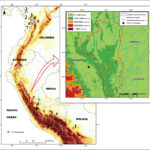
Embarking upon a journey into the habitat of Centrolene huilense feels akin to stepping into an ethereal, mist-laden realm. Found in Colombia’s cloud forests at elevations between approximately 2,000 to 2,400 meters, these frogs thrive in environments characterized by perpetual humidity, cool temperatures, and dense vegetation.
These mountainsides are blanketed in moss-clad trees, ferns, bromeliads, and orchid species that form an intricate network of greenery and moisture. Running waters weave through these altitudinal ecosystems, cascading gently through pristine rivulets. It is precisely near such freshwater streams and dripping vegetation—crucial microhabitats—that Huila Glass Frogs thrive.
These streams provide optimal sites for egg deposition and tadpole development, serving as lifelines weaving through the frogs’ delicate existence. Moreover, the frog’s reliance on pristine stream habitats makes Centrolene huilense exceptionally vulnerable to shifts in ecosystem health, rendering it an indispensable bioindicator of environmental quality.
Physical Characteristics#
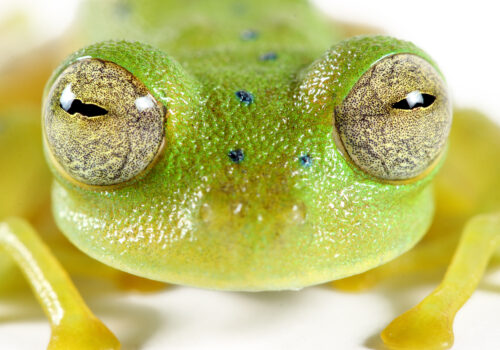
To behold a Huila Glass Frog is to witness nature’s exquisite craftsmanship up close. Generally small, reaching measurements between 20 and 30 millimeters from snout to vent, this species epitomizes the subtle elegance for which glass frogs are famed. Their smooth skin, shimmering gently in moist environments, ranges from delicate emerald hues to soft shades of jade—colors that effortlessly blend into their leafy environment.
The true wonder, however, emerges when observing the ventral side. Beneath their translucent bellies, internal organs such as the heart, liver, and digestive tract can be discerned. When resting beneath a leaf with sunlight filtering softly above, their translucent bellies render them temporarily invisible to potential predators staring upward—an ingenious camouflage perfectly tailored by evolution.
Large expressive eyes, golden-green and penetrating, sit prominently atop their heads, offering exceptional eyesight vital in navigating arboreal habitats at night. Pads on their toes equipped with adhesive discs bolster agility, enabling them to traverse precariously across wet foliage and to securely hold onto slippery leaves—a life skill imperative for arboreal creatures living within a perpetually moist environment.
Behavior and Life Cycle#
Nocturnal Guardians of the Foliage#
The life of Centrolene huilense is cloaked in nocturnal mystery. As twilight falls, calling males occupy prominent perches, crouched beneath wet leaves around streams and waterfalls, emitting soft yet melodic mating calls. This captivating serenade, heard on humid evenings, attracts nearby females seeking suitable mates. The calls display remarkable specificity, enabling females of the same species to recognize their potential mates among the cacophony of creek inhabitants.
Caring Fathers: An Uncommon Dedication in Frogs#
Remarkably, male Huila Glass Frogs exhibit devoted paternal care. After successful mating, each female deposits a clutch of eggs—usually between 10 to 30 gelatinous, translucent capsules—carefully placed onto the undersides of leaves suspended above swiftly running streams. Once deposited, the female departs, leaving the male guardian in charge.
These vigilant fathers take their responsibilities seriously, fiercely protecting eggs from predators such as insects and other amphibians while maintaining adequate moisture levels critical to egg viability. At regular intervals, the male moistens and cleans the developing embryos by gently pressing and revisiting the clutches, behavior indicative of remarkable evolutionary dedication.
From Tadpole to Froglet: A Fragile Journey#
The embryo-to-tadpole transformation concludes around two weeks, at which point tiny tadpoles bravely drop into the flowing stream beneath. There, concealed among rocks and fallen leaves, they continue their perilous journey towards metamorphosis. During their aquatic phase, tadpoles forage on algae, organic debris, and microorganisms within the streams, fueling their growth until legs emerge, breathing lungs form, and fins gradually shrink into fully developed limbs.
Ecological Role#
Though diminutive, the ecological impact of the Huila Glass Frog extends significantly beyond its modest size. Predominantly insectivorous, these arboreal amphibians regulate populations of night-active insects, including mosquitoes and moths, thus serving as crucial balancers within their ecosystem. Their presence simultaneously provides nourishment for a range of predators such as snakes, birds, bats, and larger amphibians, demonstrating their intertwined role within the trophic web.
Additionally, glass frogs act as environmental sentinels, their sensitivity to pollutants and habitat disturbances making their populations indicative of broader ecosystem health. As a flagship species highlighting the integrity of Andean cloud forests, the conservation of Centrolene huilense simultaneously safeguards myriad other species sharing their critical habitats.
Threats and Conservation Status#
Despite their mesmerizing beauty and ecological importance, the Huila Glass Frog faces significant threats. Habitat loss and degradation stemming from deforestation, agriculture expansion, and mining activities along Colombia’s mountain ranges constitute critical concerns. Climate change further compounds habitat vulnerability, as shifting temperatures and altered rainfall patterns disrupt sensitive reproductive cycles and tadpole survivability.
Currently designated as “Vulnerable” by the International Union for Conservation of Nature (IUCN), conservationists emphasize the urgency to implement habitat protection measures, enforce stricter environmental regulations, and increase awareness of their plight.
Cultural and Scientific Significance#
In local folklore and culture, glass frogs, including the Huila species, symbolize ecological purity and vulnerability—a reflection of humanity’s delicate relationship with nature. Scientifically, this frog offers vital clues about climate responses and disease susceptibility, thereby helping shape strategies to protect not only amphibians but entire ecosystems affected by environmental change.
Conclusion#
The enchanting life of Centrolene huilense, Colombia’s precious glass frog, tells a poignant ecological story—one brimming with beauty, fragility, and complexity. Preserving this obscure yet captivating amphibian means safeguarding the rich biodiversity and delicate balance upon which all life ultimately depends. Our mission must mirror the dedicated vigilance of the male glass frogs themselves: quiet, steadfast, and deeply protective of these gems nestled amidst the verdant heart of Colombia’s forests.
Let this glimpse into their delicate world inspire action, knowledge, and continued conservation spirit—for every translucent belly holds within it a heartbeat that resonates far beyond the misty forests of the Andes.