- Exploring the Amazon's Enigmatic Giant Toad: The Remarkable Life of <em>Rhaebo guttatus</em>
Exploring the Amazon’s Enigmatic Giant Toad: The Remarkable Life of Rhaebo guttatus#
In the dense heart of the Amazon rainforest, under a canopy ablaze with emerald hues, countless creatures thrive. Among them, quietly traversing the leaf-littered forest floor, is a fascinating amphibian whose life remains intriguingly enigmatic to many: the Giant Toad known scientifically as Rhaebo guttatus. Cloaked in impeccable camouflage and carrying distinctive reddish-brown splashes against its dark, mottled skin, the Smooth-Sided Toad—as it’s commonly called—is an essential yet often overlooked guardian of jungle floors.
Despite its humble demeanor, Rhaebo guttatus plays an integral role within the Amazonian ecosystem. By preying upon numerous insects and smaller amphibians, and simultaneously serving as prey for larger predators, this large, terrestrial toad weaves itself into the intricate tapestry of rainforest life. A peculiar trait worth highlighting early on: unlike many toads, this species possesses relatively smooth skin, lacking pronounced wart-like growths, providing an immediate, fascinating divergence from common toad imagery.—an elegant, surprising emissary from Amazonian realms.
Taxonomy and Classification#
First described by Schneider back in 1799, Rhaebo guttatus belongs to the Bufonidae family, a group widely known for their broad distribution and characteristic wart-studded skin—though ironically, in this species, such warts are conspicuously gentle in form.
The genus Rhaebo encompasses various neotropical toad species, each uniquely adapted to specialized niches within Central and South American ecosystems. Among closely related species are the equally intriguing Rhaebo haematiticus, featuring stronger terrestrial adaptations, and the lesser-known but intriguing Rhaebo ecuadorensis, endemic to certain distant Andean foothills. Yet, among these close relatives, Rhaebo guttatus stands apart as one of the largest and most widespread, thereby taking center stage in ecological dynamics across its distribution.
Natural Habitat#
Geographic Range and Distribution#
The Amazon rainforest, famously called the “lungs of our planet,” provides refuge to an abundance of flora and fauna, including Rhaebo guttatus. This giant toad’s expansive range stretches broadly through Brazil, Peru, Ecuador, Colombia, Venezuela, Bolivia, Guyana, Suriname, and French Guiana, embracing the biodiverse heartland of the Amazon Basin.
From dense lowland forests to gently undulating terrain, the Smooth-Sided Toad prefers humid, shady habitats rich in leaf-litter and organic debris. Such areas deliver optimal conditions for camouflage, hunting opportunities, and reproduction, with moisture-rich ground cover protecting it from dehydration.
A Haven Beneath the Canopy#
Envision a dense undergrowth cloaked beneath thick branches interwoven with lianas and moss-covered trunks. In this moist, dark realm—far from sunlight’s direct reach—Rhaebo guttatus often remains largely unseen, its subtly beautiful skin blending effortlessly into the earthy shades beneath shifting shadows. The fallen leaves, decaying wood, and myriad fungi create a rich microhabitat tailored for this stealthy, nocturnal creature.
Adapted to life predominantly at ground level, these toads skillfully navigate forest floors, finding safety and sustenance amid decomposing organic matter. Shallow forest streams and seasonally flooded habitats further attract these toads, especially during vital periods of their life cycles, allowing them ideal breeding sites essential for the inevitable journey from aquatic larvae to terrestrial adults.
Physical Characteristics#
A Distinctive Appearance in the Amphibian World#
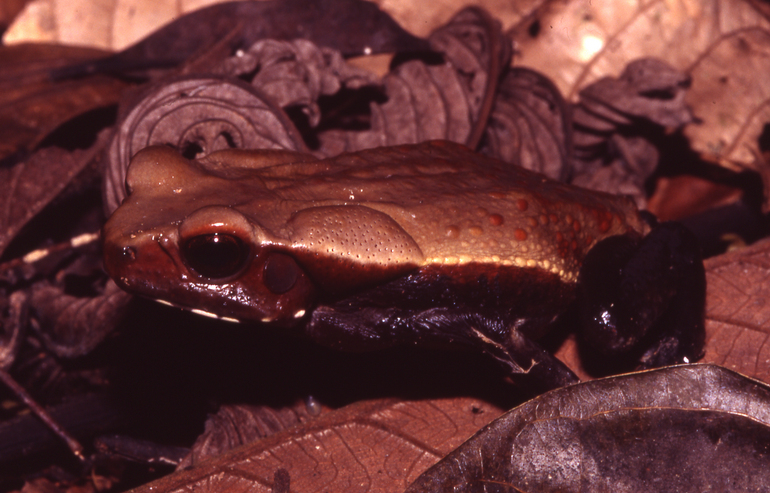
The Smooth-Sided Toad, true to its common name, stands noticeably apart from its wart-ridden counterparts. Its skin texture, comparatively smooth and subtly granular, sparkles gently under moisture, evoking intriguing impressions unlike typical amphibians of the Bufonidae family.
Adult individuals regularly astonish researchers and wildlife observers with their robust stature—often reaching lengths between 10 and 18 centimeters (4-7 inches). This makes Rhaebo guttatus one of the largest toads in Amazonian habitats, frequently mistaken at first glance for small forest mammals or discarded foliage given its natural camouflage.
Coloration and Adaptive Features#
A patchwork of browns, reds, maroons, and olive hues richly embarks a journey across this creature’s wide dorsum. Dark, irregularly shaped blotches typically overlay a lighter, reddish backdrop, producing mesmerizingly intricate patterns suited to blending among rainforest detritus.
Beyond appealing aesthetics, this coloration offers immense adaptive advantage. Concealed expertly among fallen leaves and organic material, the toad efficiently eludes predation, reducing vulnerabilities during its quiet daytime rests in plain yet unseen view.
Behavior and Life Cycle#
Nocturnal Wanderers of Forest Floors#
As twilight falls over the Amazon basin, signaling a flurry of activity and awakening nocturnal ecosystems, Rhaebo guttatus patiently emerges from protective shelters—under logs, within leaf piles—to commence nightly feeding expeditions. Equipped with excellent nocturnal vision and sensitive skin tuned to detect vibrations and scents, the Smooth-Sided Toad skillfully hunts insects, spiders, worms, and even smaller amphibians, ensuring balanced ecological equilibrium.
Unlike darting frogs inhabiting branches higher in the canopy, these terrestrial dwellers approach prey with calculated stealth rather than swift leaps. Their patient style rewards careful hunters who depend upon subtle, strategic movements instead of immediate attack.
Reproduction and Parental Strategy#
Seasonal rains mark critical points in the reproductive cycle of Rhaebo guttatus. With the onset of nourishing rainfall, males converge near shallow pools or slow-flowing streams, calling persistently in deep, echoing notes designed to attract females. Courtship occurs near aquatic environments, essential places boasting safety for fragile eggs and developing tadpoles.
A single female can lay thousands of tiny, gelatinous eggs at once. Interestingly, while parental care is generally minimal, abundant egg production increases the likelihood some will survive predation or habitat disruptions. Larvae grow rapidly within these sheltered microhabitats, and once transformed into tiny toadlets, they venture bravely onto forest floors, risking innumerable threats posed by predators and environmental challenges along their journey toward adulthood.
Ecological Role#
These land-dwelling toads fulfill multiple roles within Amazonian ecosystems. Efficient insectivores, they regulate insect populations significantly, thereby indirectly safeguarding vegetation from unchecked herbivorous insects. Acting as prey to larger predators—such as snakes, large birds, and mammals—they support intricate food chains, exemplifying practical interconnectedness prevalent within tropical biodiversity.
Furthermore, researchers regard amphibians like Rhaebo guttatus as valuable sentinel species, their health indicative of broader environmental conditions within their sensitive rainforest habitats. Such remarkable amphibians often serve as indicators of ecosystem disturbances, from pollution impacts to climate-induced shifts.
Threats and Conservation Status#
While currently classified by the International Union for Conservation of Nature (IUCN) as Least Concern, Rhaebo guttatus nevertheless faces emerging threats common to rainforest inhabitants.
Accelerating deforestation driven by logging, agriculture expansion, and infrastructure encroachment relentlessly reduces available habitats. Pollution from human settlements and agricultural runoff likewise negatively impacts amphibian health, increasing vulnerability to fatal skin infections such as chytridiomycosis. Climate change remains an existential threat, potentially altering rainfall patterns essential for successful reproduction cycles, impacting long-term viability.
Cultural and Scientific Significance#
Indigenous Amazonians hold deep admiration toward their region’s immense biodiversity—including creatures such as Rhaebo guttatus. Various traditional stories and mythologies connect amphibians intimately to forest health and spiritual belief systems, attributing symbolic importance to species indicating environmental balance.
Scientifically, the Smooth-Sided Toad attracts keen interest. Studies examining amphibian toxins and ecological adaptability glean insights invaluable to conservation biology, pharmacology, and climate resilience investigations. Exploration around their unique adaptations could uncover meaningful implications inspiring broader conservation efforts globally.
Conclusion: Guardians of the Rainforest Floor#
The enchanting yet rarely spotlighted Rhaebo guttatus embodies the intricate harmony defining Amazonian biodiversity. Their silent presence underscores ecological interconnectedness essential to tropical ecosystems.
Through understanding and appreciating these understated guardians of terrestrial realms, each of us can champion their protection—vital acts ensuring a future for these exceptional creatures. Let their quiet hum remind us of Earth’s fragile beauty, igniting actions that safeguard not only the Smooth-Sided Toad but the vibrant tapestry of life within their magnificent rainforest home.