Nectophryne batesii: Exploring the Enchanting Life of Bates’ Tree Toad#
Deep within the lush, verdant forests of Central Africa, among countless shades of green and beneath a thick canopy alive with calls and songs, dwells a remarkable creature whose subtle existence adorns the edges of streams and forest floors with quiet intrigue. Meet Nectophryne batesii, also known as Bates’ Tree Toad—a fascinating amphibian with a lifestyle as captivating as its intricate patterns of camouflage. Though modest in size and often elusive to the casual observer, this enchanting frog seamlessly blends science and wonder, inviting us into an immersive journey through nature’s tapestry of survival and adaptation.
First described by George Albert Boulenger in 1913, this discreet, yet ecologically crucial species serves as a beautiful testament to biodiversity and the sophisticated, delicate balance that supports forest ecosystems. Let us step softly into its habitat to unravel the mysterious narrative of Bates’ Tree Toad.
Taxonomy and Classification#
Bates’ Tree Toad, scientifically known as Nectophryne batesii, belongs to the Bufonidae family—generally known as “true toads.” Within this diverse and globally distributed family, Nectophryne batesii resides specifically under the genus Nectophryne, a relatively small genus of amphibians uniquely adapted to Central African rainforests. It shares its genus with one close relative, Nectophryne afra, collectively known as the African Tree Toads, recognized for their specialized adaptations to arboreal and semi-terrestrial lifestyles.
Understanding the taxonomic placement of this species highlights the evolutionary nuances influencing its morphology and behavior, and showcases how biodiversity unfolds differently within specific geographic and environmental contexts.
Natural Habitat#
Bates’ Tree Toad inhabits the biologically rich rainforests of Central Africa, notably in regions across Cameroon, Gabon, Equatorial Guinea, Nigeria, and Democratic Republic of Congo. These tropical forests, deeply shaded and humid year-round, provide ideal conditions for amphibian life, supporting extraordinary biodiversity from towering trees down to decomposing leaf matter.
An Intimate Connection with Rainforest Streams#
Unlike many of their terrestrial cousins, Nectophryne batesii has a pronounced affinity for habitats adjacent to clear, slowly moving bodies of water. Forest streams and their damp, leaf-littered banks, marked by dappled light filtering gently through the canopy, represent essential havens for their survival and reproductive needs. The dense shade prevents rapid evaporation, maintaining the moisture levels indispensable to their sensitive amphibian skin, while the constant trickle of water achieves a fine ecological balance, sheltering prey species and supporting stable water chemistry vital for tadpole development.
In this moist haven, the Tree Toad moves discreetly amid moss-covered logs, tangled roots, and forest floor vegetation. Its choice of habitat underscores a specialized ecological connection that continually shapes the toad’s adaptive strategies, driving evolutionary refinement to its behaviors and features.
Physical Characteristics#
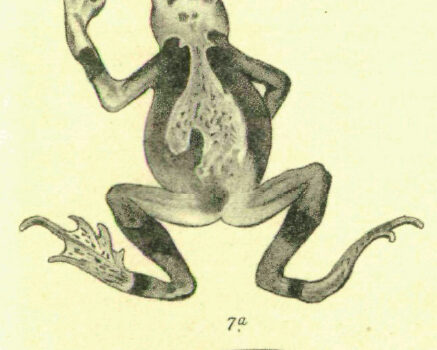
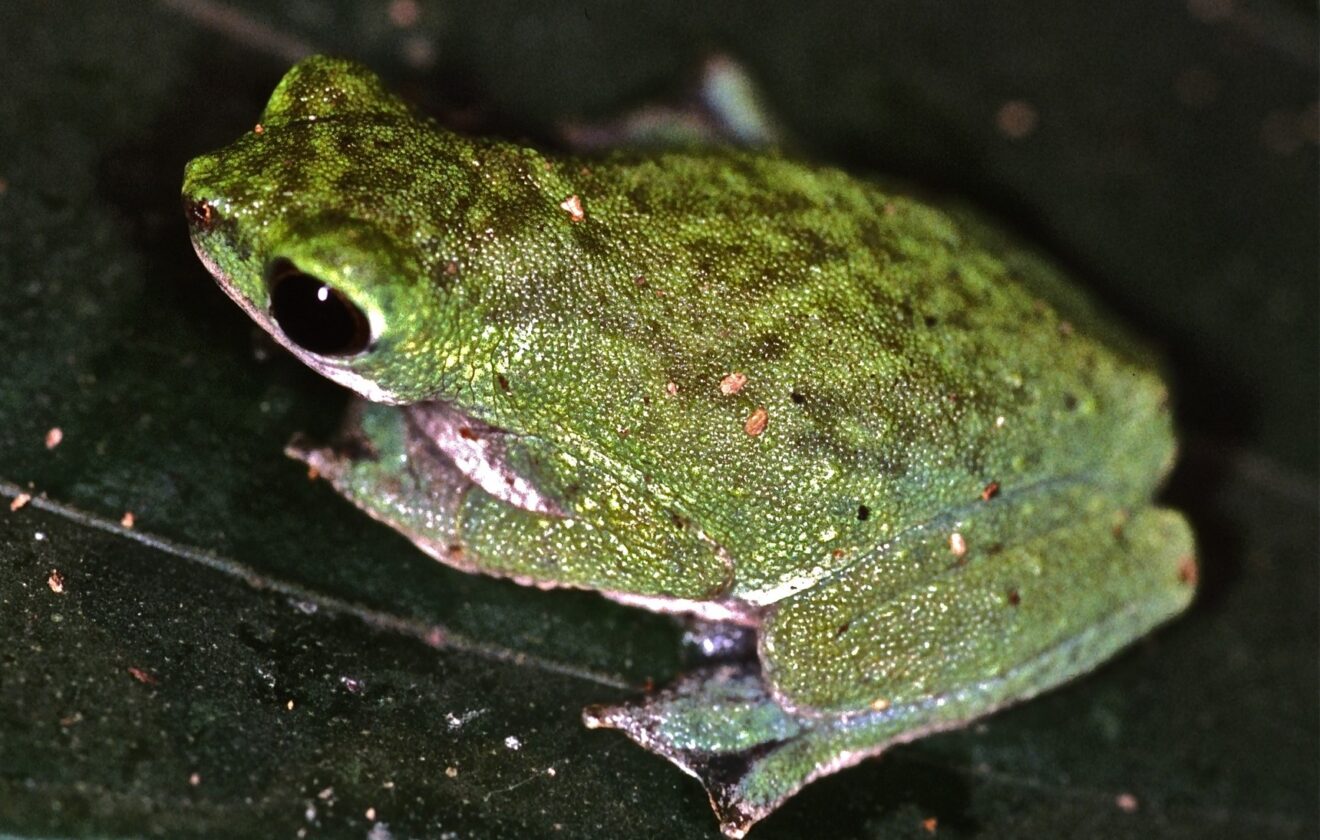
The Bates’ Tree Toad is comparatively small, typically measuring between 25 and 30 millimeters in length at maturity. Despite their modest stature, their appearance commands attention with distinctive complexity. Their rough, granular skin resembles forest textures, punctuated by intricate blotches and patterns ranging from earthy browns and greens to subtle shades of reddish hues.
A Master of Camouflage#
Colorations and patterns of the Bates’ Tree Toad serve notably efficient camouflage purposes. Their cryptic appearance blends seamlessly into their leafy, damp surroundings, making them nearly invisible against decaying leaves and moss-covered bark. This adaptation is essential for survival—concealing themselves from predators, gently gliding unnoticed through the mosaic of the forest understory.
In addition, large, forward-facing eyes provide excellent vision critical for nocturnal hunting, while their agile limbs allow precise movement among low vegetation and horizontal surfaces. Wide, rounded toe pads enhance their ability to grip slick surfaces—even in moist, slippery rainforest conditions—allowing graceful navigation through their arboreal and terrestrial habitats alike.
Behavior and Life Cycle#
Bates’ Tree Toad exhibits fascinating nocturnal behavior, becoming active at dusk when cool moisture saturates forest environs. Their nightly routine is a quiet symphony of patient hunting and cryptic movement—picture the gentle rustle of damp leaves, the occasional quiet hop from moss-covered branch to fallen log.
Feeding Habits: A Skilled, Patient Predator#
Nectophryne batesii preys chiefly upon small arthropods, including mites, ants, spiders, and tiny beetles found in abundance within the leaf litter habitat it occupies. With precise jumps, these small but keen hunters capture prey after careful stalking or opportunistic encounters, using their sticky tongues to seize unsuspecting food items.
Reproductive Behavior and Tadpole Development#
Breeding for Bates’ Tree Toad occurs predominantly around the wet season’s height, when rainforest streams overflow and abundant rainforms small temporary pools. Male frogs call faintly yet distinctly—delicate chirps emanating from the tropical night as they seek females who respond positively to these soft, enchanting serenades.
Mated pairs deposit strings of gelatinous egg masses in quiet riverine pools or near slow-moving streams. Once hatched, tadpoles flourish in freshwater habitats, developing swiftly amid the steady availability of algae and organic debris. After several weeks of sustained growth and development, metamorphosis yields tiny, terrestrial juveniles, equipped to venture out into their forest habitat, continuing the perpetual cycle integral to the species’ continued existence.
Ecological Role#
Every creature in the dense rainforest ecosystem plays its role, intricately interconnected in a delicate balance; the Bates’ Tree Toad is no exception. Its significant role aids in maintaining populations of small arthropods, contributing to controlling insect species within forest ecosystems, indirectly protecting foliage and aiding decomposition processes.
An Indicator Species for Forest Health#
Amphibians like Bates’ Tree Toad often serve as ecological indicators because of their permeable skin and dependence on both terrestrial and aquatic ecosystems. Healthy populations signal stability regarding habitat quality and environmental integrity, making these amphibians critical subjects of observation for conservation biologists monitoring ecosystem health.
Threats and Conservation Status#
Despite these adaptive strengths, Nectophryne batesii faces significant ecological threats. Ongoing habitat destruction from logging activities, agriculture expansion, and human infrastructure is progressively encroaching on their pristine rainforest homes. Climate change further exacerbates these challenges, altering precipitation patterns and undermining the stability of freshwater habitats vital for their reproduction.
Current Conservation Efforts and IUCN Status#
The International Union for Conservation of Nature (IUCN) currently classifies Bates’ Tree Toad as Least Concern, meaning it survives in relatively stable numbers for now. However, continuous evaluation remains vital. Conservation strategies implemented locally emphasize critical habitat preservation, conducting biodiversity assessments, and community-driven education programs promoting sustainable practices in rainforest-dependent communities, underscoring the importance of amphibian biodiversity and ecosystem resilience.
Cultural and Scientific Significance#
Although perhaps overshadowed culturally by more charismatic fauna, amphibians such as Bates’ Tree Toad hold subtle importance to indigenous communities who traditionally view rainforest animals as part of forest guardianship values—symbolizing nature’s quiet yet essential balance.
Scientifically, amphibians continue bringing critical insights into ecological indicators studies. Observing these creatures sensitively and respectfully can advance our understanding of complex ecosystem dynamics, uncovering new information about environmental change impacts, biodiversity trends, and conservation strategies applicable beyond rainforest ecosystems themselves.
Conclusion#
The delicate, enthralling existence of Nectophryne batesii—Bates’ Tree Toad—symbolizes the intricate wonders of tropical biodiversity, quietly thriving beneath a rainforest canopy that conceals countless biological narratives. By exploring, understanding, and protecting this remarkable amphibian, we invest in a bigger ecological promise—not only securing its future survival but safeguarding the broader mosaic of life to which it vitally belongs.
Let us continue observing, respecting, and protecting these quiet ambassadors of Earth’s biodiversity. Join efforts—learn, support, protect—and keep the music of the forest alive for generations yet to wander beneath its lush canopy.