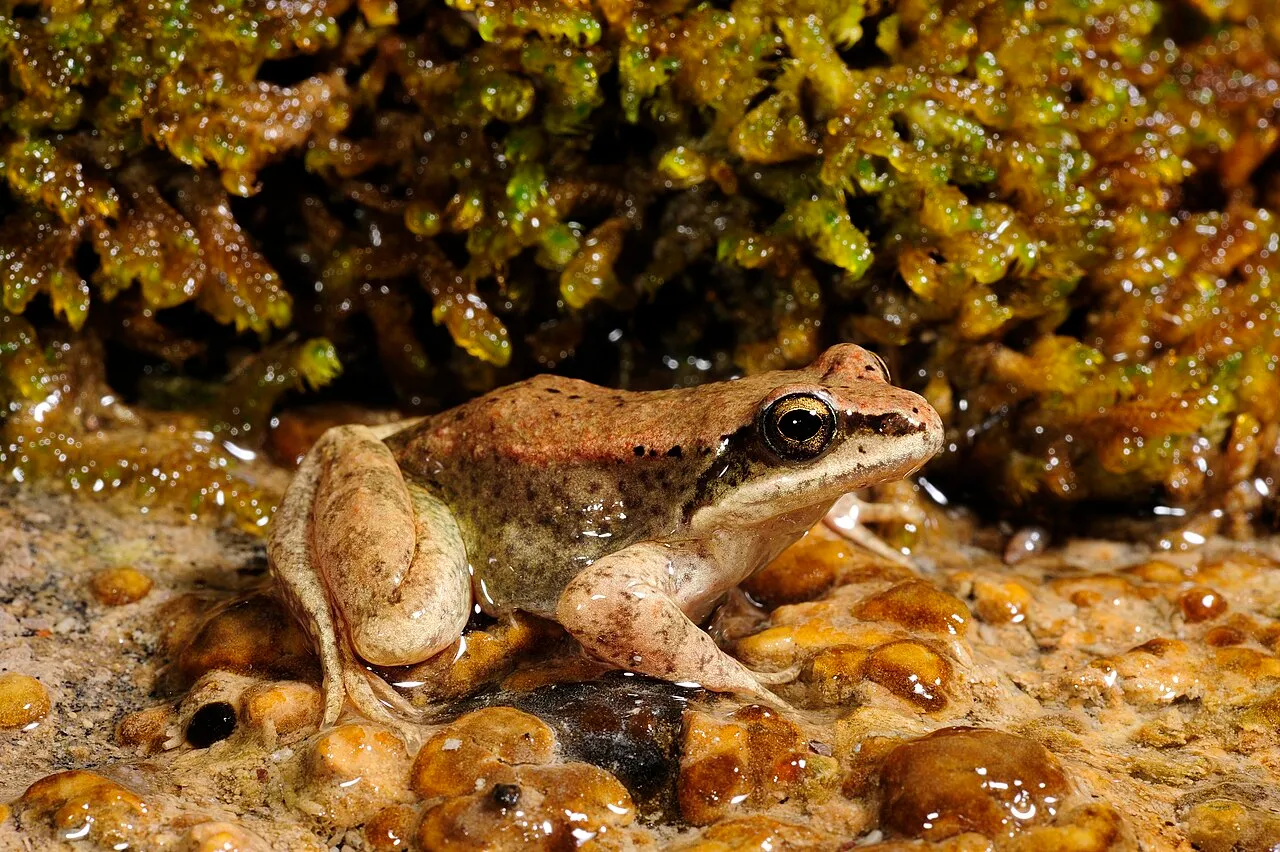
Rana pyrenaica, the Pyrenean frog, is a species of true frog in the family Ranidae, endemic to the Pyrenees, with most populations on the Spanish slopes, ranging from Ordesa y Monte Perdido National Park to the Roncal Valley in Navarre, and a few populations also on the French side. It is a specialist of fast-flowing mountain streams and, at about 33 to 45 mm snout-to-vent length, is one of Europe’s smallest brown frogs. That combination of a tiny range and a narrow habitat requirement makes it one of the more vulnerable amphibians native to the mountain range it is named after.
Identification
Adults measure about 33 to 45 mm snout-to-vent length, with females slightly larger than males, making this species notably smaller than most other brown frogs sharing its range. There is no record in the facts behind this page of distinctive colour patterns or calls that would set it apart at a glance beyond its size; in practice, small size combined with its tight association with fast-moving water is the most useful starting point for telling it apart from similar species in the field, and the “Similar species” section below gives the specific marks to check against its most likely look-alike.
Habitat and range
Rana pyrenaica lives in and around fast-moving, rocky mountain streams with little vegetation, mostly at altitudes between about 1,000 and 1,800 m. It avoids still water, unlike many other European brown frogs that will also use ponds and lakes, and it shares its habitat with Pyrenean brook salamanders, another stream specialist of the same mountains. Within its endemic range, it is found mainly on the Spanish slopes of the Pyrenees, from Ordesa y Monte Perdido National Park to the Roncal Valley in Navarre, with a few populations also recorded on the French side. That distribution places the bulk of the species’ known populations inside or close to one of Spain’s best-protected mountain landscapes, though protection on paper does not remove the pressures a stream-dependent species faces from changes in water flow or quality upstream.
Behaviour and breeding
Adults are mostly aquatic while juveniles are more terrestrial, a split that reflects the different demands of life in a cold, fast-flowing stream versus the banks and rocks around it. The frogs hibernate over winter and are active from February to July, with breeding taking place after snowmelt, when females lay batches totalling up to 150 jelly-covered eggs. That short active season, tied to the mountain snowmelt rather than a fixed calendar date, concentrates the whole breeding cycle into a narrow window each year and leaves little room for the timing to shift if snowmelt patterns change.
Conservation
The species’ facts box carries its current IUCN Red List category, Endangered. Its restricted range, confined to fast-flowing streams within a limited stretch of the Pyrenees, leaves it with little room to shift habitat if stream conditions change, and a population tied this closely to one type of watercourse in one mountain range has few fallback options compared with more widespread relatives.
Similar species
Rana pyrenaica belongs to the same genus as the common frog, Rana temporaria, with which it shares part of its range. It is distinguished from the common frog by its much smaller size, less-pointed snout and less-distinct markings; of the three, size is the quickest check to make in the field, since the Pyrenean frog is markedly smaller than a typical adult common frog.