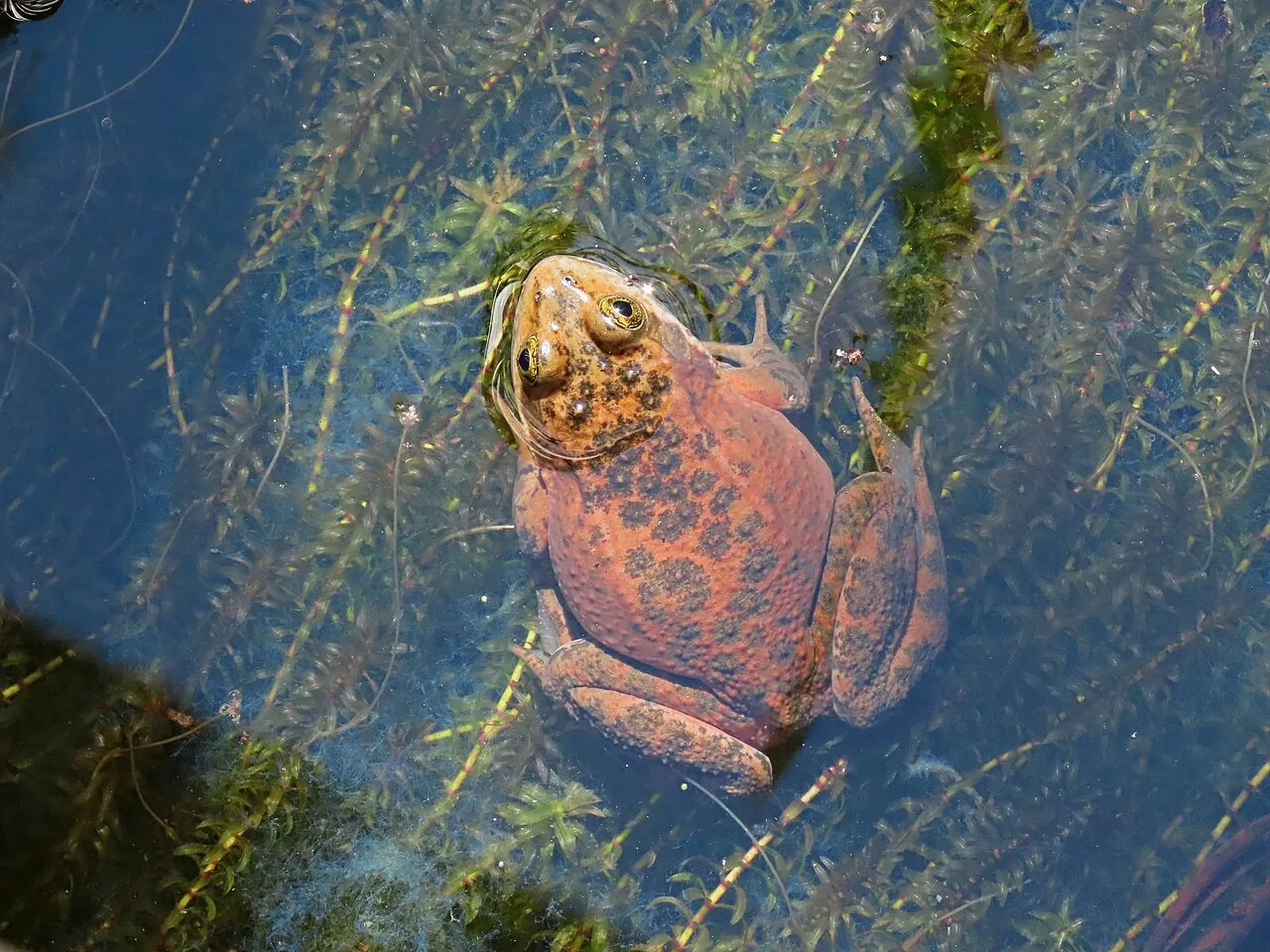
Rana pretiosa, the Oregon spotted frog, is found in south-western British Columbia, Canada, south through the Puget/Willamette Valley and the Columbia River gorge in south-central Washington to the Cascade Range and at least the Klamath Valley in Oregon, USA, though it has been extirpated from California and much of western Oregon and Washington. Adults measure 44-102mm snout-vent length, with females typically larger than males.
Identification
Colour shifts with age: tadpoles have brown back and tail musculature without dark spotting and a creamy white or aluminum-coloured belly, juveniles are brown or olive green, and adults turn brown or reddish brown, becoming increasingly red with age; the oldest frogs can be brick red over most of the back and red across the entire abdomen to the chest. The head and back carry black spots with light centers that grow larger, darker and more ragged-edged with age. Juveniles are white or cream below with reddish underleg pigment, while adults show vivid orange-red colour on the underlegs and red pigment across the abdomen. The eyes are greenish-gold, upturned and mostly uncovered by the eyelids when viewed from above — a useful field mark, since the frog often suns itself with little more than the eyes above the waterline. The hind legs are short relative to body length, and the hind feet are fully webbed, the webbing reaching onto the last segment of the longest toe. The groin is uniformly gray, sometimes faintly mottled with gray markings and red-orange flecks.
Habitat and range
The species is highly aquatic and seldom strays from standing water, favouring zones of shallow water with abundant emergent or floating aquatic plants in wetlands, lakes and slow-moving streams, where it uses mats of aquatic vegetation for basking and escape cover. It is found across an elevation range of 20 to 1,570 m (70-5,150 ft), and these shallow habitats often carry a thin layer of unusually warm water that the frogs appear to prefer. In the United States the species now persists mainly in Deschutes, Lane and Klamath counties in Oregon and Thurston County in Washington.
Behaviour and breeding
Adults feed on a variety of live animal prey, mostly insects, while tadpoles graze on algae, rotting vegetation and detritus. The late-winter breeding season is brief, lasting less than four weeks, with males calling quietly by day or night. Egg-laying begins once water temperatures reach 8°C, with timing ranging from late February to early March at lowland sites to late May through late June at montane sites in Oregon. Frogs breed in warm shallow water, often 5.1-30.5cm (2-12in) deep, among grasses, sedges and rushes, laying eggs in fully exposed, shallow water that the sun readily warms. A female breeds every year, producing a single egg mass, and masses are laid communally, with between 10 and 75 individual egg masses forming one cluster; in British Columbia, each egg mass held an average of 643 eggs. Eggs hatch after 18 to 30 days, and metamorphosis follows 110 to 130 days after hatching in British Columbia, and potentially as few as 95 days in Oregon. Males reach sexual maturity within their second year in British Columbia, or by the end of their first year in central Washington, while females mature in their second or third year in British Columbia, or by the middle of their second year in central Washington. Wild frogs typically live between two and five years.
Conservation
The IUCN category for the Oregon spotted frog is given in the facts box above. In the United States the species was listed as threatened under the Endangered Species Act on 29 August 2014, and in Canada it is listed as endangered under the Species at Risk Act. Its decline has been linked to areas colonised by the introduced American bullfrog, along with the loss and degradation of breeding habitat from dam construction, altered drainage patterns, dewatering for urban and agricultural water use, excessive livestock grazing and other activities that reduce shallow standing water. Recovery work is underway at institutions including the Vancouver Aquarium, Woodland Park Zoo and the Washington State Department of Fish and Wildlife, and school groups help manage invasive canarygrass and bullfrogs to improve habitat.
Similar species
The Columbia spotted frog, Rana luteiventris, was once treated as a subspecies of the Oregon spotted frog before being elevated to full species status, and the two remain easy to confuse where their ranges come close. Against the northern red-legged frog, Rana aurora, the Oregon spotted frog is told apart by groin colouration, the length of the dorsolateral folds, eye orientation, resting posture, the extent of toe webbing and how much time it spends away from water — the Oregon spotted frog’s fully webbed hind feet and near-permanent attachment to standing water are useful checks in the field. Few other ranids in its range share its upturned, greenish-gold eyes that stay mostly clear of the eyelids when the frog is viewed from above, another useful distinction from look-alikes.