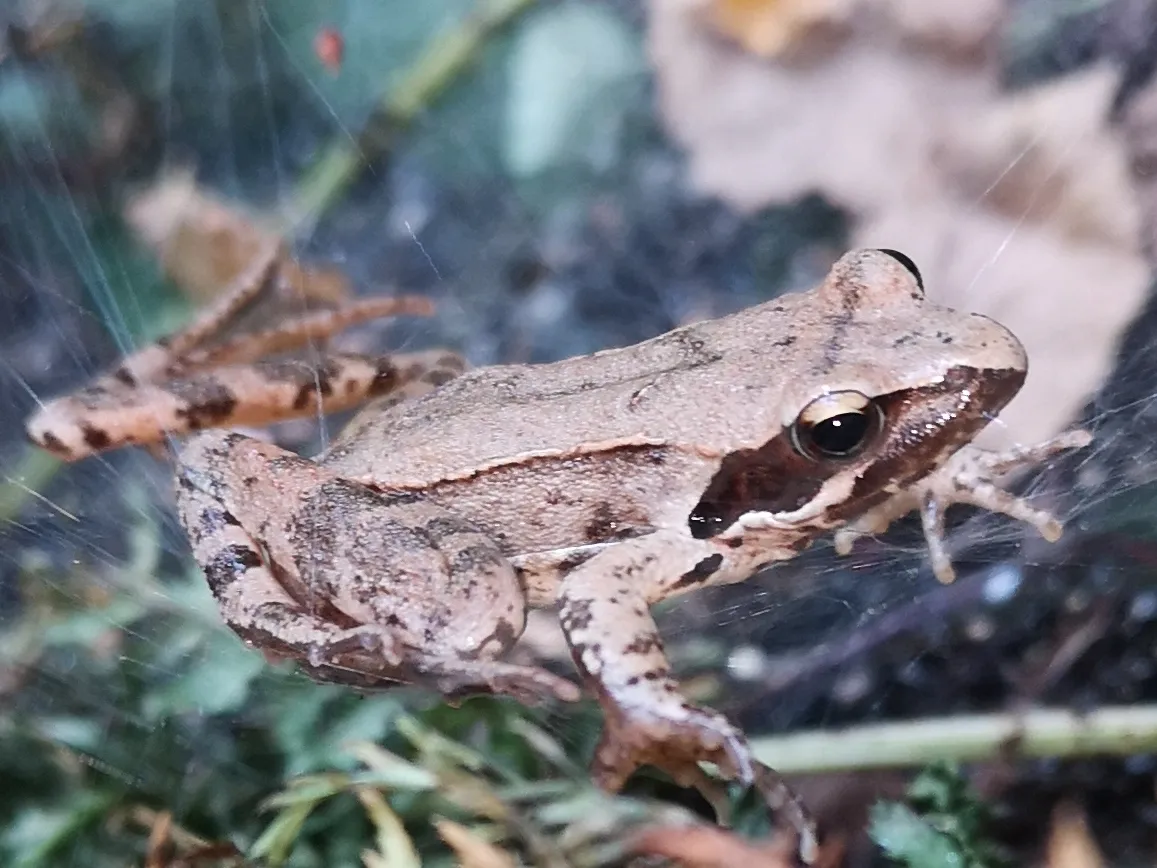
Rana latastei, the Italian agile frog, is a lowland member of the family Ranidae, closely related to the agile frog but restricted to a much smaller corner of Europe. It is endemic to the plains of northern Italy, namely Lombardy, Veneto, Piedmont and Friuli-Venezia Giulia along the Po river basin, plus the extreme southern tip of Switzerland, the Istrian region of Slovenia and adjacent Croatia.
Identification
Adults reach a head-body length of up to 7.5 cm, with females tending to grow slightly larger than males. The back is gray or brownish-red with white bellies, and shows almost no colour variation across its range. A useful field mark is the throat: it is dark, with a light narrow central stripe reaching down to the chest. In breeding condition, males develop dark red or brown spots on the throat, orange-red colouring on the underside of the thighs, and thumb pads on the forelimbs. Most individuals have a pointed snout, though rounded snouts occur in some.
Habitat and range
This is a decidedly lowland species, rarely found above 400 m, living in oak and hornbeam-dominated plain woods, hygrophilous woods and riparian woods of white poplar and white willow. It favours humid ground with plenty of rotting plant material, staying close to rivers, streams, lakes and other freshwater, always with abundant leaf litter underfoot. Movements track the seasons: adults stay close to water during the February-to-April breeding season, then move back into the forest as it grows more humid through late spring and summer.
Behaviour and breeding
Males call underwater with two distinct sounds, repeated every 20 to 60 seconds until a female arrives: a short, high-pitched “mew” lasting about half a second, audible up to 4 m away, and a harsher, guttural “brum” lasting about a second, used only at ranges under 30 cm. Breeding runs from late February to mid-April, at small permanent or temporary water bodies thick with aquatic vegetation. A female lays 676 to 2,720 eggs, averaging about 1,278, in a single compact clump within 50 cm of the surface, usually 2 to 15 days after mating; the eggs carry thinner gelatinous layers than related species, only 6 to 7 mm thick and hatch after 10 to 15 days once the water reaches at least 2 °C. Metamorphosis takes 2 to 3 months, producing froglets 13 to 15 mm long that leave the water in late June or July. Frogs can breed in their first season after metamorphosis but reach full sexual maturity only in their second year; males typically live about 3 years and females about 4. Adults hunt beetles, bugs, earwigs, worms, snails, centipedes and various arachnids in forest litter, burrows and riverbanks, while tadpoles graze on algae and other particles in the water.
Conservation
The IUCN category is shown in the facts box above. Roughly 250 wild populations survive, with the western ones smaller and at greater risk of extinction. Because the frog rarely strays far from its breeding site and avoids long-distance movement, habitat fragmentation hits it hard: water pumping for crop irrigation has made many habitats unsuitable for breeding, while introduced predators such as Percottus glenii, the American bullfrog and crayfish add further pressure. Fragmented populations also show reduced genetic diversity, which is predicted to make the species more vulnerable to ranaviruses and other pathogens. A newer threat is plastic pollution: in tadpoles, greater microplastic exposure has been linked to reduced growth, activity and survival, with the smallest fragments doing the most harm.
Similar species
The Italian agile frog often shares habitat with its close relative, the agile frog, Rana dalmatina, but the two rarely compete for resources or shelter thanks to more specialised habitat and breeding behaviour in Rana latastei — though Rana latastei does see reduced breeding success where Rana dalmatina is abundant. The surest distinction is the throat: Rana latastei’s dark throat with a pale central stripe is not shared by its relative, and its range is far narrower, confined to the Po basin and a handful of neighbouring regions rather than spread across most of Europe.