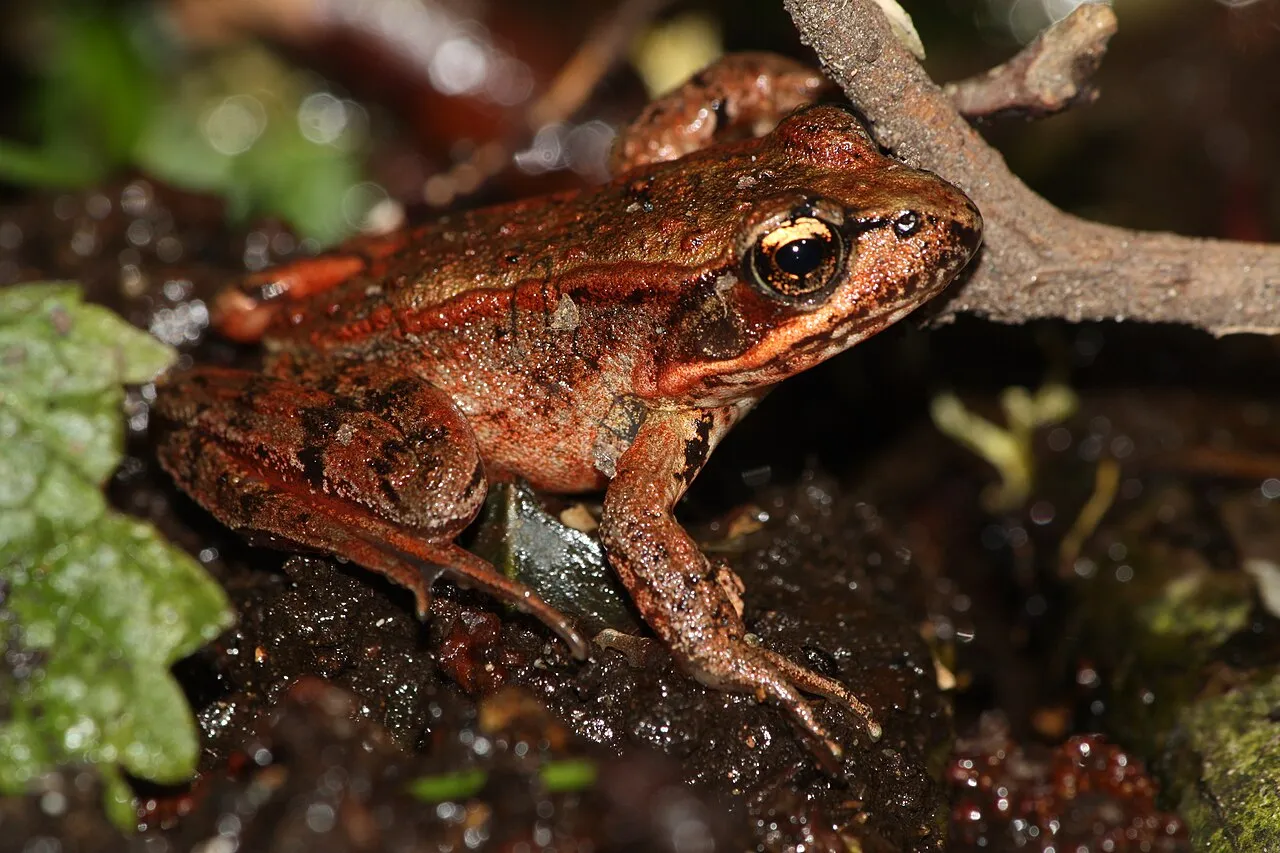
Rana aurora, the northern red-legged frog, lives in the Pacific Northwest of North America, from northern California to southwestern British Columbia (including Vancouver Island) and through western Oregon and Washington, mostly west of the Cascade Range, at elevations up to about 1,426 m. Adults are sexually dimorphic: females reach about 107 mm (4.2 in), males about 81 mm (3.2 in), with Washington populations running smaller still.
Identification
The frog’s skin is greenish- to reddish-brown with dark spots across the back and a dark facial mask, smooth and without warts, and marked by prominent dorsolateral folds running along the back. Its most distinctive feature gives the species its name: the undersides of its relatively long, webbed hind legs are bright red. The eyes are golden-brown, and a thin, horizontal dark line runs from the front of the eye to the nostril, with a light stripe along the jaw beneath the dark, mask-like patch covering the eardrum. Like other members of the genus, it has a narrow waist and long, powerful legs built for jumping.
Habitat and range
The species relies on both upland terrestrial habitat and aquatic habitat, breeding in still or slow-moving ponds, marshes or streams that hold both vernal and permanent water with submerged vegetation. It is unusually tied to its aquatic sites, favouring thickly vegetated shoreline and breeding ponds with sunny patches that help eggs develop. Within California it occurs in every coastal county from southern Mendocino County northward, staying below 1,200 m in Northern California and 914 m in Washington; it is considered introduced where it turns up in Alaska.
Behaviour and breeding
Adults eat mostly terrestrial insects, along with small snails, crustaceans, worms, tadpoles, small fish and other small frogs, while tadpoles graze on algae. When threatened, a frog will plunge to a depth of a metre or more to escape, and some northern populations hibernate over winter. Outside the breeding season, adults range roughly half a kilometre to summer habitat, usually riparian zones.
Frogs move toward breeding sites as early as October and as late as January, with breeding itself running generally from January to March once water reaches a stable minimum of 5.5 to 6.5 °C (42 to 44 °F); females lay only once the surface water hits at least 6.1 °C (43 °F). Adults spend one to two weeks at the breeding site, with males arriving first to defend territories through nocturnal calling, and the species is known for underwater breeding choruses unique among ranid frogs. A female lays a single globular egg mass about 10 cm (3.9 in) across, holding 500 to 1,100 and sometimes up to 2,000 eggs of 2.0 to 3.0 mm each, attached to submerged vegetation 7 to 15 cm (2.8–5.9 in) below the surface. Eggs take 3 to 5 weeks to hatch, unusually long for a Rana species, and many tadpoles are lost to predation soon after. Tadpoles metamorphose at 5 to 7.6 cm (2–3 in), emerging as froglets of 2 to 2.5 cm (0.8–1 in).
Conservation
The IUCN category for the northern red-legged frog is given in the facts box above, though population sizes are noted as decreasing and the state of Oregon lists it as a conservation strategy species. The main documented threat is road mortality during the annual breeding migration between upland forest and lowland wetlands, worsened by greater distance to forest patches and more impervious surfaces near breeding sites. In Portland, Oregon, the volunteer Harborton Frog Shuttle, running since 2013, has carried hundreds to thousands of frogs across roads each year, and the city’s Palensky undercrossing stands as Oregon’s first amphibian-specific wildlife crossing structure as of 2025.
Similar species
The northern red-legged frog is often confused with its southern relative, the California red-legged frog, but the two are not each other’s closest kin: genetically, Rana aurora sits closer to the Cascades frog than to the California red-legged frog. The clearest field mark is vocal anatomy: the northern species lacks vocal sacs, while the California red-legged frog has a pair of them, and the northern frog also runs smaller, with differences in colour pattern, limb length and eye size. Against the Oregon spotted frog and the Cascades frog, it is separated by groin colouration, the length of the dorsolateral folds, eye orientation, resting posture, the extent of toe webbing and how much time it spends away from water.