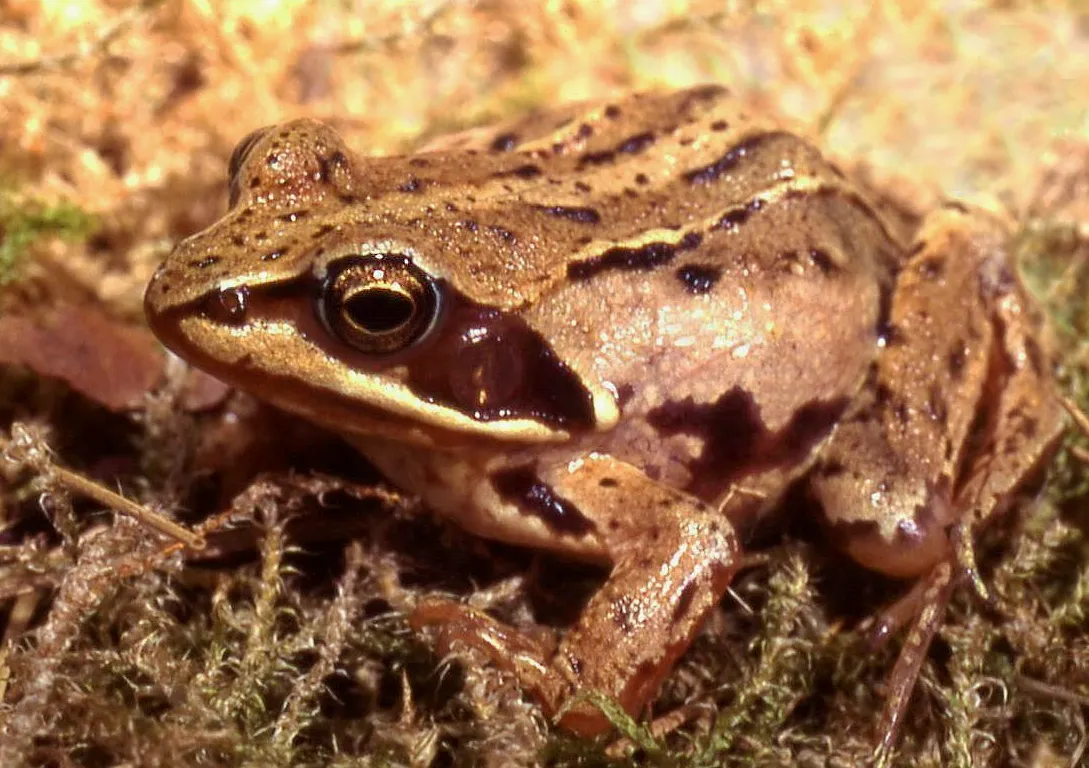
Rana arvalis, the moor frog, takes its scientific name from the Latin for field frog, and is also known as the Altai brown frog where its range meets that mountain range in Asia. It ranges across mainland Eurasia from northeastern France and northern Belgium east to the Lena River in Siberia, near Novosibirsk, and from the 69th parallel in Finland south through the Pannonian Basin and the Balkans. Adults typically measure 55-60 mm in length, occasionally reaching up to 70 mm.
Identification
Base colouring runs from reddish-brown to yellow, grey or light olive on the back, with white or yellow undersides and black stripes running from the nostrils along the sides of the head. The head is more tapered than that of the common frog, and the hind feet carry a hard metatarsal tubercle roughly half the length of the innermost toe, a firmer spur than the soft, small one found on common frogs. The feet are partially webbed, the back legs comparatively short, the pupils horizontal, and the tongue forked and free. Males carry nuptial pads and paired vocal sacs, and for a few days each year during peak breeding activity they turn a conspicuous blue, a colour most dramatic in ultraviolet wavelengths; females stay brown year-round.
Habitat and range
The moor frog is found in acidic wetlands, peat bogs, meadows and fields, favouring still or slow-moving water rich in decomposing organic material with a fairly acidic pH, around 6 or below. Within that range it turns up in settings as different as near-tundra conditions, taiga, conifer forest, forest steppe, dry steppe, open forest, glades, arid chaparral-like areas, swamp, and urban parks near human settlements. It occurs up to 900 m in western Europe and as high as 2 km in the Altai Mountains. The range was once wider still: fossil records from the middle Pleistocene show the species reaching as far south as south-central France and as far west as the eastern coast of Great Britain, ground it no longer occupies. Because it tolerates such a wide span of climates and elevations today, from near-tundra bog to arid steppe, researchers treat the moor frog as a useful model species for studying how populations adapt locally to different environments.
Behaviour and breeding
Moor frogs breed from March to June, immediately after emerging from hibernation. The predominant mating system is multimale amplexus, in which several males compete to mate with one female, and sperm then compete inside the female’s reproductive tract; females favour males whose past matings show greater fertilisation success over larger body size. Spawning itself is quick, completed within 3 to 28 days, and each female lays 500 to 3,000 eggs in one or two clusters in warm, shallow water. Males call in breeding choruses that have been likened to air escaping from a submerged, empty bottle. Colony size varies widely across the range: a study of Romanian breeding sites found 200 to 400 adults typical per population, with exceptional sites holding as many as 2,000. Outside the breeding season, adults are opportunistic predators that wait for prey rather than hunt it, taking mostly beetles, along with true bugs, wasps and flies, and non-insect invertebrates such as snails, spiders and centipedes.
Depending on latitude, moor frogs hibernate on land between September and June, sheltering in leaf litter and between tree stumps rather than in water. The species is renowned for tolerating freezing temperatures, and Siberian populations can freeze to as low as -16°C, with up to 65% of the body turning solid for roughly three months before thawing and reviving. That tolerance is not uniform across the range: Danish populations withstand only -4°C, and just for three to four days, a much narrower margin than their Siberian counterparts.
Conservation
The IUCN category for the moor frog is given in the facts box above. Even so, that Least Concern rating does not properly reflect a currently declining trend driven by habitat loss from urbanisation, agricultural intensification and recreational use, by acidification of breeding waters from pollution, and by peat-cutting and wetland drainage that fragment populations and erode genetic diversity. In France the species is considered nearly extinct, with only four isolated populations remaining as of 2020, down from a formerly contiguous range. Conservation responses include liming acidic breeding pools with limestone to raise their pH and restoring riparian vegetation to rewet degraded habitat.
Similar species
The moor frog’s closest look-alike is the common frog, Rana temporaria, which shares its damp habitats and general brown colouring. The clearest field check is the metatarsal tubercle on the hind foot: hard and roughly half the innermost toe’s length in the moor frog, against a soft, small tubercle in the common frog, alongside the moor frog’s more tapered head. During the breeding season the difference is unmistakable: moor frog males turn a conspicuous blue, while common frog males show at most a faint blueish tint.