- Centrolene buckleyi: The Enchanting World of Buckley's Glass Frog
Centrolene buckleyi: The Enchanting World of Buckley’s Glass Frog#
Deep within the shimmering mist and emerald embrace of South America’s Andean cloud forests, there exists a creature seemingly sculpted from crystal and imagination. Centrolene buckleyi—more poetically known as Buckley’s Glass Frog—is a remarkably translucent amphibian whose skin gently unveils its beating heart and intricate internal organs with breathtaking clarity. As fascinating as it is mysterious, this delicate helping of evolutionary wonder is much more than merely transparent skin; it is an indicator of ecosystem health and a subtle, beautiful voice amid the global chorus advocating for conservation and sustainable coexistence.
If there ever existed a frog perfectly suited to symbolizing nature’s delicate balance, it is Centrolene buckleyi. Through this article, we journey into the secluded valleys and rain-wrapped slopes to understand the life and ecology of one of the forest’s most enigmatic creatures.
Taxonomy and Classification#
At the heart of understanding any species is deciphering the delicate lineage it belongs to within the great branching tree of life. Centrolene buckleyi is classified within the family Centrolenidae, commonly known as glass frogs because of their remarkable translucent appearance. Within this family resides a vibrant choir of frogs spread largely across Central and South America.
First described formally in 1882 by George Albert Boulenger, Buckley’s Glass Frog earned its scientific name, Centrolene buckleyi, honoring the naturalist Clarence Buckley who collected diverse specimens throughout Latin America. Scientifically, this frog sits comfortably within the genus Centrolene, one of several genera known collectively as glass frogs. These amphibians are revered among herpetologists for their ornate complexity, subtle variation in markings, and diverse methods of reproduction and parental care.
Natural Habitat and Distribution#
Centrolene buckleyi inhabits a realm of perpetual twilight and softly rolling mists, thriving primarily within the moist, high-altitude cloud forests of the Andean slopes in Ecuador and Colombia. These cloud forests are enchanted ecosystems known for their palpable humidity, lush vegetation, and persistent fog that cloaks canopy and understory alike, offering ideal conditions for a species so intricately intertwined with moisture and subtlety.
A Precise Preference: Streams and Foliage in Cloud Forests#
Buckley’s Glass Frog is rarely found far from gently flowing streams or small forest rivers. Indeed, its very existence depends on proximity to pristine, unpolluted freshwater habitats that exhibit constant humidity, dense canopy shading, and lush foliage. These frogs perch delicately on leaves stretching over trickling forest streams, relying entirely upon careful ecological balance.
These precise environmental demands make Centrolene buckleyi an invaluable indicator species. Scientists often look to this translucent resident as a barometer of ecosystem health, their delicate frames sensitive to even subtle shifts in water quality, temperature, and humidity.
Physical Characteristics: A Frog of Crystal Transparency#
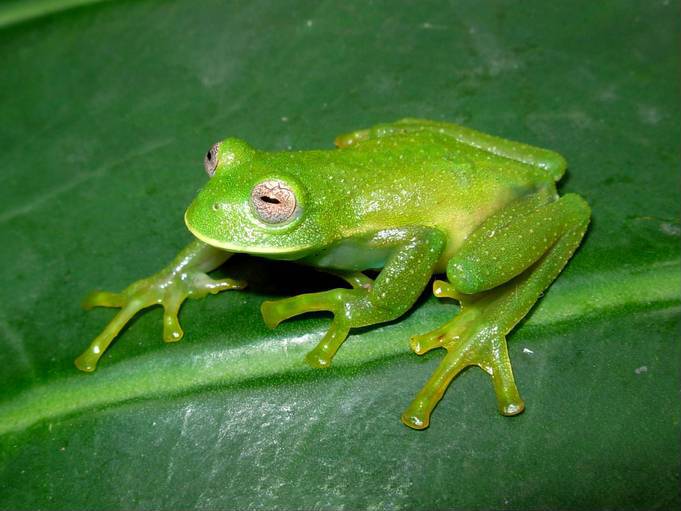
Buckley’s Glass Frog is breathtakingly beautiful, like a tiny sculpture fashioned out of delicate blown glass. Adult frogs typically measure between 23 and 27 mm from snout to vent, an elegant tableau of minute grace and fascinating fragility. Their eyes, unmistakably large compared to the body, are gilded with iridescent gold and silver hues, watching attentively for the fluttering movement of tiny insects and predators in their environment.
What truly sets them apart, however, is the uncanny translucency of their ventral side. Hold this frog gently toward the diffuse light, and you might gaze directly upon its heart, pulsing rhythmically beneath the semi-transparent chamber of its tiny chest, or perhaps follow the branching opacity of arterial networks within its tiny frame. This transparency is neither a curiosity nor an accidental byproduct but an evolved adaptation for camouflage within their leaf-rich landscape.
The dorsal (upper) surface of Centrolene buckleyi exhibits shades of lime-green to faintly blue-green forks of coloration. Tiny yellowish and white markings, randomly arranged over their backs and legs, resemble drops of dew or wet moss—perfect camouflage against predators scanning the green foliage for meals.
Behavior and Life Cycle#
The elusive Buckley’s Glass Frog is largely nocturnal, retreating by day beneath dense leaves or into the cracks of moisture-laden branches to evade predators and conserve precious bodily fluids. With the arrival of twilight, these frogs awaken and begin their vital nightly patrols.
Feeding Habits: Mosaics of Micrometeorites#
Centrolene buckleyi actively hunts insects—usually soft-bodied flying species like flies, mosquitoes, gnats, and smaller moths. Perched high in the understory, they capture prey with astounding precision. Their sticky, agile tongues snap forward instantly, catching prey mid-flight and providing an essential dietary balance of proteins and nutrients in this harsh ecological niche.
Reproduction and Parental Care#
The glass frogs’ courtship rituals reflect nature’s romantic spirit—a delicate serenade of high-pitched calls ringing softly along riverbanks and rain-drenched foliage. Males await patiently on leaves overhanging streams, producing distinctive chirping calls that resonate softly throughout their leafy sanctuaries to attract potential mates.
After successful courtship, females deposit carefully-arranged clutches of eggs beneath the leaves’ undersurfaces, intricately suspended like miniature crystal beads. Remarkably, males remain vigilant guardians—even during daylight hours—in contrast to the more common amphibian habit of abandoning the eggs upon laying. Male Buckley’s Glass Frogs defend the delicate embryos against potential predators and ensure moisture levels remain suited for proper incubation until eggs hatch. Once they reach sufficient maturity, tadpoles drop into the water below, where further metamorphosis occurs, eventually emerging into adult frogs ready to continue their remarkable life journey.
Ecological Role: Guardians of Forest Health#
Centrolene buckleyi serves as a pivotal biological sentinel, sensitive to even subtle shifts within the forest’s nuanced ecological web. Acting as both predator and prey, their diet helps regulate populations of small insects, some of which are potential pest species.
In turn, glass frogs themselves provide an important food source for numerous predators, including carefully adapted birds, snakes, and small mammals, thereby fulfilling their role and maintaining fragile biodiversity balances. Because of their proximity to water, researchers routinely study Buckley’s Glass Frog populations as indicators of freshwater habitat health, providing valuable insights into water pollution and ecosystem status.
Conservation Status and Threats#
Unfortunately, despite their enchanting appearance and critical ecological roles, Centrolene buckleyi faces considerable threats rooted in human activities. Currently listed as “Least Concern” by the International Union for Conservation of Nature (IUCN), region-specific populations nonetheless suffer considerable stress due to habitat loss, fragmentation, and pollution.
Agricultural expansion, logging, road construction, and the encroachment of human settlement continue to fragment and degrade essential rainforest habitats. Compounded by climate change, which alters streamwater temperatures and humidity levels crucial for successful breeding, these gentle amphibians increasingly depend upon targeted conservation strategies and awareness efforts to maintain healthy populations.
Cultural and Scientific Significance#
While Centrolene buckleyi may not feature prominently within traditional folklore or indigenous storytelling, it undoubtedly embodies the forest’s mystery, enchanting aesthetic, and delicate beauty. Its scientific value is substantial, having served as a model for researchers exploring topics ranging from amphibian physiology adaptations and transparent skin functions to ecosystem health and conservation biology.
The unique translucency trait of glass frogs has spawned intriguing investigations into medical research and biomimicry—a pursuit inspired by nature’s ingenious adaptations—to inform innovative material design and technology.
Conclusion: Conserving an Enigmatic Gem#
Centrolene buckleyi is more than just a captivating frog species; it represents a lush, interconnected rainforest ecosystem where each organism holds intrinsic value and profound importance. By unraveling the remarkable secrets embedded within this translucent amphibian, you also begin to decode the intricate narrative of biodiversity and evolutionary ingenuity hidden within their habitats.
As custodians of this beautiful planet, we must actively preserve ecosystems where these delicate creatures thrive. Understanding Buckley’s Glass Frog encourages appreciation, empathy, and commitment toward meaningful conservation. Let this little frog inspire our shared efforts toward preserving the haunting beauty of our wild places before their secrets vanish like the whispering mists surrounding them.