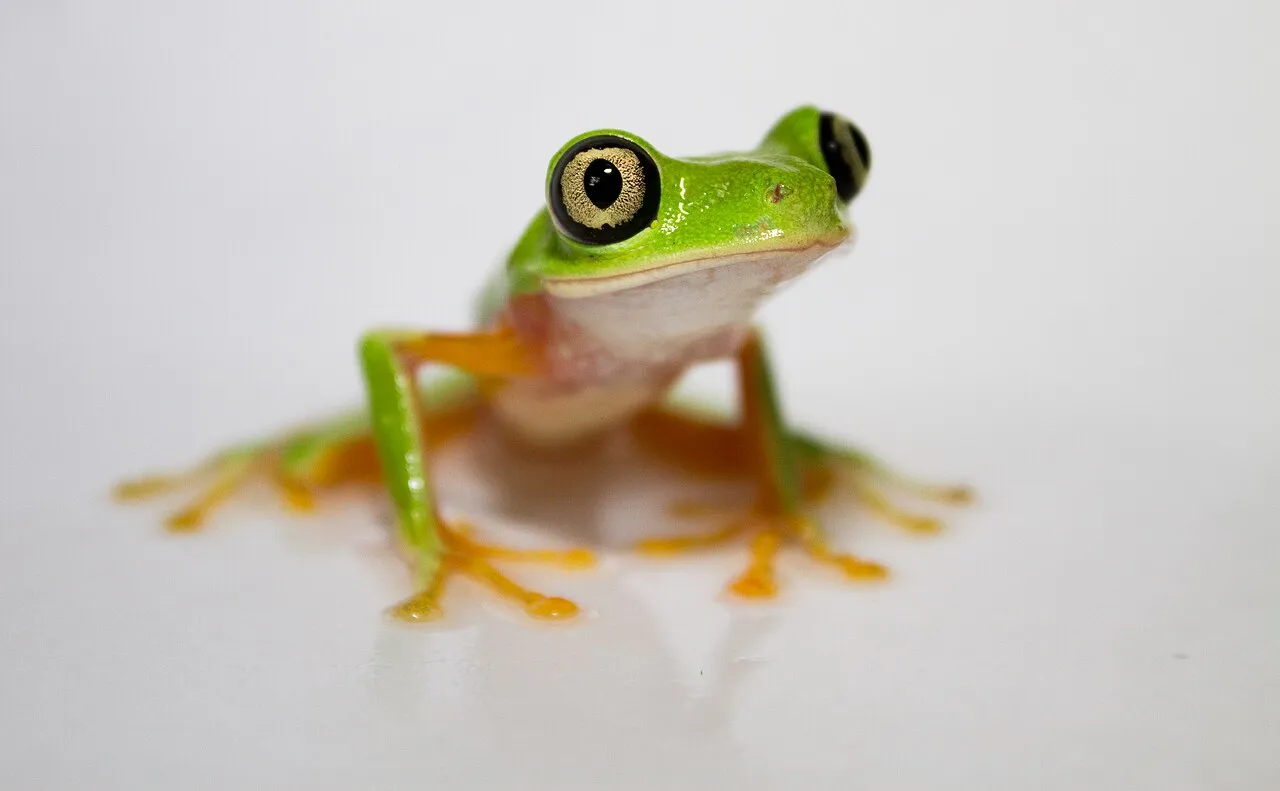
The lemur leaf frog, Agalychnis lemur, is a slender, lime-green treefrog named for its large, forward-facing eyes. It lives in tropical mid-elevation pre-montane rainforest in Costa Rica, Panama and adjacent northwestern Colombia, between about 440 and 1,600 m above sea level; in Costa Rica it is now known from only a handful of sites, including Fila Asuncion, an area near Parque Nacional Barbilla, and Guayacan in Limon Province.
Identification
The species is sexually dimorphic in size: males are about 30-35 mm long and weigh roughly 2 g, while females reach about 40-45 mm and roughly 4 g. Like other members of its genus it has a slim body and large dark eyes set against pale lime-green skin, with none of the bold flank or eye colouring of its red-eyed relatives.
Habitat and range
A. lemur is confined to tropical mid-elevation pre-montane rainforest across its three-country range, favouring the 440-1,600 m elevational band of Costa Rica, Panama and northwestern Colombia. Costa Rican records have thinned to a few known sites within its historical range.
Behaviour and breeding
The frog is mainly nocturnal, resting on the undersides of leaves by day and becoming active after dark. Breeding runs through extended rainy-season periods, with males calling to attract mates; females lay up to about 20 eggs under leaves overhanging water. Tadpoles hatch after roughly 7 days and metamorphose in about 90-150 days, a window that shortens when eggs are threatened by predators or rain.
Conservation
The facts box carries the species’ current IUCN Red List category, Critically Endangered. Its decline tracks the broader loss of mid-elevation rainforest across its Costa Rican, Panamanian and Colombian range, with Costa Rica’s population now reduced to a scatter of known sites.
Similar species
A. lemur can be told apart from its showier genus-mates, such as the red-eyed A. callidryas and the blue-flanked A. annae, by its plainer lime-green colouring and the absence of bold eye or flank markings. Its smaller size and dark, unadorned eyes are the clearest field marks.