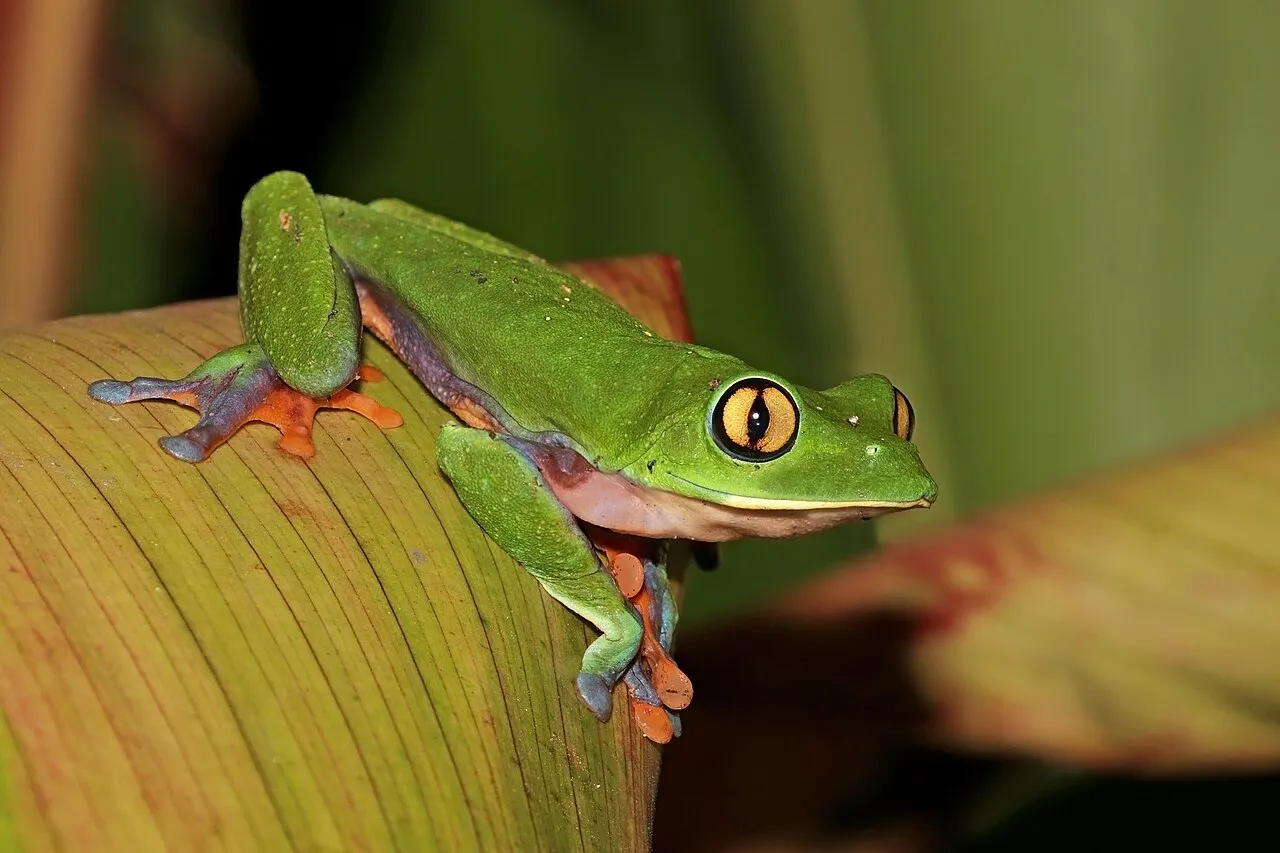
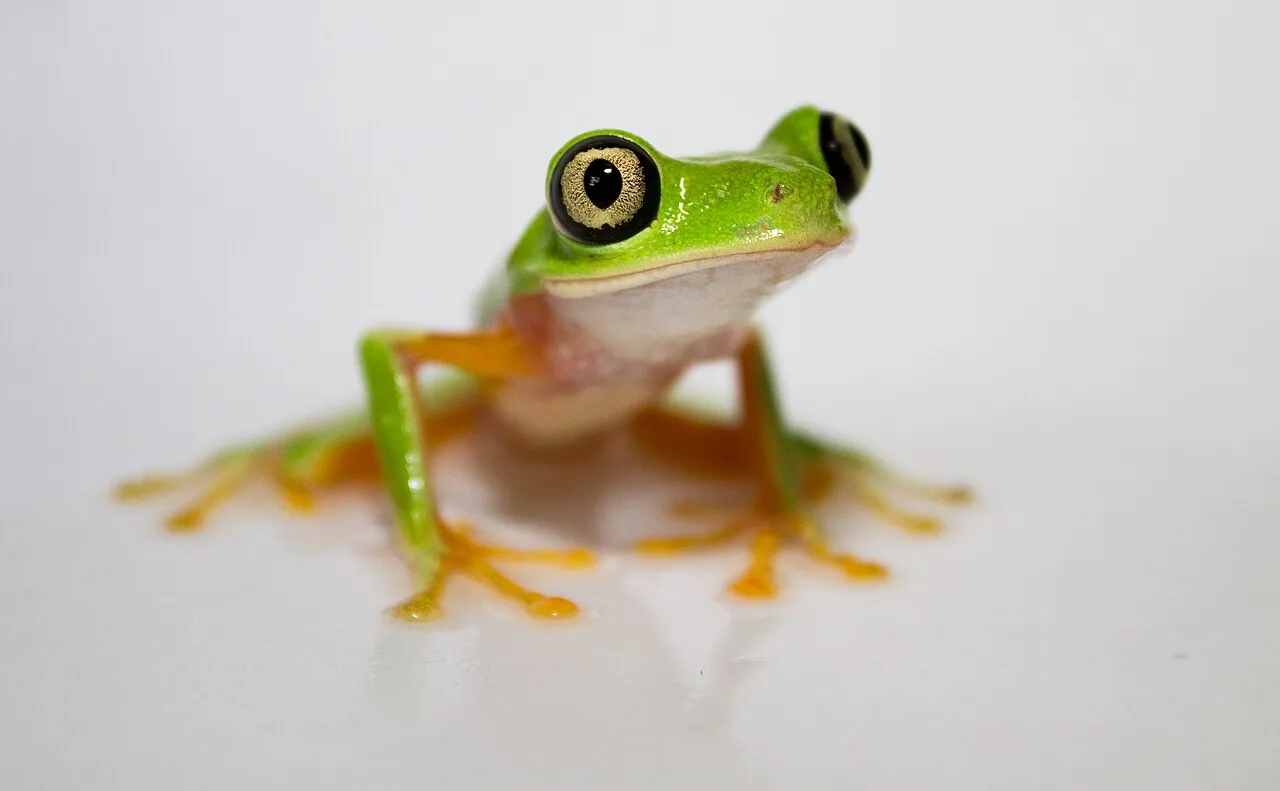
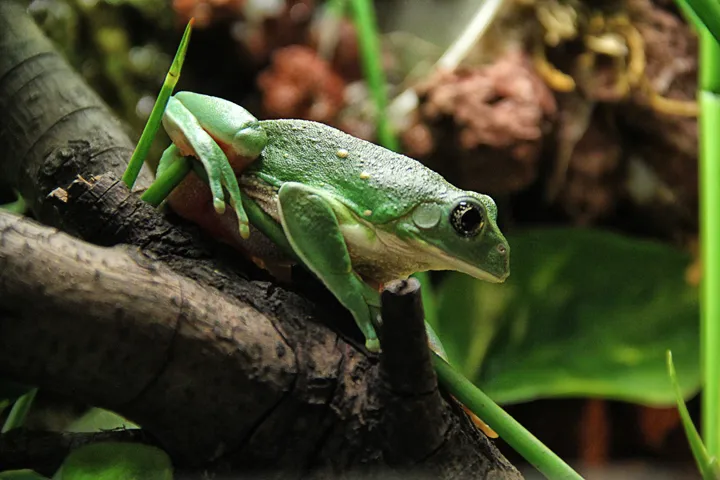
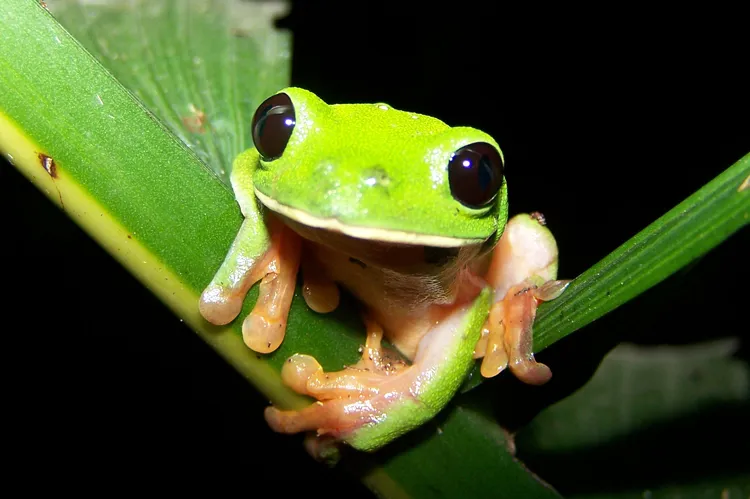
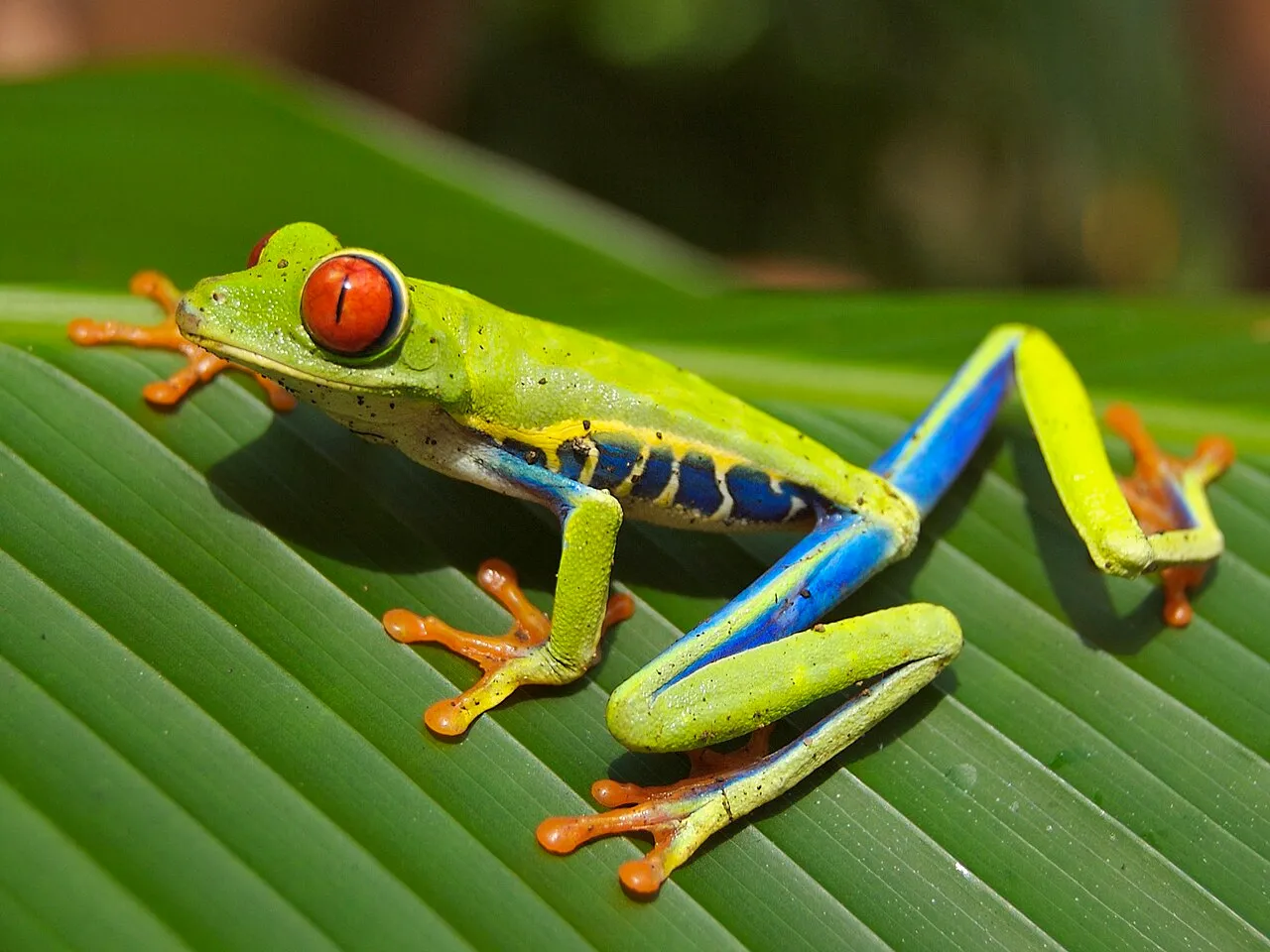
The misfit leaf frog, Agalychnis saltator, also called the parachuting red-eyed leaf frog, is a frog of the subfamily Phyllomedusinae, genus Agalychnis. It is nocturnal and arboreal, living in the Caribbean lowlands of northeastern Honduras through east-central Costa Rica. It was first described by Taylor in 19551 and has also been placed in Phyllomedusa as Phyllomedusa saltator.
Identification
Males measure 38-44 mm and females 52-62 mm in snout-vent length. The frog has red eyes with vertical pupils and a dorsum that is light or dark leaf green with bluish purple flanks. It has large suction disks and extensive webbing between the fingers and toes1.
Habitat and range
The species lives in lowland and montane humid and wet forest, at elevations of 15 to 1,300 m. Its range runs through the Caribbean lowlands from northeastern Honduras to east-central Costa Rica. It lives in tree canopies but descends to temporary pools to reproduce1.
Behaviour and breeding
A. saltator is an explosive breeder, breeding after heavy rains in aggregations of 25 to 400 frogs, typically 100 to 200, on vines overhanging temporary ponds and on marsh vegetation. Most of an aggregation is made up of couples in amplexus, each female accompanied by one to four males. Males can leap from considerable heights onto plants at the mating sites, extending their limbs and spreading the skin between their fingers and toes, hence the name “parachuting frog”. Eggs are laid amid the mosses covering the vines, where they are very vulnerable to predation. Males of the species have also been observed in amplexus with female red-eyed treefrogs, Agalychnis callidryas; the eggs from such matings are infertile1.
Conservation
The species is Least Concern in version 2022.2 of the IUCN Red List2, and it is not threatened on the whole. It is listed on CITES Appendix II. Its distribution is naturally fragmented, and it is not particularly common but is regularly seen on breeding sites. The 2020 IUCN assessment notes local fragmentation of its habitat from deforestation for agricultural development and logging, and a 2011 account by Elizondo and Bolaños1 records it as collected for the illegal pet trade.
Similar species
- Red-eyed treefrog (Agalychnis callidryas): larger, with males about 51 mm and females about 76 mm against A. saltator’s 38-44 mm males and 52-62 mm females; it has orange webbed feet and blue and yellow lateral stripes3, where A. saltator has bluish purple flanks1.