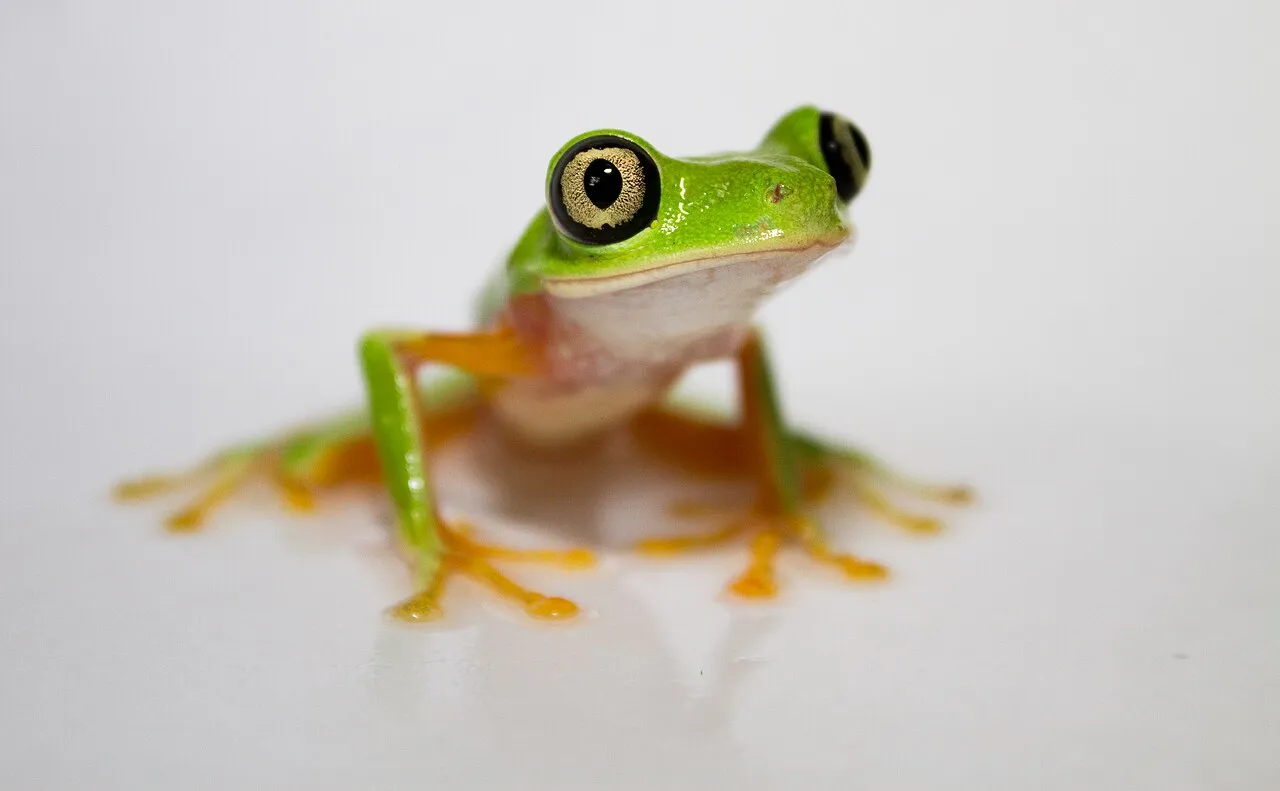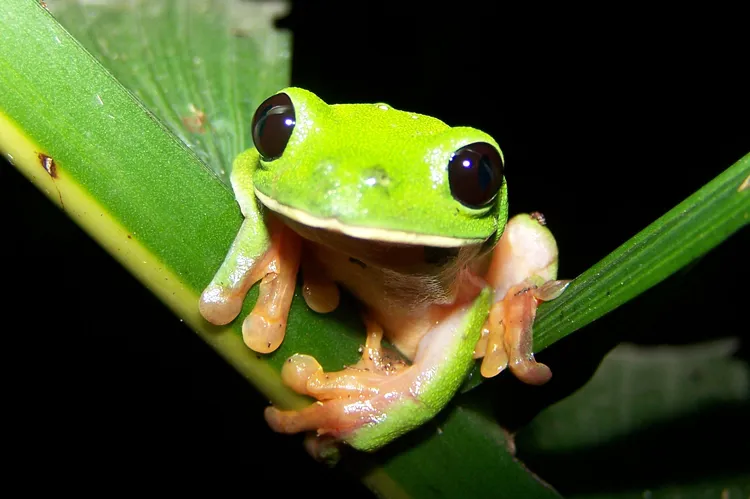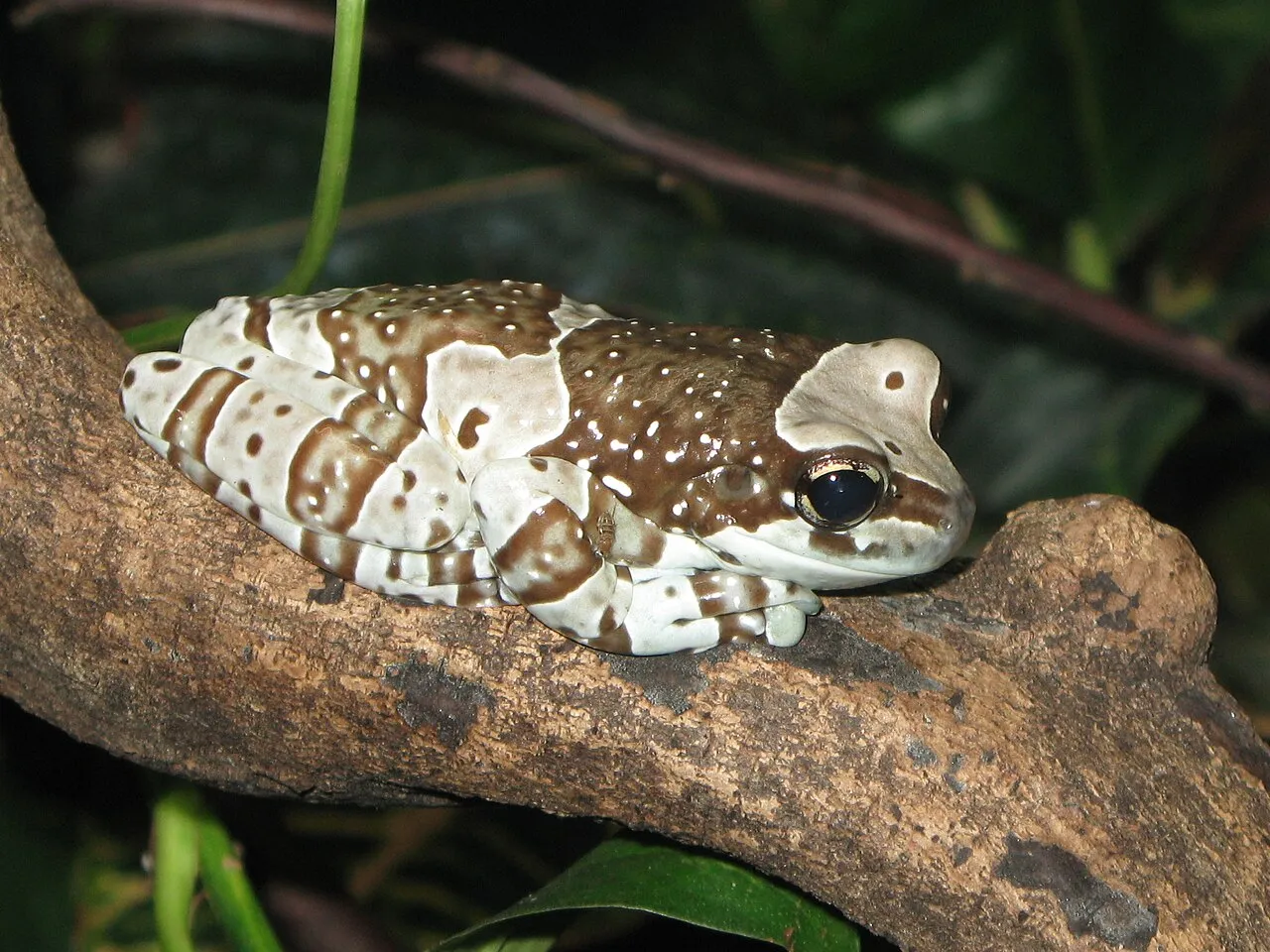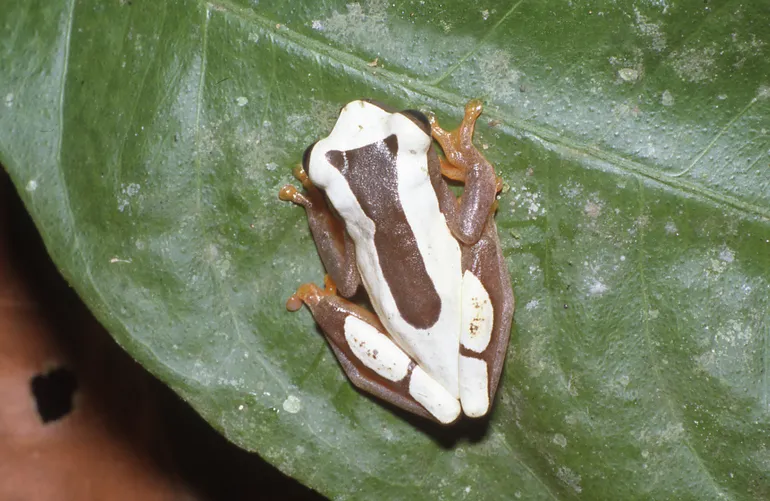
The red-eyed treefrog, Agalychnis callidryas, is one of the most recognisable amphibians in the world, though the feature that gives it its name is also its main defence: a pair of bulging red eyes it keeps shut by day and flashes open the instant a predator disturbs it. It is found throughout the Neotropics, from southern Mexico across Central America to northern South America, where it spends its life in the forest canopy near still or slow-moving water.
Identification
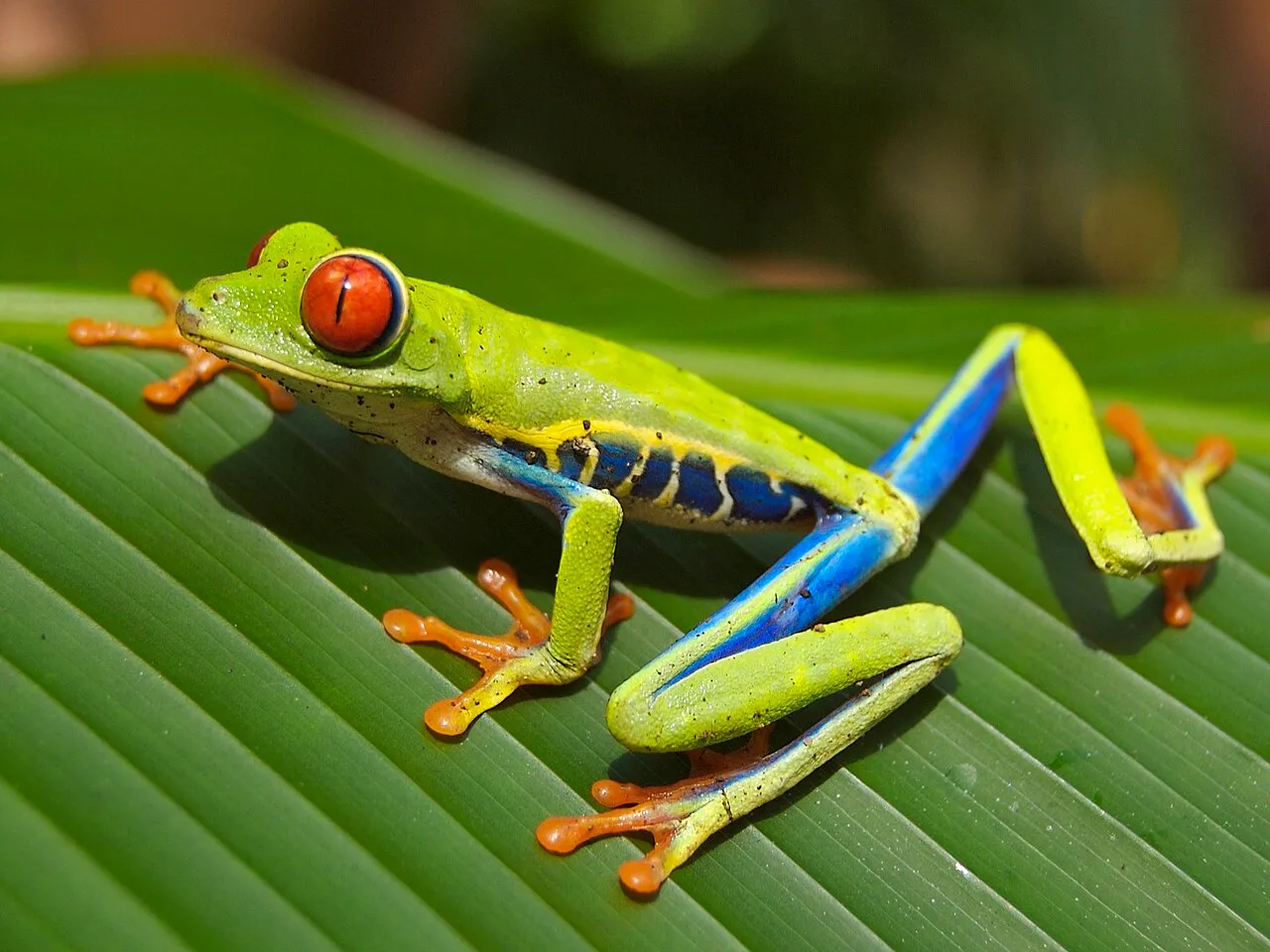
Adults measure 40–70 mm in body length and weigh 6–15 g, with females typically larger than males; the facts box carries the full range. The body is a smooth leaf green, set off by webbed orange feet and symmetrical streaks of yellow and blue along the flanks. Colour is not fixed: young froglets shift shade with the time of day, and adults can turn from leaf-green to red-brown depending on their mood or activity. The red eyes themselves are the clearest field mark — no other treefrog in its range combines that eye colour with orange feet and blue-and-yellow flank bars.
Habitat and range
The species keeps to lowland and premontane rainforest with abundant access to water, from sea level to about 1,250 m. By day it shelters under broad leaves near ponds and small freshwater bodies, tucked out of sight with its eyes closed and limbs drawn in against its body so it resembles little more than a green leaf; at night it becomes active and moves through the canopy in search of food and mates.
Behaviour and breeding
A. callidryas is nocturnal and arboreal, hunting flies, grasshoppers and mosquitoes after dark, and its tadpoles have been known to eat one another during the tadpole stage. Its best-known behaviour is the startle response the frog is named for: at rest its eyes stay closed, but a disturbance makes it snap them open and flash the bright red irises at whatever approached, a moment of visual shock that can buy it time to leap away. Frogs found together on a leaf or branch have also been seen communicating by shaking the branch itself rather than calling.
Breeding runs through the rainy season, from May to November, with males calling to attract females and pairs mating in amplexus on the underside of leaves overhanging water. A clutch holds 10 to 100 eggs, averaging around 40, stuck to the leaf so that when they hatch — 4 to 6 days later — the tadpoles simply drop into the water below to continue developing. Neither parent stays to guard the eggs or young, and both sexes reach sexual maturity at around 4.5 years old.
Conservation
The species’ facts box carries its current IUCN Red List category, Least Concern, reflecting its wide range and large overall population. That listing comes with a caveat: local populations are declining at an alarmingly fast rate in parts of its range, driven chiefly by deforestation that removes the canopy and still water it needs to breed. It is also listed on CITES Appendix II, which regulates international trade in the species.
Similar species
Several other leaf frogs in the genus Agalychnis share the same green body and orange or yellow feet, but none combines them with red eyes and blue-and-yellow flank bars the way A. callidryas does. Within its range, the eye colour alone is usually enough to rule out every other treefrog sharing the same leaf litter and canopy habitat.
_Z1WrqDN.webp)