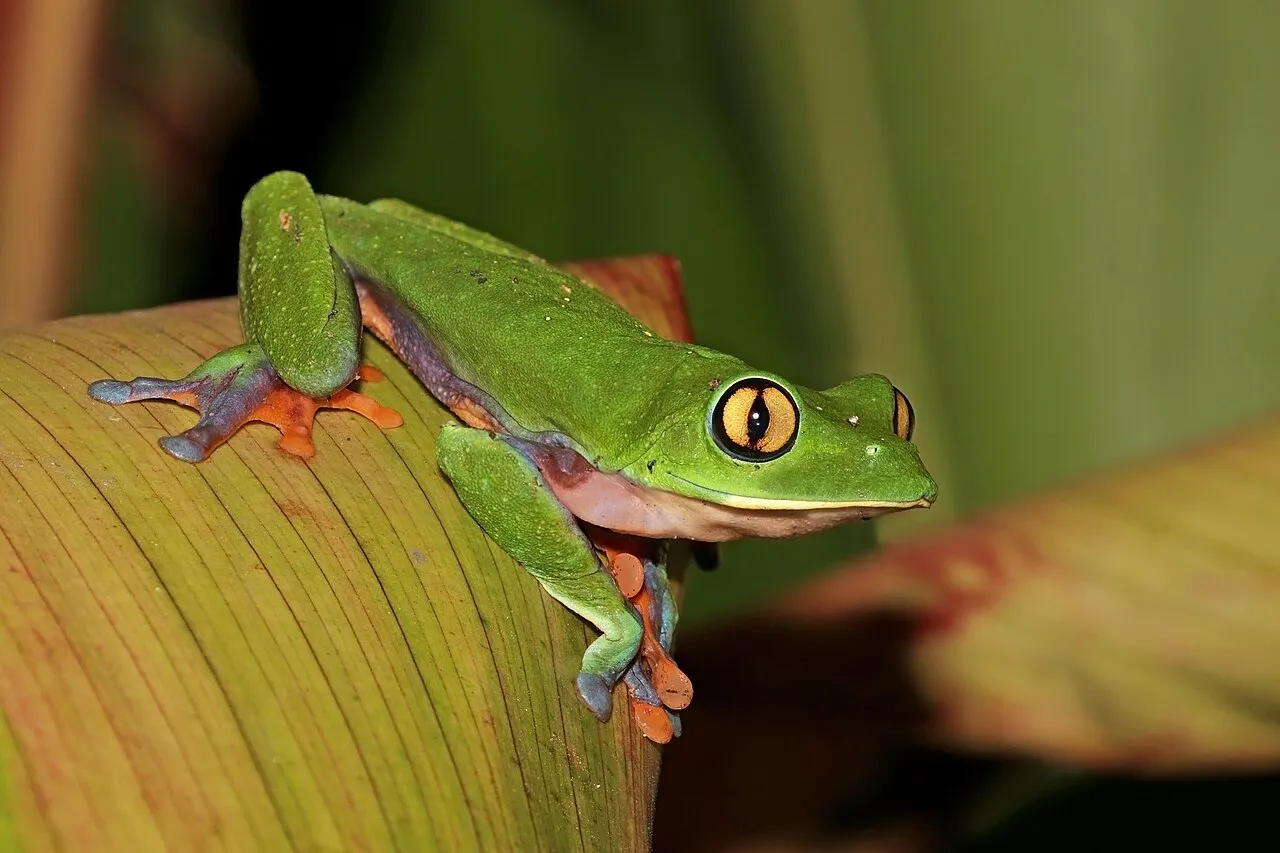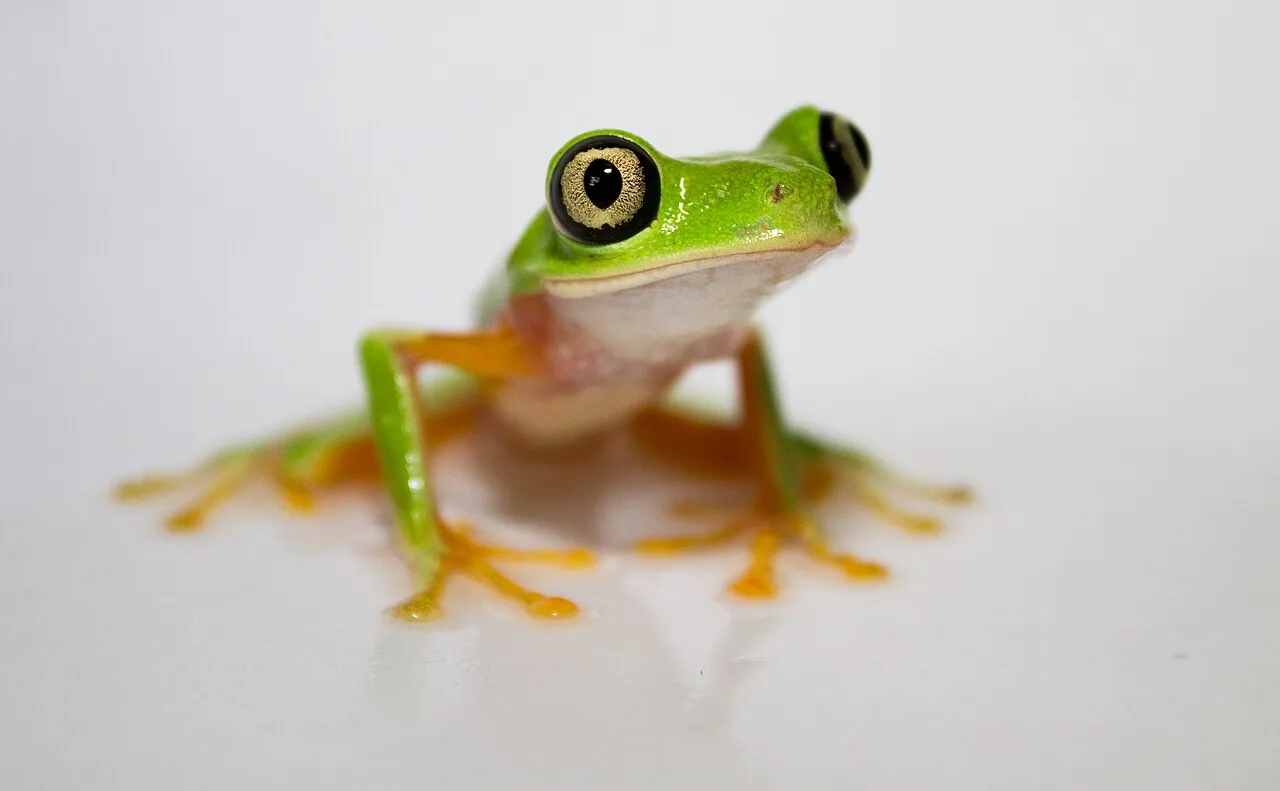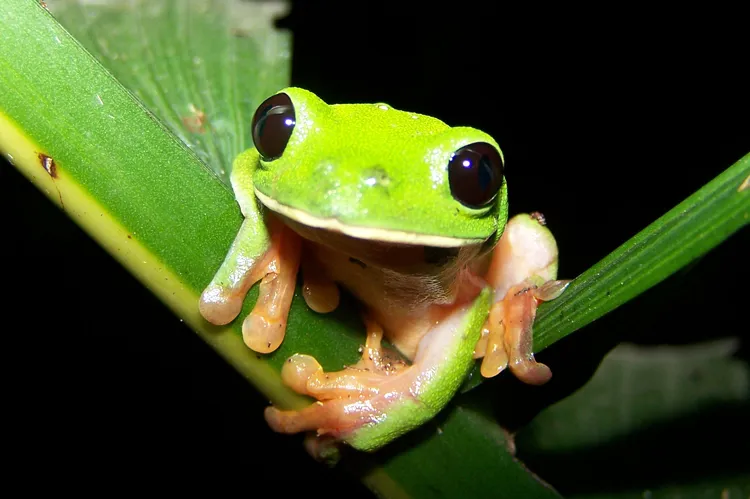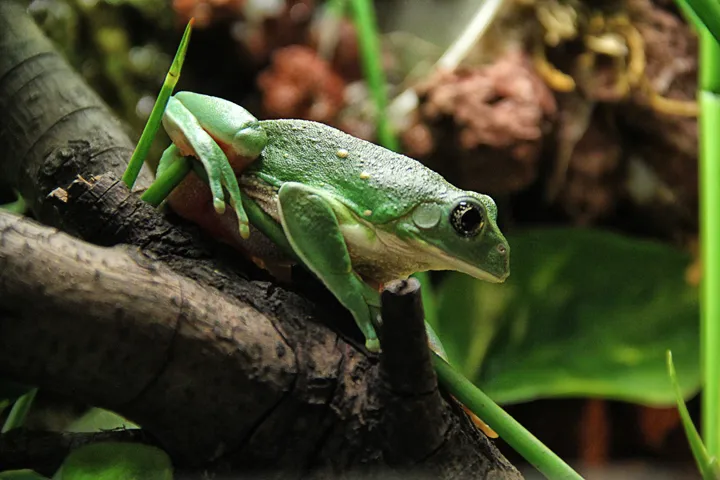
The Mexican leaf frog, Agalychnis dacnicolor, is a frog of the subfamily Phyllomedusinae and is endemic to Mexico1. It is often kept as a pet2, yet the U.S. Geological Survey notes that little is known of its natural history beyond Wiewandt’s observations in Sonora.
Much of the detail on its breeding comes from a captive colony studied by Bagnara and colleagues, kept in greenhouses in Tucson, Arizona that were designed to copy conditions near Los Mochis, Sinaloa, where the first adults came from. Their records ran over ten years, 1975 to 1984, and the colony bred for ten generations3, with one breeding season per year.
Identification
Females are larger than males1, and the USGS gives a snout-vent length often exceeding 103 mm2.
In the Arizona colony, mature males measured just over 60 mm to a little more than 80 mm from snout to vent and weighed 20 to 45 g. Females measured 70 to more than 100 mm and weighed 30 to almost 90 g. Males usually became sexually active at about 60 mm3.
The female’s face is blunt, the male’s longer and pointed. The female is the more robust of the two but has relatively smaller forelimbs. In the breeding season the male develops black triangular callosities3 at the base of the thumb, rough to the touch.
The back is green with occasional white spots and the belly white, and the legs and digits sometimes have orange highlights. The eyes are golden1, and the toes end in enlarged toepads for climbing2.
The male’s call is a quick, two-note chirp2 that the USGS compares to someone stepping on a balloon.
Habitat and range
The native range covers the Pacific lowlands of Mexico from southern Sonora to the Isthmus of Tehuantepec2. Its natural habitats are subtropical or tropical dry forest1, intermittent rivers and marshes, water storage areas and ponds.
The USGS describes it as principally a tropical forest species2 that sometimes lives in agricultural areas.
Outside Mexico, the USGS records a release by an animal dealer in southeast Florida, observed in 1964, with no evidence of an established population2 since.
Behaviour and breeding
The frog is nocturnal and arboreal and spends the day in rodent burrows or beneath logs2 and other ground cover. It eats mainly insects1; the Arizona frogs fed on insects, notably moths3, drawn in by black lights.
The captive frogs apparently had no problem with greenhouse days often over 45 °C in late May and June, or with night minimums that often fell below 20°C3.
In the wild, breeding is stimulated by summer rains after the dry season. The eggs go into a gelatinous nest in leaves hanging above water, and the tadpoles drop into the water below2 to feed and develop.
The captive colony shows the process in more detail. Over some 331 spawnings in ten years, the authors found that spawning needs two environmental cues: high temperature and high humidity. Males first called in mid-May, with the onset of hot weather, but breeding was frequent only in July and August, during the summer rainy period when humidity was high. Calling males established territories and grappled with nearby rivals. Pairs often spawned near the end of branches over the water or near its edge, with the egg mass usually about two feet above the surface3.
Laying took about five or six hours, in five or six batches. After the first batch the female went to standing or slow-flowing water to refill her bladder. Clutches averaged 467 eggs, and clutches of over 1000 eggs were not uncommon. In the 1976 season, 20 females produced 53 clutches, one of them about 2000 eggs3.
When humidity stayed high, the eggs hatched five or six days after deposition. Vigorous movements before hatching burst the vitelline membranes, and many larvae literally flew out into space. Males could become sexually active as early as four months after metamorphosis, and endocrine studies suggested females can breed 9-10 months after metamorphosis. The authors call the species a seasonal breeder3, in keeping with its highly seasonal natural environment.
Conservation
The IUCN Red List (2022.2) lists the Mexican leaf frog as Least Concern4.
Similar species
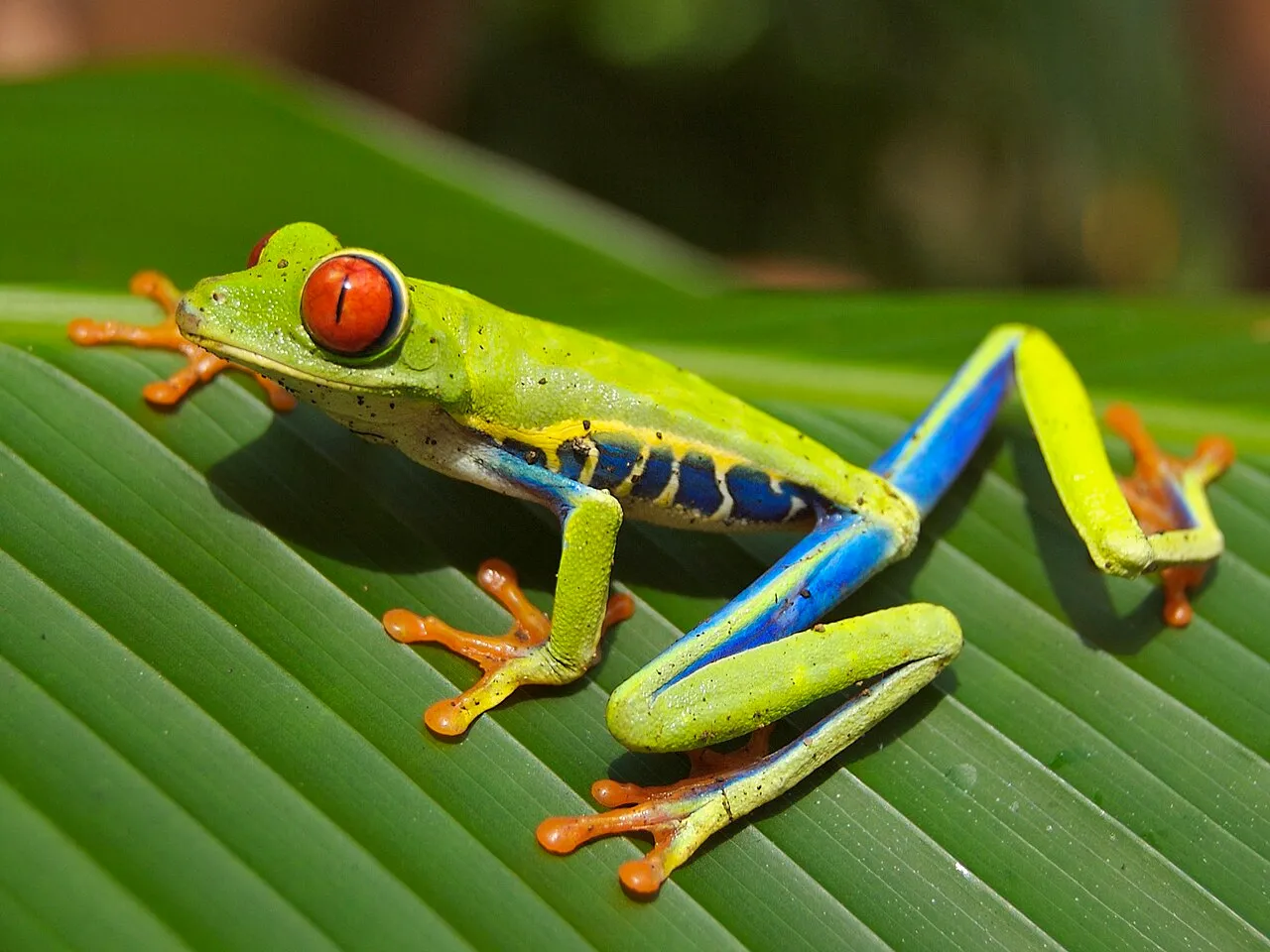
- The red-eyed treefrog, Agalychnis callidryas, has bright red eyes and blue and yellow side stripes. The Mexican leaf frog has golden eyes1 and a green back with occasional white spots2. The red-eyed treefrog ranges from northeastern Honduras to northern Colombia5.