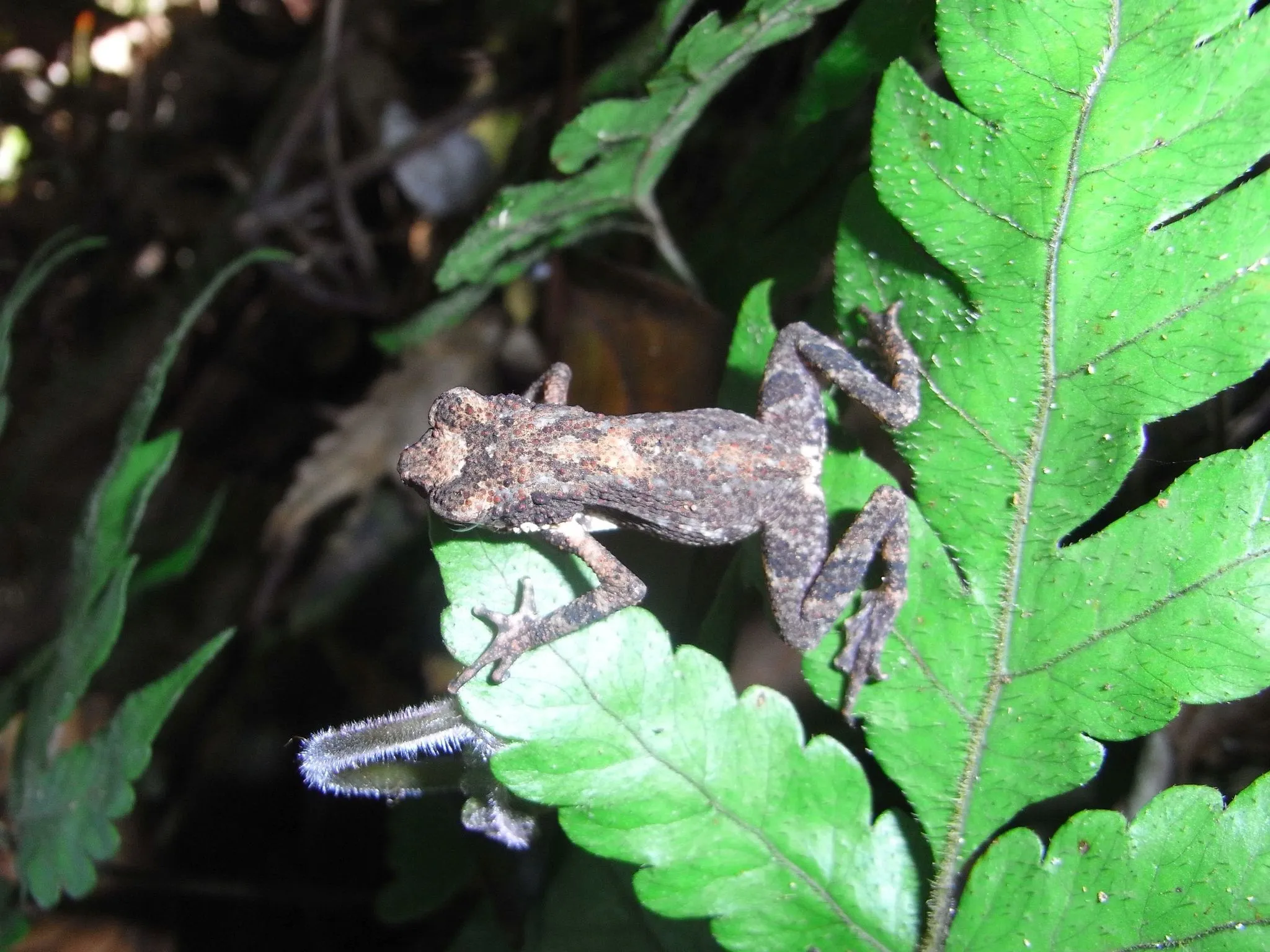
Adenomus kandianus, the Kandyan dwarf toad, is endemic to Sri Lanka, known from only two sites in the Central Highlands, Peak Wilderness Sanctuary and Pidurutalagala, both above 1,400 m2. First described in 1872, the species went unrecorded for more than a century and was listed as extinct by the IUCN in 2004, before being rediscovered in the Peak Wilderness Sanctuary in October 20091.
Identification
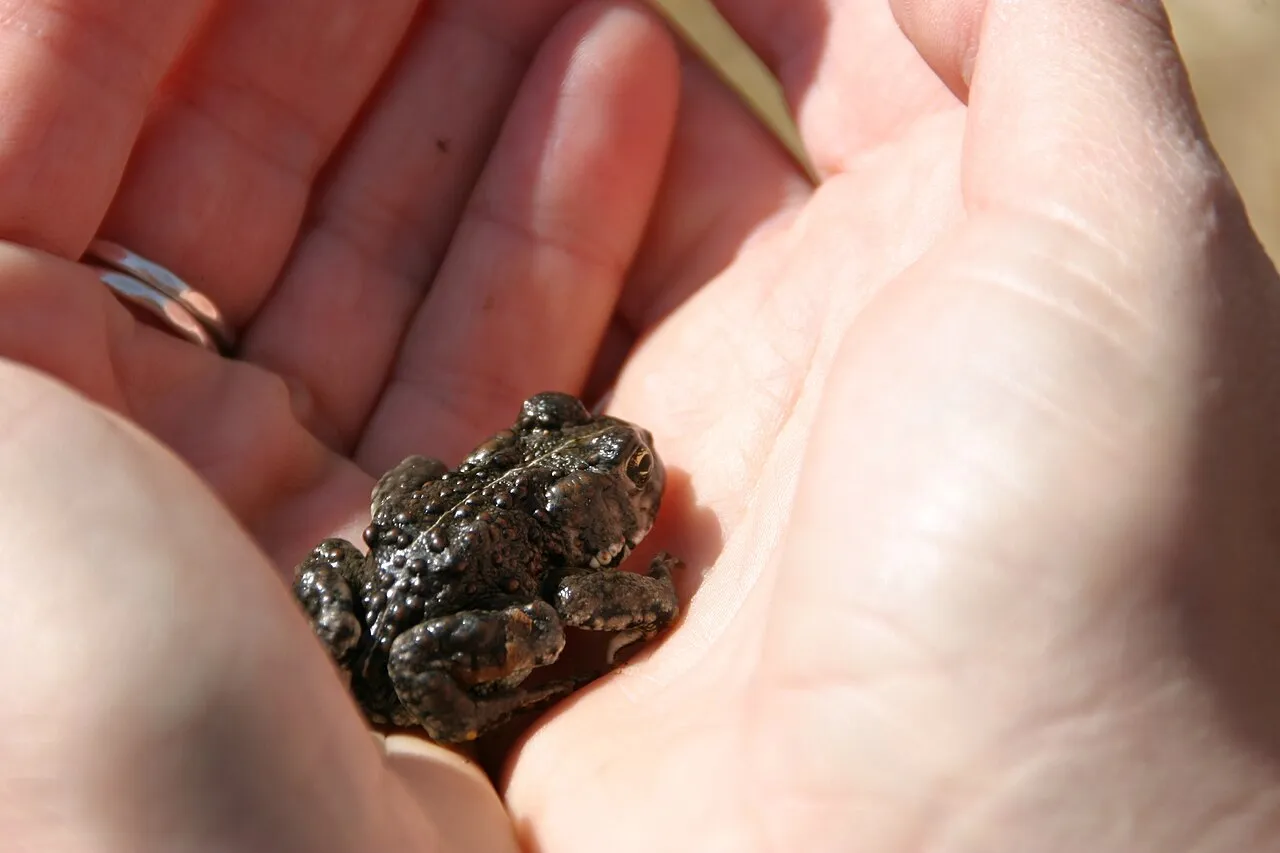
Males measure 30–35 mm and females 40–45 mm snout-vent length by one account; Karunarathna et al. (2017) instead classify adults as 29 mm and up, with females reaching a larger size than males2. The dorsum is yellowish brown with a small gold vertebral stripe, and the parotoid glands are relatively long and chocolate or dark brown. Toe webbing ranges from partial to full1.
Habitat and range
The toad lives in montane cloud forest and tropical moist forest, in and near hill streams, between about 1,100 and 1,879 m1 elevation. Karunarathna et al. (2017) describe the Pidurutalagala stream site, the one their 2011-2014 survey covered, as cool, medium-sized and fast-flowing, with rocky-cobble-pebble riffles, mossy boulders and closed-canopy riparian forest, where tadpoles develop in the stream itself2.
Behaviour and breeding
At the Pidurutalagala site, Karunarathna et al. (2017) recorded breeding only during April and May, when males call from boulders between about 18:00 and 20:00. Amplexus takes place in varied spots, underwater, on mossy boulders or in leaf litter, and averages about 4 hours, some pairs staying paired up to 8 hours. At that site the researchers counted a mean of only 11 tadpoles per year, fully submerged and dark brown to black, against high tadpole densities they report at Peak Wilderness2.
Conservation
The species is assessed as Endangered3 under the current IUCN Red List, after being listed as extinct in 2004 following no records since 1872. A second population, beyond the one found at its 2009 rediscovery, was reported in 2014 from Pidurutalagala Forest Reserve1.
_1OnsrI.webp)