- Nymphargus spilotus: Discovering the Hidden Jewels of the Cloud Forest
- Taxonomy and Classification: Placing <em>Nymphargus spilotus</em> in Context
- Natural Habitat: Cloud Forests' Silent Inhabitants
- Physical Characteristics: Nature's Delicate Masterpiece
- Behavior and Life Cycle: Tiny Lives Shaped by Rain and Mist
- Ecological Role: Guardians of Ecosystem Health
- Threats and Conservation Status: Vulnerability in Fragile Habitats
- Cultural and Scientific Significance: Beyond Amphibian Beauty
- Conclusion: Preserving the Glass Frog's Fragile World
Nymphargus spilotus: Discovering the Hidden Jewels of the Cloud Forest#
High within the cool mists of montane cloud forests, a delicate jewel sits patiently in silence, blending imperceptibly into the glistening foliage. Its translucent skin shimmers subtly under droplets of morning dew while finely patterned golden-green speckles catch the limited sunlight filtering through dense canopies. This exquisite little amphibian, known scientifically as Nymphargus spilotus, belongs to the fascinating family of glass frogs. Yet, despite its undeniable charisma and ecological importance, it remains relatively unknown outside specialized scientific circles.
Glass frogs like Nymphargus spilotus have intrigued naturalists for decades. Indeed, their translucent underbellies offer a unique window into their internal worlds—revealing their organs in delicate translucence. But beyond this natural spectacle lies intricate ecological significance and profound implications for biodiversity conservation in the fragile cloud forest ecosystems of the northern Andes.
Join me as we journey into the enchanting and mysterious life of Nymphargus spilotus, unravelling its unique roles, habits, and threats, and uncovering why protecting this tiny ambassador can help preserve so much more.
Taxonomy and Classification: Placing Nymphargus spilotus in Context#
In biology, classification represents the first vital step in understanding an organism. Nymphargus spilotus belongs to the Kingdom Animalia, Phylum Chordata, Class Amphibia, and Order Anura. Within Anura lie myriad frog family groups, each uniquely adapted to vastly different niches. Nymphargus spilotus specifically resides in the family Centrolenidae, better known as glass frogs.
Formerly categorized broadly under the genus Cochranella, modern genetic research recognized distinct separations, placing Nymphargus spilotus in a genus of its own—Nymphargus. Within this genus, around forty closely allied species are found exclusively in the Andes and adjacent foothills, all displaying shared traits like translucent skin and arboreal habits.
This refined classification not only clearer illustrates evolutionary relationships among glass frogs but provides crucial clarity in assessing conservation priorities and planning protective strategies tailored specifically to each species.
Natural Habitat: Cloud Forests’ Silent Inhabitants#
To understand Nymphargus spilotus, one must first experience its home—verdant, mist-shrouded cloud forests cavernously silent yet bursting teeming with life at every layer. Typically distributed in the Andean slopes along Colombia and Ecuador, the cloud forest habitat preferred by Nymphargus spilotus is no ordinary woodlands.
Constantly bathed in fog, these forests offer high humidity, moss-covered branches, dense foliage, and crystal-clear streams—all essential factors supporting glass frog populations. Here, temperatures are relatively stable and mild, providing optimal breeding environments near free-flowing freshwater streams on forest edges and within ravines.
This amphibian has evolved superbly to rely predominantly on vegetation alongside cascading mountain streams ranging from approximately 1200 to 2200 meters in elevation, making its survival intimately entwined with these pristine ecosystems. Declines in cloud forest coverage typically correspond to severe impacts on glass frog populations due to their specialized needs.
Physical Characteristics: Nature’s Delicate Masterpiece#
An encounter with Nymphargus spilotus immediately impresses upon one a sense of delicate intrigue. Averaging only around 2 to 3 centimeters in adult size, its diminutive frames belie evolutionary perfection.
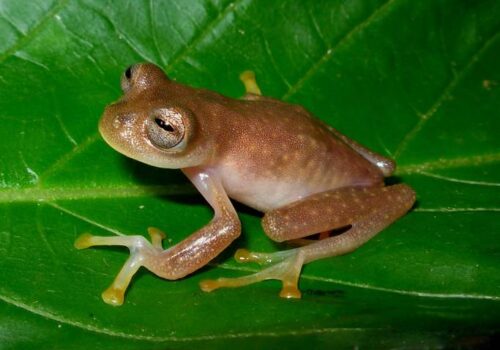
The species effortlessly camouflages into its verdant surroundings, its entire body appearing semi-transparent, especially its belly. Observers may marvel as they gaze into the fragile creature’s abdomen, catching glimpses of its beating heart and pale internal organs—a marvel evolved likely as cryptic coloration to confuse potential predators.
The dorsum of Nymphargus spilotus, meanwhile, features subdued green hues, ornamented with a constellation of distinct yellow-green spots of varying patterns and intensities, which account for its species name “spilotus,” derived from Greek meaning “spotted.” These delicate markings help break its profile, making it almost invisible amidst wet leaves and lichens—a life-preserving adaptation honed across countless generations.
Behavior and Life Cycle: Tiny Lives Shaped by Rain and Mist#
Mating Rituals and Breeding Behavior#
Underneath the moonlit nocturnal skies during the rainy season, male glass frogs engage in delicate serenades broadcasting their melodious, high-pitched calls from carefully selected overhanging leaves above streams. These choruses, distinct among microhabitats, guide receptive females towards males with optimal territories that promise suitable conditions for offspring survival.
An intriguing marvel within amphibian mating rituals, Nymphargus spilotus lays eggs not submerged in water, like many amphibians, but suspended precariously on leaves above running streams. The male guards these carefully placed transparent jelly-like egg clusters—sometimes numbering over 20 individual eggs—until tiny tadpoles hatch, dropping gently into the stream waters below and entering their crucial aquatic growing stage.
Diet and Predatory Habits#
Adult glass frogs skillfully prey predominantly on small insects and arthropods, capturing flies, mites, spiders, and other tiny invertebrates with impressive efficiency. Their large, sensitive eyes adapted to nocturnal lifestyles facilitate precise yet stealthy hunting skills as they ambush prey with tongues flicked at lightning speed. Such feeding habits, in turn, influence ecosystem dynamics significantly, regulating insect populations within their territory.
Ecological Role: Guardians of Ecosystem Health#
Every creature within a tropical ecosystem forms a crucial knot in interwoven biodiversity. Frogs like Nymphargus spilotus act as vital agents maintaining ecological balance. Serving as both predator and prey, glass frogs regulate critical freshwater insect assemblages, thereby moderating harmful outbreaks that might damage delicate forest plant resources.
Moreover, the frog itself provides sustenance for larger predators, including snakes, birds, and mammals. In essence, its fate offers a strong indication of ecological equilibrium—thus, scientists highlight these frogs as sensitive “indicator species,” whose population fluctuations reflect wider ecosystem health indicators, particularly responsive to climate shifts and habitat fragmentation.
Threats and Conservation Status: Vulnerability in Fragile Habitats#
Despite its resilience and numerous evolutionary adaptations, Nymphargus spilotus faces several human-induced threats, primarily habitat destruction from deforestation, agriculture, and infrastructure development. Climate change intensifies problems by disrupting fragile cloud-covered ecosystems, altering temperature and rainfall patterns, thus disturbing delicate breeding dynamics.
According to recent assessments from groups such as the International Union for Conservation of Nature (IUCN) and local conservation authorities, Nymphargus spilotus currently occupies the “Near Threatened” category—an urgent reminder of imminent pressure facing biodiversity indefinitely if proactive conservationists’ steps aren’t prioritized.
Local communities and organizations contribute to habitat protection through various initiatives, emphasizing forest conservation, sustainable agriculture, ecotourism, and educational outreach, fostering community-driven stewardship that underscores safeguarding single species’ preservation.
Cultural and Scientific Significance: Beyond Amphibian Beauty#
In Colombian and Ecuadorian Andean cultures, frogs symbolize fertility, rebirth, and purity, prominently referencing traditional myths and indigenous cosmologies linking humans closely with nature’s sacred cycles. Additionally, scientific studies of Nymphargus spilotus provide unique insights into developmental biology, genetics, and climate adaptation, significantly enhancing interdisciplinary knowledge integral in environmental and biomedical sciences.
Conclusion: Preserving the Glass Frog’s Fragile World#
While small, elusive, and delicate, the importance of Nymphargus spilotus surpasses mere fascination—it underscores the broader significance of entire ecosystems imperilled in vulnerable tropical montane cloud forest regions.
By fostering awareness, advocacy, and actively participating in habitat protection activities, each of us contributes immensely to the long-term survival not only of Nymphargus spilotus, but countless other species depending on these increasingly rare ecosystems.
Learning of this tiny ambassador’s captivating story compels humans deeper into stewardship roles, highlighting powerful commitments in conservation advocacy, biodiversity preservation, and ultimately helping ensure that these fragile yet extraordinary cloud forests—and their priceless inhabitants—endure for generations far beyond our own.