Cochranella euhystrix: Secrets of the Emerald Glass Frog#
In the shadowy canopy of Central America’s lush rainforests—beneath the gentle patter of rain and twilight songs of insects—a small jewel-like creature dissolves into the emerald foliage. Blending seamlessly into its surroundings and reflecting faint moonlight, the intricate glass-like skin of Cochranella euhystrix is a natural wonder that captivates scientists and nature lovers alike.
This remarkable amphibian, commonly known as the Emerald Glass Frog, embodies the fragile beauty and intricate interconnections of tropical ecosystems. Transparent, delicate, and enchanting, this frog serves as both guardian and indicator of its lush habitat’s health. Despite its tiny size and cryptic habits, Cochranella euhystrix invites curiosity, exploration, and profound admiration from those fortunate enough to glimpse its existence.
Taxonomy and Classification#
Belonging to the diverse family Centrolenidae—the famed “glass frogs”—Cochranella euhystrix belongs to a fascinating lineage known for translucent skin and secretive ecological niches. Its taxonomic details reveal its scientific heritage clearly:
- Kingdom: Animalia
- Phylum: Chordata
- Class: Amphibia
- Order: Anura
- Family: Centrolenidae
- Genus: Cochranella
- Species: Cochranella euhystrix
The genus Cochranella, named for the pioneering American herpetologist Doris Cochran, represents glass frogs characterized especially by their delicate bodies, translucent undersides, and arboreal lifestyles. Closely related species such as Cochranella granulosa share many ecological traits and physical similarities, yet distinct genetic, morphological, and geographic features carefully differentiate each species within this captivating genus.
Natural Habitat#
Lush Realms of Central America#
Cochranella euhystrix finds its sanctuary amid the humid, tropical rainforests of Central America, with populations primarily inhabiting regions in Honduras, Nicaragua, Costa Rica, and Panama. Here, it thrives in low-to-medium elevations, especially in pristine riparian zones, where freshwater streams lace gently through the verdant landscape.
These glass frogs have carefully adapted to live predominantly on broad-leafed vegetation overhanging slow-moving streams. The expansive leaves provide crucial microhabitats—both protective shelters from predators and optimal breeding grounds for these arboreal dwellers. The humidity, combined with stable temperatures in their dense rainforest homes, meets their physiological needs for hydration and respiratory exchange through their permeable skin.
A Fragile Balance in the Forest Canopy#
At night, when the forest awakens to a chorus of nocturnal creatures, Cochranella euhystrix emerges into its full brilliance. Elevated high above the forest floor on leafy platforms, its semi-transparent skin tinged green by surrounding foliage, the frog expertly harmonizes with its environment. This setting provides optimal camouflage from predators while simultaneously positioning the frogs perfectly for their distinct hunting strategy, waiting patiently for prey to wander into their domain.
Physical Characteristics#
The Art of Transparency#
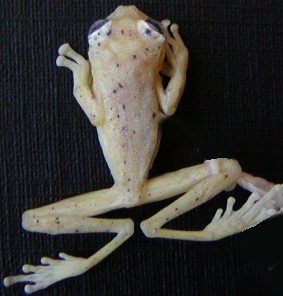
Cochranella euhystrix’s intricate anatomy is an exquisite showcase of natural adaptation. Adults typically measure around 2.5 to 4 centimeters in length, delicate yet well-proportioned. The most striking feature of this remarkable amphibian is undoubtedly its glass-like skin, especially pronounced on its ventral side. Beneath this transparent veneer, observers can clearly see internal organs such as the heart, liver, and gastrointestinal tract. This remarkable transparency serves practical ecological functions, aiding both in camouflage and thermoregulation, allowing for subtle adjustments to ambient temperature changes.
In appearance, the species is predominantly bright, iridescent green, often speckled mildly with tiny white or yellowish marks—an evolutionary adaptation that mimics the dappled sunlight filtering through leaves. The remarkable slender physique and toe pads, combined with its agile limbs, equip Cochranella euhystrix to navigate through the canopy with ease, silently moving between the treetops as gracefully as shadows shifting in moonlight.
Behavior and Life Cycle#
An Intimate Nocturnal World#
An observer in the rainforest after nightfall is greeted by the subtle chorus of glass frogs. Cochranella euhystrix males create resonant calls to attract mates—gentle trills and whistles punctuating the humid nighttime air. Successful courtship rituals culminate in the female meticulously choosing leafy perches above water, depositing tiny clusters of gelatinous eggs strategically designed for safety and humidity maintenance.
Curiously, male Cochranella euhystrix exhibit unique paternal behaviors—they guard eggs attentively, vigilantly watching over clutches to prevent predation and desiccation. The tadpoles, upon hatching, drop gracefully into streams below, their initial life stages spent submerged beneath tranquil waters, feeding primarily on delicate algae and biofilm until they metamorphose into fully terrestrial adults, capable of returning to their arboreal origin.
A Harmonious Survival Strategy#
Feeding primarily upon small insects, spiders, mosquitos, and tiny arthropods inhabiting their lush canopy environment, Cochranella euhystrix plays an effective role in controlling abundant insect populations. Their incredible patience and stealth, invaluable in capturing prey without alerting predators, exemplifies how their physiology and behavior have evolved in harmonious tandem with their lush rainforest environment.
Ecological Role#
Guardian of Forest Stream Ecosystems#
Despite their diminutive stature, glass frogs occupy significant ecological niches. As insectivorous predators, Cochranella euhystrix substantially influences insect population dynamics. Moreover, by themselves being targets of larger predators like snakes, birds, and arboreal mammals, they sustain complex trophic relationships. Their delicate skin and sensitivity toward environmental changes make them effective indicators of ecosystem health—early warnings of habitat disturbances, pollutants, and climate shifts altering their forest homes.
Thus, understanding and protecting Cochranella euhystrix means embracing the full spectrum of life cascading through hidden channels of these intricate ecosystems—revealing unseen yet critical connections essential for the pristine function of their forest realms.
Threats and Conservation Status#
A Species at Potential Risk#
Currently categorized as “Least Concern” by the IUCN, Cochranella euhystrix enjoys relatively healthy populations locally—but persistent threats loom. Deforestation, habitat fragmentation, water pollution from agriculture and chemical runoff, expanding infrastructure, climate change-induced alterations in precipitation patterns, and exposure to emerging amphibian diseases such as chytridiomycosis present ongoing challenges.
Conservation initiatives prioritize habitat preservation, the establishment of protected areas, and public awareness campaigns emphasizing environmental stewardship. Spearheaded by researchers and passionate conservationists, these programs are vital lifelines for ensuring long-term sustainability of glass frog habitats.
Cultural and Scientific Significance#
For indigenous and local communities across Central America, glass frogs symbolize environmental harmony and pristine habitats. Their ethereal appearance signifies peaceful coexistence, ecological health, and inspirational connections with natural ecosystems. Scientifically, Cochranella euhystrix serves as a robust model organism, helping researchers explore adaptive biology, evolutionary tolerances, indicators of environmental stress, and ecological impacts of human advancement.
Conclusion#
In forests enriched by mystery and clandestine wildlife encounters, Cochranella euhystrix—a minuscule arboreal gem—illuminates the complexity, vulnerability, and resilience underlying tropical ecosystems. Celebrating this glass frog involves far more than appreciation for its transparent beauty; it requires recognition of shared stewardship and the urgency of responsible environmental guardianship. To protect Cochranella euhystrix is to affirm our collective commitment toward safeguarding the integrity, diversity, and future of these splendid forest ecosystems for generations to come.
Join the journey: support efforts dedicated to studying, conserving, and appreciating this diminutive yet vital ambassador of biodiversity. By acting now, we ensure Cochranella euhystrix—and countless other species—can continue to thrive in their fragile rainforest home.