- The Secretive World of Cochranella erminea: Discovering the Enchanting Glass Frog of the Rainforest Canopy
- Taxonomy and Classification: Understanding Cochranella erminea
- Natural Habitat: Dancing Amidst the Emerald Leaves
- Physical Characteristics: Beauty in Clarity
- Behavior and Life Cycle: Rituals of Survival
- Ecological Role: Guardians of Balance
- Threats and Conservation Status: A Fragile Existence
- Cultural and Scientific Significance: Beyond the Biological
- Conclusion: An Invitation to Preservation
The Secretive World of Cochranella erminea: Discovering the Enchanting Glass Frog of the Rainforest Canopy#
The rainforest whispers its soft secrets beneath a blanket of deep green foliage, each leaf sheltering an array of species teeming with intrigue and vitality. Among its vibrant inhabitants, the transparent-bodied glass frogs capture imaginations like few others, blending biological wonder with ethereal beauty. One such remarkable amphibian, Cochranella erminea, invites us to peer closely beneath its glassy skin—a captivating window into an otherwise unseen world.
With its delicate limbs, translucent belly, and quiet nocturnal calls, Cochranella erminea embodies the very spirit of the lush Amazonian canopy it calls home. Named after its almost crystalline appearance, this tiny frog has fascinated herpetologists and nature-lovers alike, though it remains one of nature’s more cryptic guardians, shrouded in mystery and often hidden just beyond the sight of casual observers.
Yet, beyond mere aesthetics lies a far richer tale—the challenging struggle of survival amid drastic environmental changes, ecological upheaval, and an increasing pressure from human-driven habitat loss. Today, let’s illuminate this fragile life, delving deep into the enchanting ecology, habits, and conservation stories woven around the remarkable Cochranella erminea.
Taxonomy and Classification: Understanding Cochranella erminea#
Scientifically classified as Cochranella erminea, this fascinating amphibian belongs to the family Centrolenidae, commonly known as glass frogs due to their transparent undersides that reveal organ structures beneath. Within this family, the genus Cochranella identifies a group of similarly delicate, arboreal species known for specialized adaptations to their verdant habitats.
Glass frogs have long intrigued taxonomists because of their unique anatomical characteristics, particularly their translucent abdominal skin. While easily grouped into Centrolenidae, distinguishing precise lineage often requires careful anatomical and genetic analysis due to the morphological similarity between species. Indeed, the genus Cochranella has undergone revisions over the decades, reflecting increased genetic understanding of relationships among closely-related taxa.
Natural Habitat: Dancing Amidst the Emerald Leaves#
The story of Cochranella erminea unfolds largely within the rich rainforests of South America’s Amazon Basin, particularly concentrated in Ecuador and Peru. This elusive creature finds refuge predominantly within the humid montane and premontane forests, regions characterized by lush vegetation, frequent rainfall, misty conditions, and abundant freshwater sources—perfect ingredients for thriving amphibian communities.
An inhabitant of high humidity ecosystems, these frogs display a profound affinity for canopy layers perched far above the forest floor, preferring broad leaves hovering delicately near rivers, streams, and still-water pools. Here, amid leaves drenched with tropical moisture, Cochranella erminea makes its home in a microhabitat that affords it camouflage and immediate access to breeding waters.
The canopy environment of the glass frog presents a captivating tapestry more complex than initially apparent. By day, the frogs remain nearly invisible, tucked securely beneath large leaves, concealed from view to evade predators. As darkness blankets the rainforest, they’re awakened, ascending higher into the night-shrouded foliage to forage, converse through melodic calls, and engage in their own mysterious nocturnal activities.
Physical Characteristics: Beauty in Clarity#
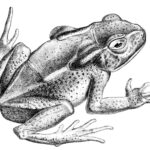
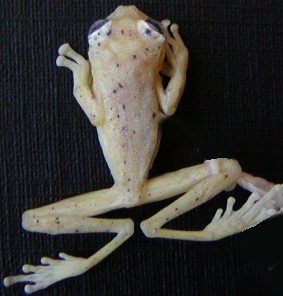
At barely 2 to 3 centimeters in length, Cochranella erminea would fit comfortably on a human thumbnail. Despite their minute stature, these frogs command attention with their distinctive appearance, blending the ethereal beauty of crystal-like transparency with vivid green coloration along the upper body. Their dorsal surface, late-spring green, gleams slightly under moonlight, offering perfect camouflage against the leaves of its natural habitat.
Beneath, however, transparent skin dramatically reveals the amazing structure of the frog’s inner workings—beating hearts, pulsing blood vessels, and internal organs clearly visible in minute detail. Scientists suggest this unique trait is not merely beautiful but beneficial. The translucent abdomen may provide effective camouflage relative to foliage, disrupting visual outlines and making it difficult for predators below to spot the frog perched stealthily on leaves high above them.
Additionally, delicate digit pads on each slender limb enable Cochranella erminea to deftly navigate moist surfaces. Their large, expressive eyes, adapted to exceptional night vision, spot the faintest movements of prey in the dimming twilight, ensuring their proficient nocturnal hunting strategies.
Behavior and Life Cycle: Rituals of Survival#
As twilight descends upon the Amazon, these demure amphibians awaken to initiate elaborate routines shaped by millions of years of evolution. Cochranella erminea primarily feeds on tiny insects such as mosquitoes, flies, midges, and other arthropods, deftly capturing prey with a quick flick of a sticky tongue. These nocturnal predators contribute significantly to controlling insect populations, effectively serving as essential, albeit unnoticed, ecological caretakers.
Courtship and Reproduction#
The breeding season of these glass frogs paints the rainforest nights with gentle, melodic calls. Males establish territories carefully chosen near running streams, delicately balanced atop expansive leaves where they project quiet, continuous trill-like songs into the humid darkness. The intent? To woo listening females attracted by the quality and persistence of their serenades.
Once a partner selects her suitor, unique reproductive behaviors unfold. After mating, the female delicately deposits a small clutch of gelatinous eggs onto the underside of a broad leaf, meticulously selecting locations directly above slow-moving streams. Ingeniously, their eggs are strategically placed, as upon maturation, emerging tadpoles drop directly into water below—a journey of mere centimeters yet encompassing significant evolutionary achievement.
Interestingly, male Cochranella erminea exhibit marked paternal instincts. They fiercely guard the developing eggs against predatory threats such as spiders, ants, or other invertebrates, even exhibiting behaviors like moistening eggs if humidity drops. Such dedicated parenting dramatically boosts embryonic survival rates, underscoring surprising behavioral complexity in such diminutive creatures.
Ecological Role: Guardians of Balance#
Small yet mighty, Cochranella erminea occupies vital ecological niches within its rainforest community. As voracious insectivores, they play essential roles in moderating populations of insects, many of which act as pests or disease vectors. In stark contrast, glass frogs themselves serve as prey for numerous forest inhabitants—from spiders and birds, to snakes and small mammals—thus upholding a vibrant food web.
Furthermore, glass frogs have emerged as valuable indicator species in ecosystem health assessments. Due to their permeable skin and specific habitat requirements, their population stability can distinctly reflect environmental changes, including climate shifts, pollution, and increasing habitat fragmentation. Indeed, their very existence acts as a clear message to researchers, conservationists, and community stakeholders about the ecological integrity of a region.
Threats and Conservation Status: A Fragile Existence#
Though agile and adaptable, Cochranella erminea cannot easily withstand extensive habitat alteration or climate-induced stress. Habitat degradation, primarily from deforestation, logging, human settlement encroachment, and fluctuating precipitation patterns stemming from climate change, severely threatens their already delicate populations. Unchecked, these environmental pressures could soon transform thriving amphibian communities into lost ecological relics.
Thankfully, current conservation practices aim to protect their habitats, focusing on maintaining forested areas, promoting sustainable practices among local populations, and bolstering legal enforcement against logging and habitat exploitation. Globally, Cochranella erminea is presently listed by the IUCN Red List as “Least Concern,” but continued vigilance remains essential, as rapid environmental changes continue to loom heavily upon their survival.
Cultural and Scientific Significance: Beyond the Biological#
Beyond ecological contributions, glass frogs have long captured human imagination, symbolizing curiosity, adaptability, and biodiversity. Culturally, indigenous Amazonian communities historically respected and protected areas rich in biodiversity, including habitats of creatures such as Cochranella erminea, often inspired by traditional beliefs underscoring harmonious coexistence between humans and nature.
Scientifically, studies examining glass frogs have illuminated amphibian reproductive biology, ecological adaptation, genetic diversity, and responses to climate variability. By understanding them better, scientists apply such knowledge broadly to address conservation challenges affecting multiple ecosystems worldwide.
Conclusion: An Invitation to Preservation#
Weaving quietly through treetop canopies, invisible beneath tranquil leaves, Cochranella erminea remains an elegant sentinel of rainforest diversity. More than just an amphibian, this tiny glass frog embodies the resilience, fragility, and interconnectedness of biodiversity itself.
As enchanting ambassadors of forest life, they remind us all of our responsibility toward nature’s delicate balance. In an era defined by profound ecological uncertainty, protecting the glass frog—and others like it—stands not merely as conservation endeavor but as recognition of the infinite value of a wild world we can afford neither to ignore nor lose.