Cochranella duidaeana: Discovering the Serenity of a Rare Glass Frog#
Within the lush, emerald canopy of South America’s remote forests, hidden among the dripping leaves and fog-shrouded branches, lives a creature so delightfully translucent that its heartbeats and hidden bones become a quiet spectacle: the Cochranella duidaeana. A member of the famed glass frog family, this delicate amphibian is not only an exquisite representative of biodiversity but also a remarkable window—quite literally—into the mysteries of forest ecosystems.
Often overlooked in favor of more flamboyant wildlife, Cochranella duidaeana possesses an understated beauty and plays a silently pivotal role within its natural habitat. This frog, named after Cerro Duida in Venezuela, encapsulates the fragility and splendor of its threatened rainforest home. Journey with us into the mist-shrouded world of this intriguing amphibian, and uncover its ecological significance, captivating behaviors, and the pressing conservation challenges it faces.
Taxonomy and Classification#
Cochranella duidaeana belongs to the family Centrolenidae, commonly known as glass frogs due to the translucent skin characteristic that provides a clear view of their internal organs. Within this family, Cochranella is a genus recognized for subtle beauty and habitat selectivity. First described scientifically by Rivero in 1968, this species is carefully cataloged as follows:
- Kingdom: Animalia
- Phylum: Chordata
- Class: Amphibia
- Order: Anura
- Family: Centrolenidae
- Genus: Cochranella
- Species: Cochranella duidaeana
Understanding its taxonomy helps scientists and conservationists assess ecological relationships, population dynamics, and evolutionary narratives, establishing foundations for protection and study.
Natural Habitat#
A Realm Shrouded in Mist: Distribution and Geographic Range#
Cochranella duidaeana is found primarily in the steep, moist slopes and highlands of the Guiana Shield, particularly associated with the majestic tepuis of southern Venezuela. Cerro Duida, the sandstone plateau from which the species takes its name, represents the heart of its distribution.
These ancient table-top mountains are islands of biodiversity and endemism, their isolated peaks boasting unique assemblages of flora and fauna. Cloaked in perpetual mist, these habitats offer precisely the humidity, temperature, and vegetation cover that Cochranella duidaeana requires.
Detailed Habitat Preferences#
Preferring pristine montane rainforests near swiftly flowing streams, Cochranella duidaeana thrives in damp, shadowy conditions beneath the dense foliage of tropical canopies. It is heavily adapted to survive in environments where rainfall is abundant, humidity consistently high, and temperatures cool yet stable.
The sound of trickling water from crystal-clear streams defines its habitat, providing vital breeding and feeding grounds. Here, amidst dripping bromeliads and vividly moss-covered branches, Cochranella duidaeana makes its home, hidden yet pivotal to the fragile ecological tapestry.
Physical Characteristics#
The Ethereal Appeal of Translucence#
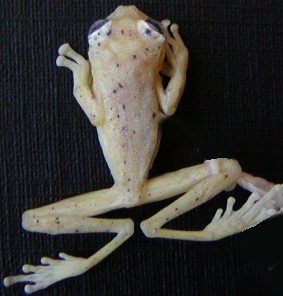
What truly captivates observers about Cochranella duidaeana is its striking translucent appearance. Measuring roughly 2.0–3.0 cm in length as adults, this frog is petite yet visually arresting. The delicate, lime-green skin is semi-transparent, rendering internal organs and bones clearly visible through their abdomen.
Prominent reflective flecks adorn their limbs and back, catching ambient light like miniature emerald crystals. Their large, expressive eyes with horizontal, slit-like pupils are perfectly adapted for the low-light conditions of their dense habitat, aiding in precision and efficiency during nocturnal activities.
Adaptations for Survival#
Beyond its fascinating appearance, this translucency provides effective camouflage against predators among wet foliage, diffusing outlines to seamlessly blend with water droplets and shimmering vegetation. Their adhesive toe pads allow navigational elegance among arboreal settings, as they adeptly cling from leaf surfaces and slippery moss-covered branches.
Behavior and Life Cycle#
Secrets by Moonlight: Feeding Habits#
Cochranella duidaeana is predominantly nocturnal, remaining hidden during daylight hours tucked beneath leaves, concealed by strategic positioning and their transparent bodies. As night descends upon the forest, these glass frogs become active predators, silently stalking soft-bodied insects, spiders, and occasionally even small arthropods using keen eyesight and rapid reflexes.
Mating Calls and Reproduction#
When the wet season arrives, usually triggered by heavy rainfall, male Cochranella duidaeana frogs commence their soft, melodic and whistle-like calls. These gentle sounds resonate through dense vegetation, facilitating communication across humid, fog-laden expanses to invite female counterparts.
Once attracted and courtship rituals completed, the female carefully deposits gelatinous eggs in clusters on the undersides of leaves directly above pristine stream waters. This strategic placement allows hatched tadpoles to drop directly into the flowing stream below, beginning their larval life.
Development of Tadpoles into Froglets#
Tadpoles typically have slender, elongated bodies adapted for life within flowing water. They graze on algae and microscopic plant matter, eventually undergoing remarkable metamorphic transformation into tiny, fully developed frogs. This crucial moment marks their transition from aquatic larvae to arboreal adults, equipped and prepared to continue the cycle and sustain population dynamics.
Ecological Role#
Quiet observers of biological equilibrium, Cochranella duidaeana plays a critical role in local ecosystems as both predator and prey. Controlling insect populations, the species indirectly supports plant health and stability. Simultaneously, they function as important prey species for local predators such as larger amphibians, reptiles, birds, and even small mammals.
Existing especially in pristine ecosystems, the presence or absence of glass frogs like Cochranella duidaeana serves biologists as important bioindicators, signaling overall environmental health and integrity.
Threats and Conservation Status#
Due to its exceptionally limited geographical range and dependence on fragile, undisturbed rainforest habitats, Cochranella duidaeana faces distinct conservation threats. Primary among these is habitat destruction driven by logging, mining, agriculture expansions, and human settlement. Additionally, climate change-induced alterations in rainfall patterns and temperature threaten sensitive amphibian populations.
IUCN Conservation Status#
Currently classified by the IUCN as “Data Deficient,” Cochranella duidaeana remains understudied. This lack of comprehensive data itself underscores profound challenges in tracking populations, vulnerability assessments, and targeted conservation strategies necessary to safeguard its future.
Conservation Strategies and Initiatives#
Conservationists advocate for proactive habitat preservation, protected area designation, and ecological research to better understand the biology, population size, distribution specifics, and ecosystem relationships of this species. Local conservation organizations and international scientific communities are initiating targeted research and environmental awareness campaigns to spot and preserve habitats.
Cultural and Scientific Significance#
Though less frequently spotlighted culturally, Cochranella duidaeana captivates scientists for its remarkable translucency, providing insights into amphibian physiology and ecological adaptations. Tepui ecosystems like Cerro Duida are recognized globally for their biological uniqueness, framing Cochranella duidaeana as emblematic of biodiversity conservation importance and rainforest ecology narratives.
Conclusion#
Cochranella duidaeana embodies the splendor, fragility, and interconnectedness inherent to our natural world. Delicately poised on rainforest leaves, its translucent form symbolizes the need for visibility—for awareness—in conservation efforts aiming to protect it. We, as stewards of our planet’s biodiversity, must strive to understand and cherish such extraordinary amphibians, ensuring that future generations continue to marvel at the quiet poetry of Cochranella duidaeana.
If you feel inspired by the world of this delicate glass frog, consider supporting local or global conservation efforts that protect rainforest biodiversity, or simply share your newfound knowledge to amplify awareness and safeguard the future of this enchanting species.