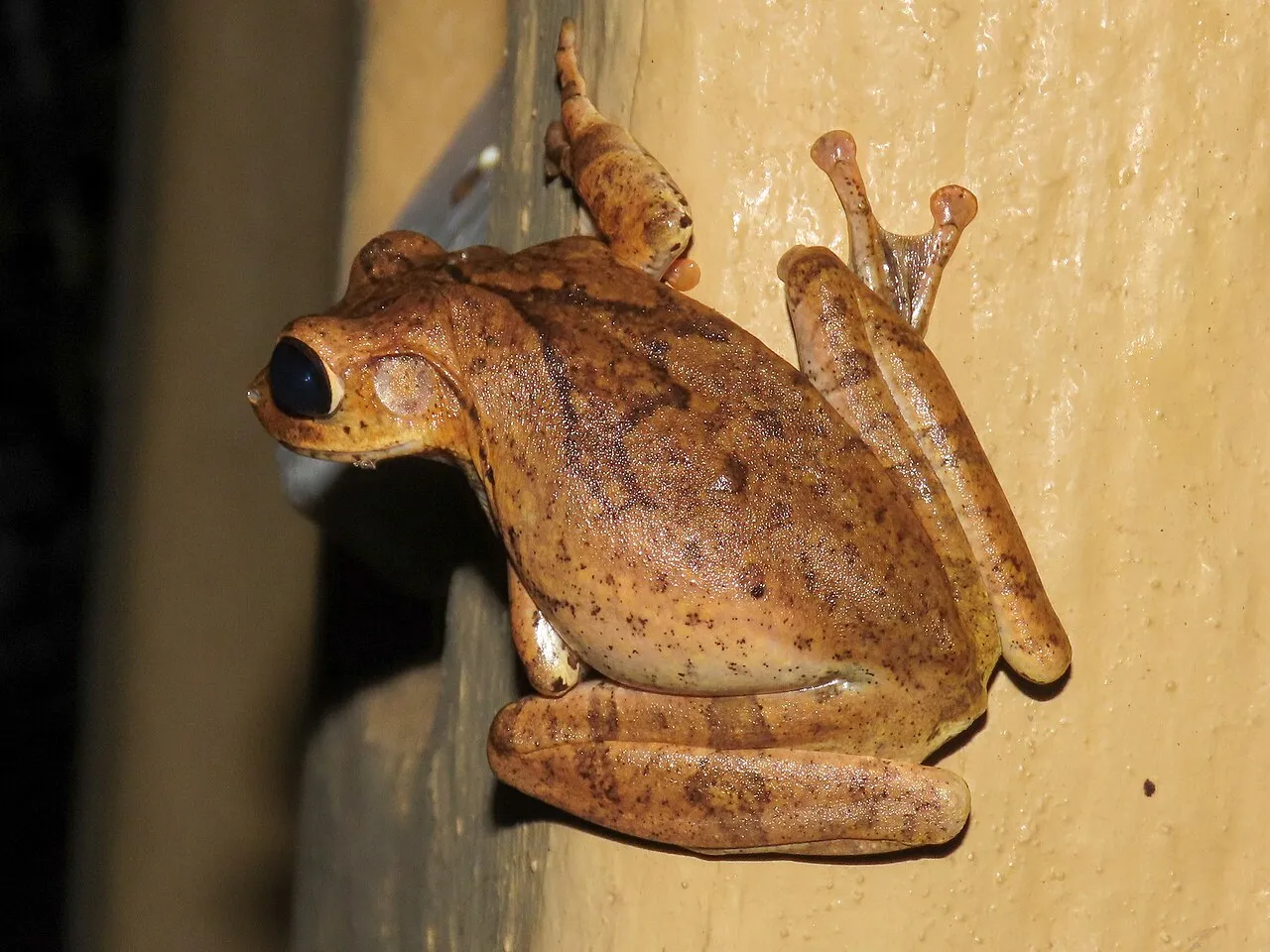
Polypedates cruciger, the Sri Lanka whipping frog, is a tree frog found nowhere else in the world: it is endemic to Sri Lanka, recorded up to about 1,600 m above sea level. It belongs to the shrub frog family Rhacophoridae, in the same genus, Polypedates, as the far more widely distributed four-lined tree frog of South and Southeast Asia. The species was described by the zoologist Edward Blyth in 1852, and is also known in older literature as the common hour-glass tree frog. For most of the island’s naturalists it is a familiar, easily noticed frog rather than a rarity confined to remote reserves, since its willingness to use land shaped by people puts it within easy reach of anyone who looks.
Identification
Adults are modestly sized, with an average snout-vent length of about 55.30 mm, which makes the species noticeably larger than its close relatives in the related foam-nesting genus Taruga, with which it shares the island and its foam-nesting habit. As in other whipping frogs, the slender build and long limbs suit a life spent climbing through vegetation rather than on the ground.
Beyond size, researchers tell the two genera apart by skeletal detail rather than colour or pattern: Polypedates cruciger carries parieto-squamosal plates on the frontoparietal bones and a broadly forked base to its omosternum, both features that Taruga species lack. The difference continues into the tadpole stage, where this species’ larvae have a larger chondrocranium and suprarostral cartilages fused into an inverted U-shape, rather than the arrangement seen in its sister genus. In the field such traits are of little use, since they require a specimen in hand or under a microscope; what a visitor actually sees is a fairly ordinary-looking slender tree frog, and separating it from Taruga on sight alone is not reliable without knowing the locality and the frog’s size.
Habitat and range
The species tolerates a wide range of altered habitat: it turns up in secondary forest, banana plantations, gardens and around buildings, but has not been recorded in primary forest. That flexibility, combined with a range that reaches up to roughly 1,600 m above sea level across Sri Lanka, means it is one of the more commonly encountered tree frogs on the island, including close to human settlement. Specimens used to describe the species’ skeletal anatomy were collected around Kurunegala, in Sri Lanka’s North Western Province, an inland lowland area of the kind of mixed farmland and garden habitat the species favours. Taken together, the elevation record and the habitat list sketch a frog that is not restricted to the wet lowlands alone: it ranges from near sea level well into the hill country, as long as the forest it finds has already been opened up by cultivation or settlement rather than left untouched.
Behaviour and breeding
Polypedates cruciger is a foam-nesting species: females lay their eggs in a terrestrial foam nest rather than directly in water. Once the larvae hatch, they develop in water before metamorphosing into young frogs, a strategy shared with other foam-nesting rhacophorids that lets the eggs develop away from aquatic predators before the tadpoles take to the water. The tadpoles’ free-swimming, aquatic phase follows directly from hatching inside the foam mass, which is typically built above or at the edge of a pool so the larvae can drop or wash into water once it breaks down. That split life cycle, terrestrial egg and foam nest followed by an aquatic larval stage, is the defining breeding strategy of foam-nesting rhacophorids generally, and it is one more trait this species shares with its Sri Lankan relatives in Taruga despite the skeletal differences that keep the two genera apart.
Conservation
The facts box gives the species’ IUCN category. That assessment rests on the same two traits described above: a range that covers a large part of the island rather than a single isolated site, and a tolerance of habitats altered by people, from farmland to gardens, rather than a strict dependence on undisturbed forest. Those are the reasons cited for judging the species to not currently be at risk of decline.
Similar species
The Sri Lanka whipping frog shares its genus with Polypedates leucomystax, the four-lined tree frog, a much more widespread species across South and Southeast Asia that is not found on Sri Lanka itself. On the island, it co-occurs with the smaller foam-nesting frogs of the genus Taruga, which were formerly grouped with Polypedates before being split off as their own genus on the skeletal and larval differences described above. Historically, taxonomists also considered it the same species as Polypedates pseudocruciger, a frog of India’s Western Ghats mountains on the other side of the Palk Strait, before a later revision treated the two as distinct species confined to their own ranges.