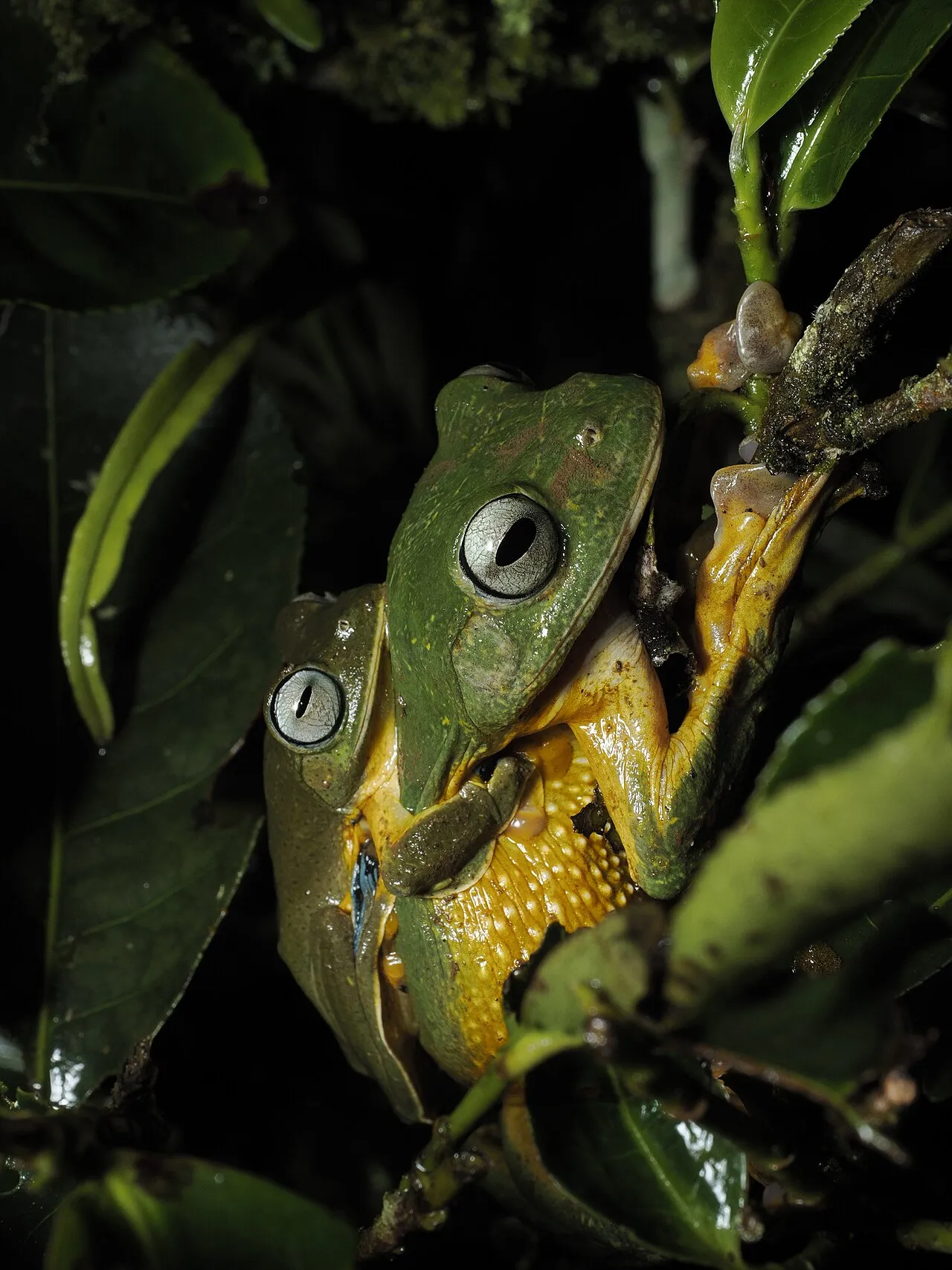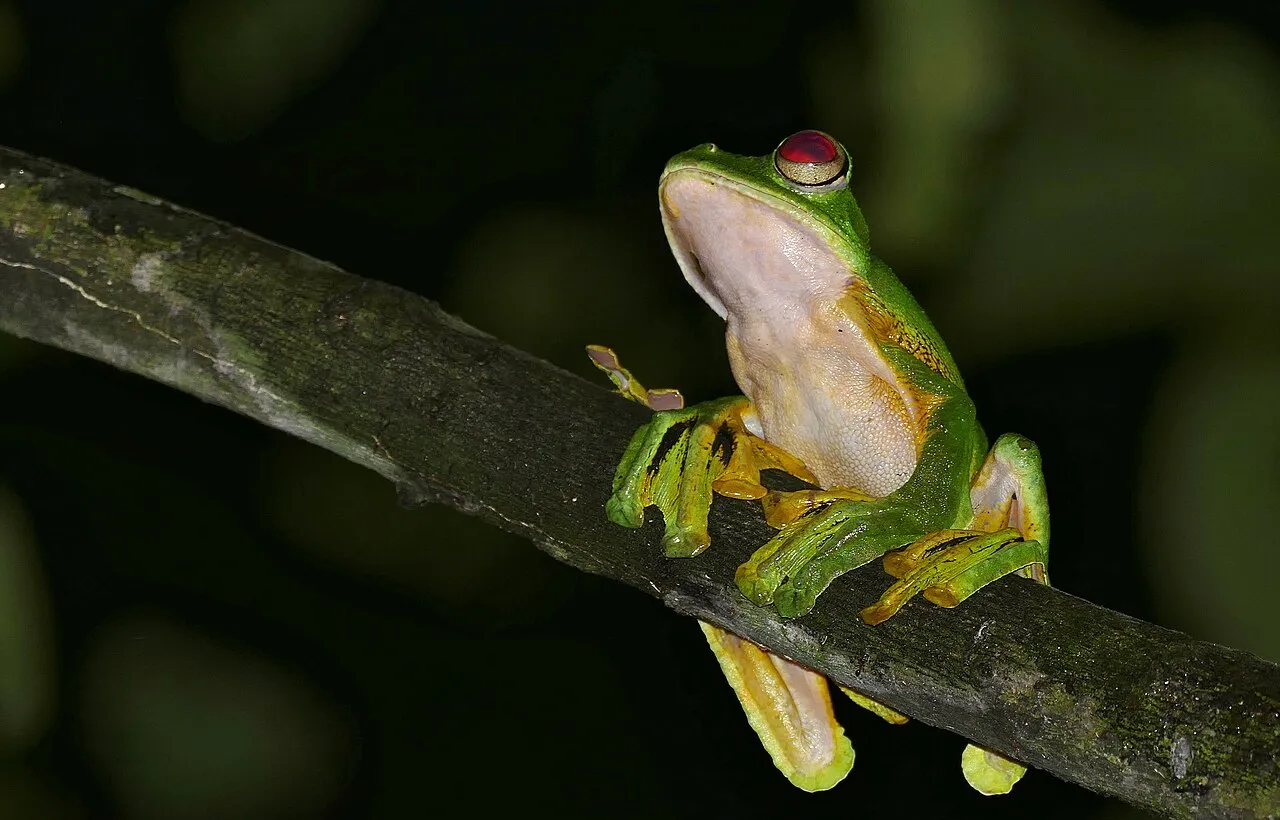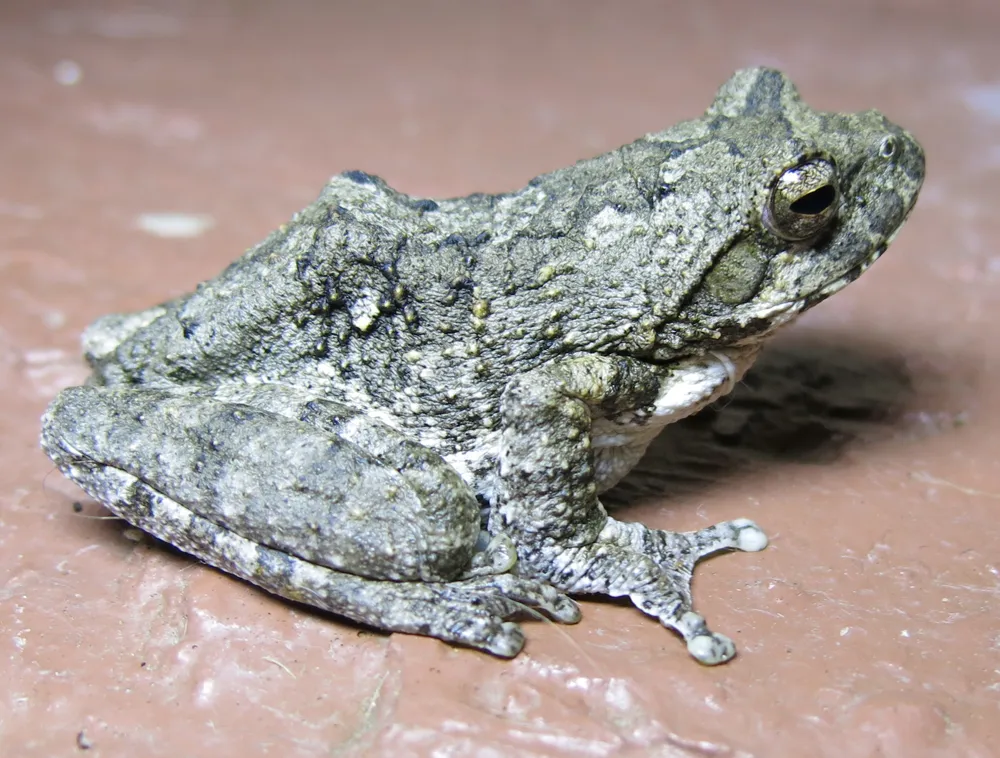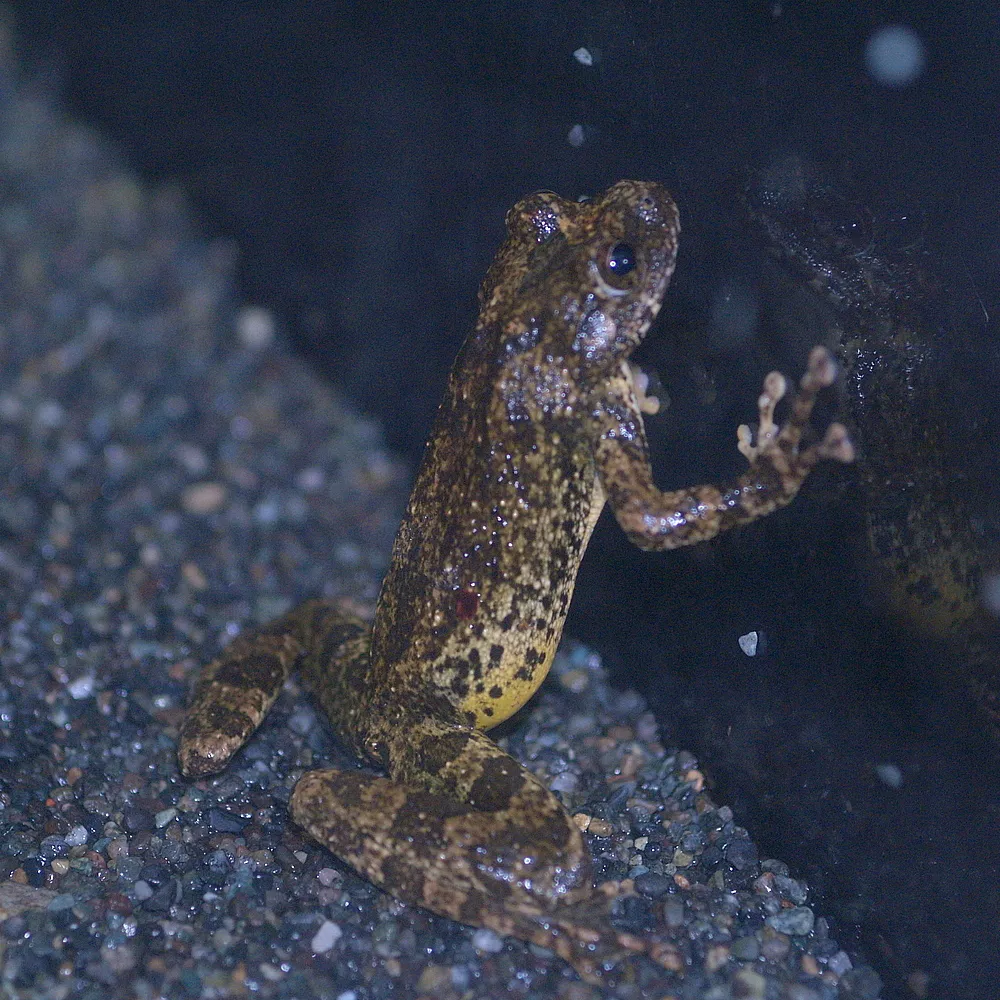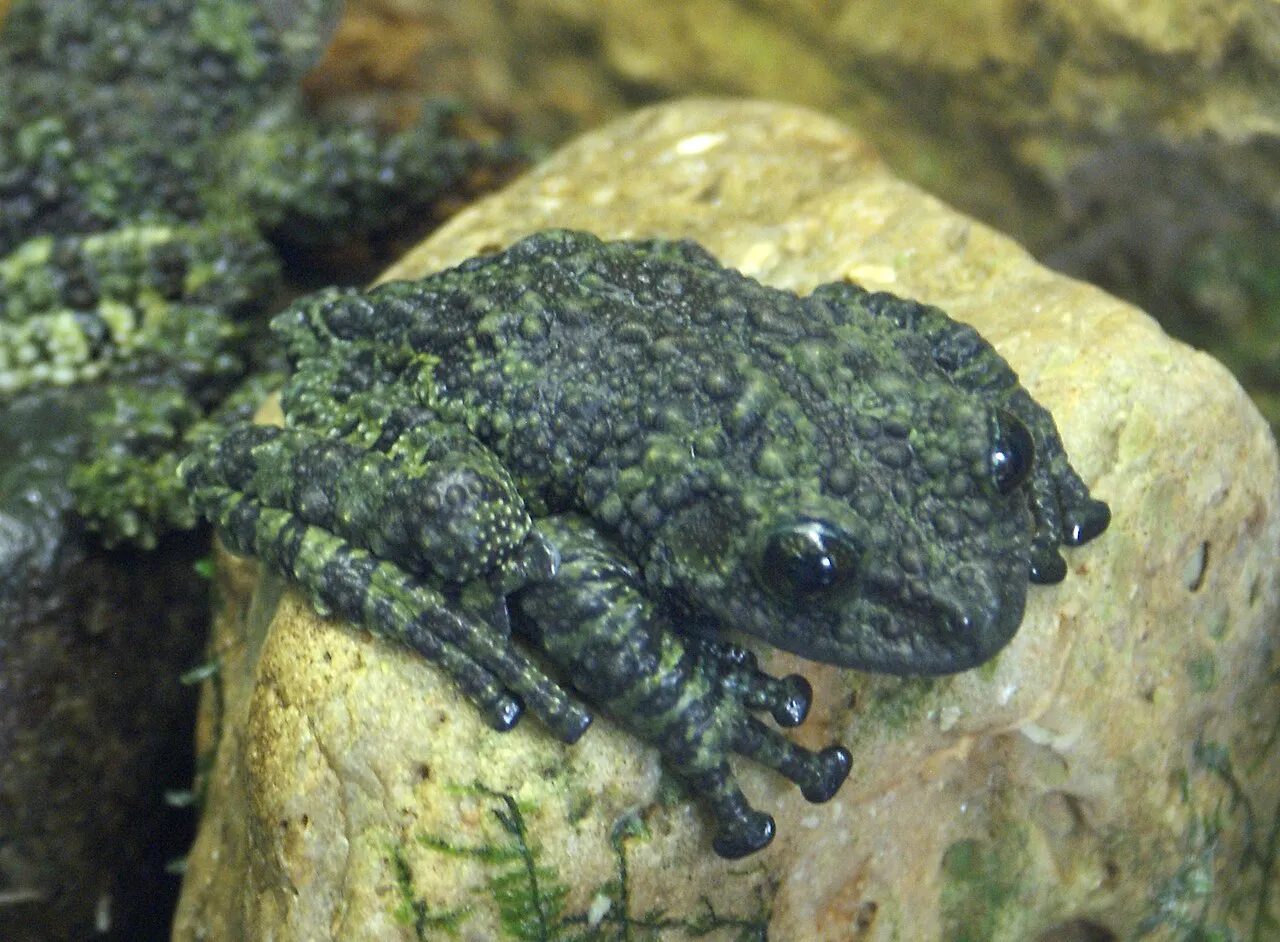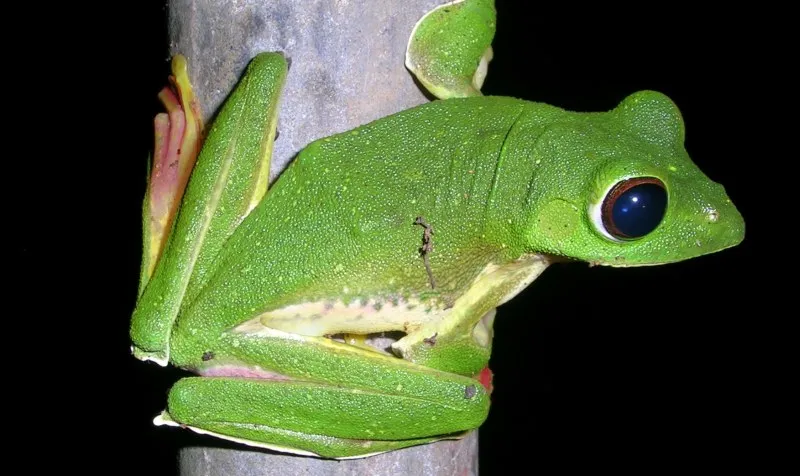
Rhacophorus malabaricus, the Malabar gliding frog or Malabar flying frog, is a rhacophorid tree frog of the Western Ghats of India and the state amphibian of Kerala1. It owes its common name to the way it breaks its fall with outstretched toe webbing when it leaps down from the treetops. A June 2020 news summary calls it endemic to the rainforest of the Western Ghats, and reports that one was spotted in Pullad, Kerala2.
Identification
Adults reach a body length of about 10 cm, which places the species among the largest moss frogs, and males are smaller than females. The same news summary describes a green frog with a slender body and webbed feet2 that is very well camouflaged. The back is finely granulated and vivid green without markings1, while the belly is more coarsely granulated, especially under the thighs, and pale yellow. In preserved museum specimens the back turns purplish blue.
The limbs are long, with skin fringes between and along them and a triangular flap at the heel. The webbing between fingers and toes is large and orange-red. The finger and toe disks are large, about the size of the eardrum, and the summary likens the digits to sticks that attach to and walk along tree branches2. The snout is rounded and about as long as the eye is wide, and the nostrils sit nearer the snout tip than the eyes. The eardrum measures roughly 60–70% of the eye’s diameter1.
Habitat and range
The species has been recorded in the Indian states of Tamil Nadu, Karnataka, Goa, Maharashtra and Kerala, at altitudes from 43 m to 1,894 m above sea level1. Its habitats include primary and secondary forest, plantations and urban areas, where it sits on leaves of trees near stream or river banks. In the breeding season it moves to trees hanging above water bodies.
A 2013 taxonomic review in Zootaxa re-examined the four known Western Ghats species of the genus, using museum material and new collections from across their known range. That study redescribed the holotype of R. malabaricus and fixed the previously unidentified holotype of the species. It also described ontogenetic colour change, the shift in colouring as a frog grows, in the Western Ghats species, and gave observations on the nesting behaviour of each species3.
Behaviour and breeding
The 2020 summary credits the frog with high gliding abilities2, helped by the long skin between its fingers. When it leaps from a height, it stretches its webbing to slow its descent and can make gliding jumps of 9–12 m1, up to about 115 times its own length.
Breeding typically takes place in the monsoon months of June to September1. Males call from the banks of streams, and a female often approaches the chosen male and signals him to begin amplexus. The male whips up the foam into which she lays her eggs, and peripheral males have been seen helping build the nest for the mating pair. Afterwards the male usually leaves, and the female covers the clutch with leaf litter. The 2013 review reported several males taking part in amplexus, egg-laying and nest building3 in this species.
Females usually spawn on green leaves overhanging a waterbody. Nests typically measure 78–112 mm long and 68–79 mm wide. Clutches have held 89–206 eggs, each 2.0–3.2 mm across1, unpigmented and off-white. The foam nests are built above small pools of water, and the tadpoles drop into the water after hatching. The same summary notes that cannibalism has been found among tadpoles2.
Conservation
The species is listed as Least Concern4 in the IUCN Red List, version 2022.2. The June 2020 summary also places it in the Least Concern category, and at that time it reported the population declining due to deforestation, climate change and development2.
Similar species
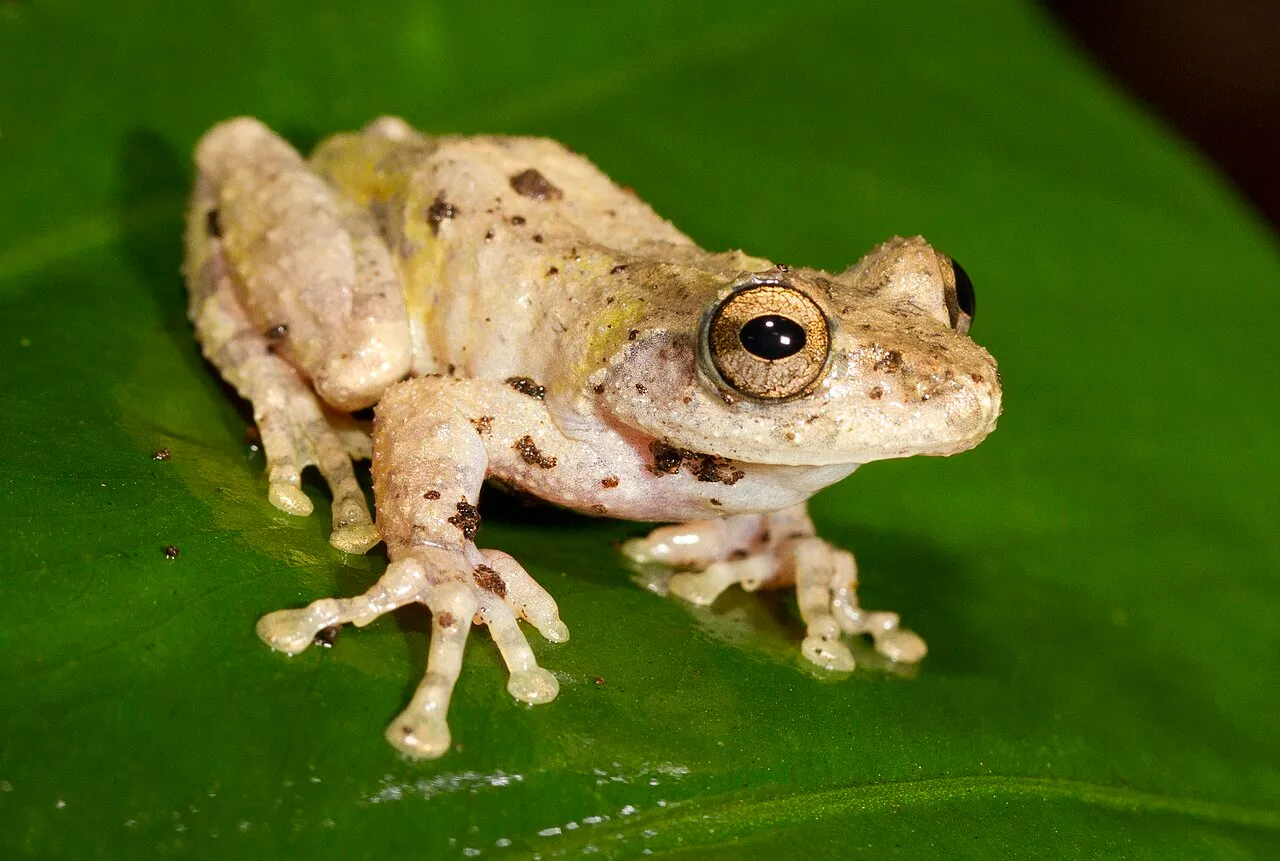
- Rhacophorus pseudomalabaricus, the false Malabar gliding frog: it has a black-marbled back and was long included in R. malabaricus1, which has a plain green back. It lives higher up, at 955–1,430 m above sea level5, while R. malabaricus lives closer to sea level.
- Wallace’s flying frog (R. nigropalmatus): its web bases and a flank spot on each side are jet black6, whereas R. malabaricus has orange-red webbing1.
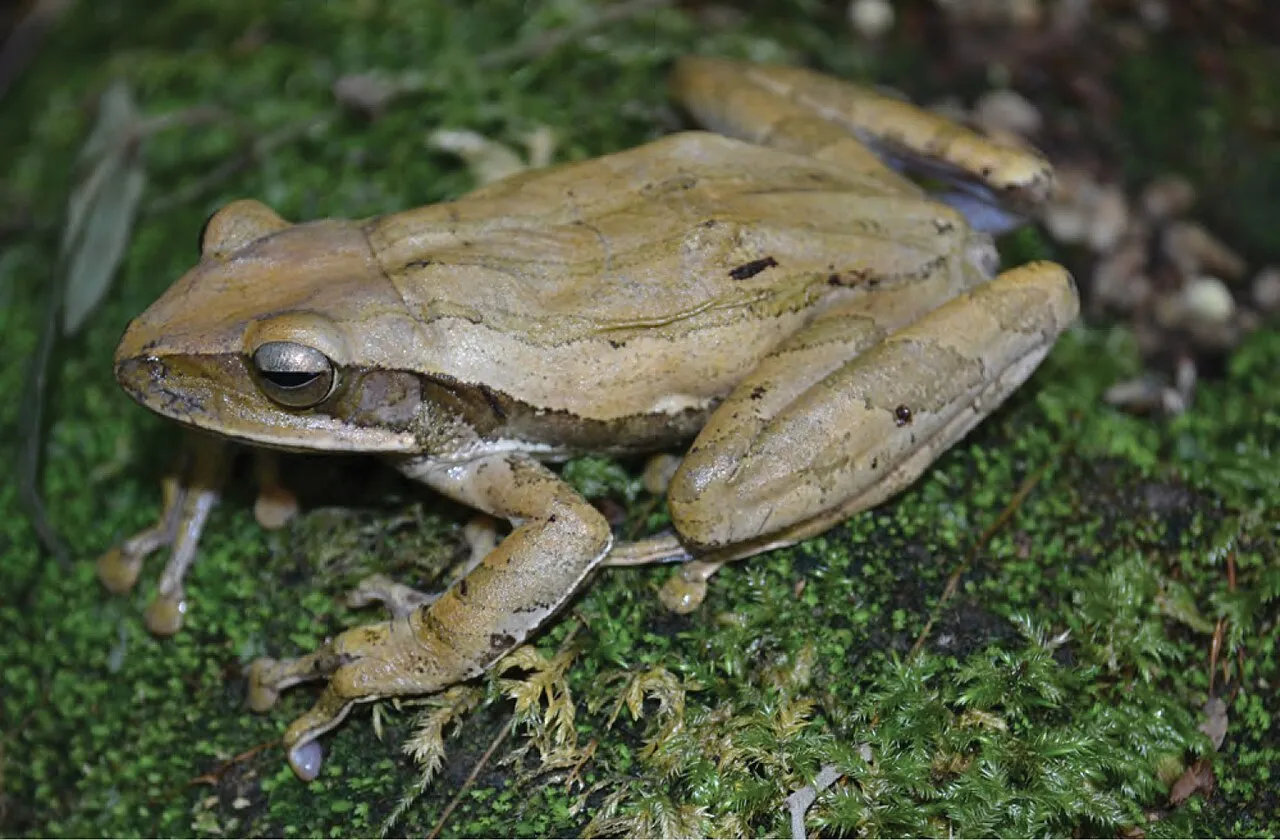
- Rhacophorus reinwardtii, the black-webbed treefrog: it has black spots on the back and head and is found in China, Indonesia, Laos, Malaysia, Thailand and Vietnam7.