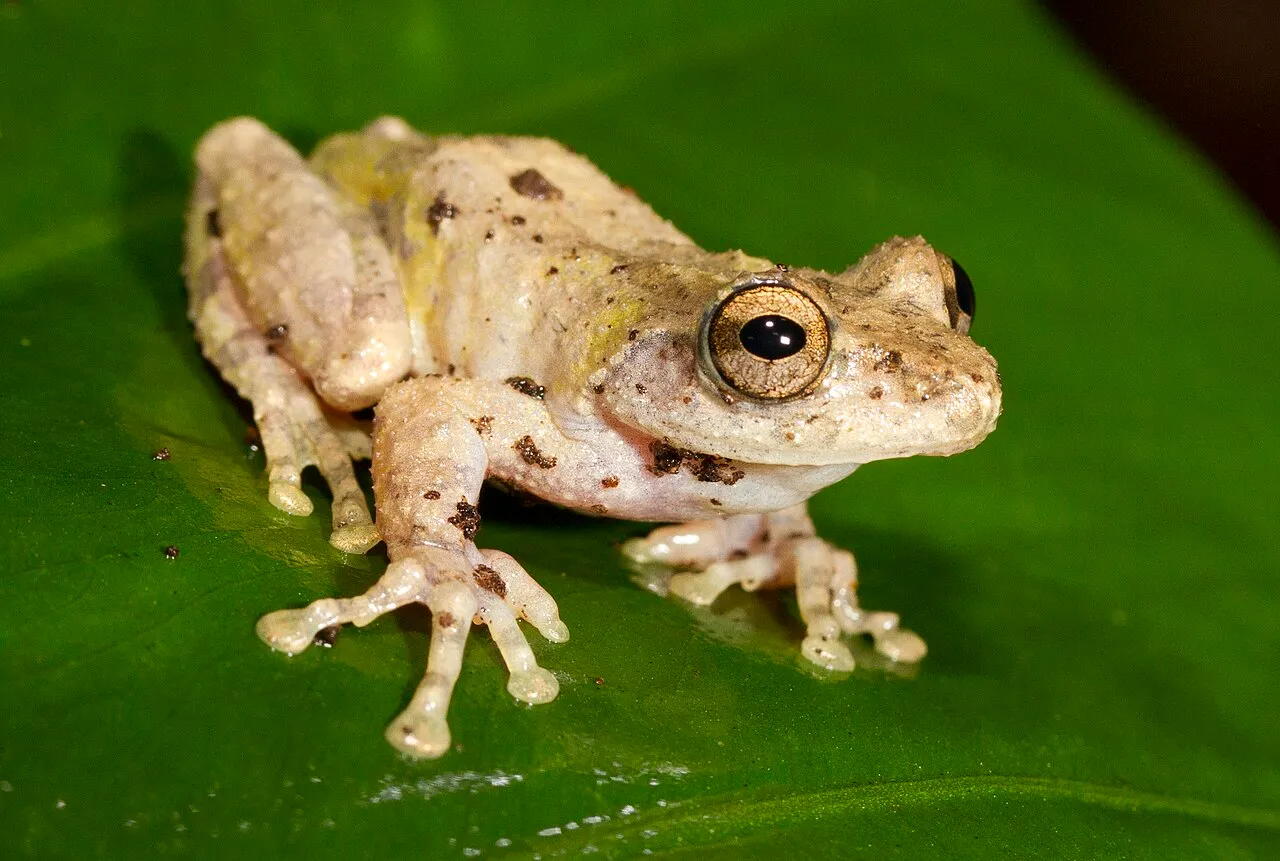
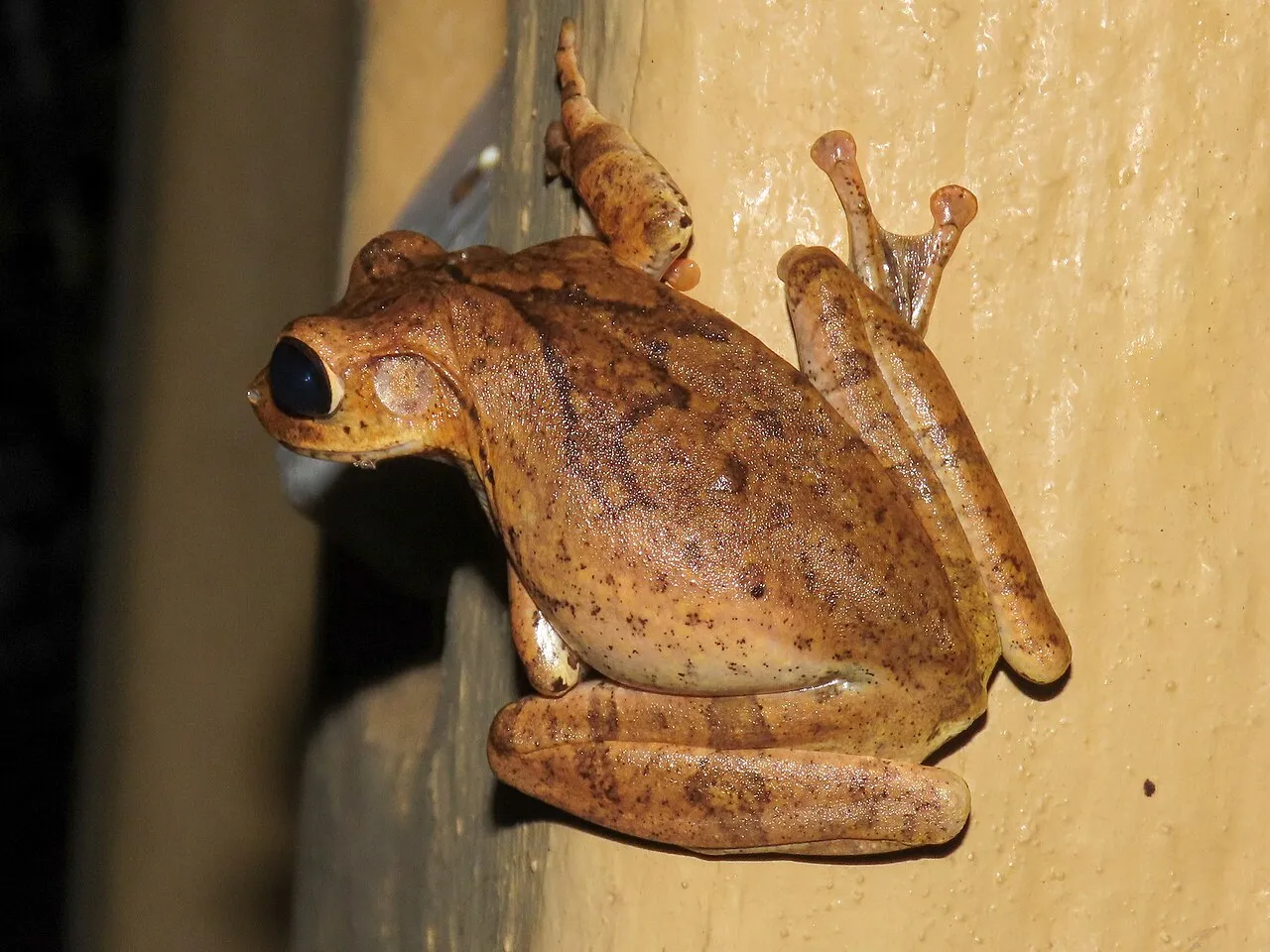
Kurixalus eiffingeri is a small, rough-skinned frog of the family Rhacophoridae, first described by Oskar Boettger in 1895 and native to Taiwan and Japan’s Yaeyama Islands in the southern Ryukyus. Several of the studies below pre-date its move to the current genus and refer to the species by its older name, Chirixalus eiffingeri. Rather than open water, it breeds in water-filled tree holes and bamboo stumps1, and its tadpoles survive on nothing but their mother’s unfertilised eggs.
Identification
Adults are a small to medium-sized frog with rough skin and a robust body. Adult males measure about 31-35 mm snout-vent length, and females about 36-40 mm1. Males carry a nuptial pad, used to grip the female during mating, that is greatly expanded, as in the Taiwanese Kurixalus berylliniris but unlike the slight pad of the mainland Chinese Kurixalus lenquanensis. Besides that pad, the species’ canthus rostralis, the ridge running from eye to snout, is straight, with a vertical loreal region below it, a combination that separates it from mainland Chinese relatives such as Kurixalus lenquanensis, whose canthus rostralis is curved and loreal region oblique2 instead.
Habitat and range
The species keeps to broadleaf, bamboo and mixed bamboo forests, at elevations between about 50 and 2000 m above sea level, across Taiwan and the Yaeyama Islands. The species is threatened by habitat loss1.
Behaviour and breeding
Breeding happens away from open water: fertilised eggs are laid above the waterline inside bamboo stumps and tree holes and hatch after 10-14 days. At a bamboo-forest study site in Nantou County, Taiwan, breeding activity runs from April to August, peaking between May and July. A clutch runs from about 10 to 155 eggs, averaging roughly 44, with most clutches found between May and July, when breeding activity peaks. Males stay at the nest only through the embryonic period, leaving once the eggs hatch and providing no further defence after that. Some begin a second clutch before the first one has even hatched, a way of making up for mating chances otherwise lost while tied to one nest. Once the male has left, about 30 percent of nests fail when the female abandons the nest or dies, most often to snake predation, and the same predator is also the main cause of death among tadpoles once they hatch3.
Once the tadpoles hatch, they depend entirely on their mother: she returns to the pool roughly every 8 days, feeding her tadpoles only at night by laying unfertilised trophic eggs, and tadpoles eat only these eggs4, never other food in the pool. A single tadpole consumes close to 80 trophic eggs on its way to metamorphosis, a schedule demanding enough that it limits how soon the female can breed again while also feeding an existing brood. Metamorphosis itself takes about 45 to 60 days from hatching3, and in the meantime the tadpoles delay defecating in their confined pool until after they leave it1.
This tree-hole breeding marks the species out even within its own genus: it is one of only three Taiwanese Kurixalus species that breed this way at all2 (see Similar species, below). At the Nantou County study site, average monthly temperature runs about 18°C, with annual rainfall near 3000 mm3.
Conservation
As of 2022, the species is assessed as Least Concern on the IUCN Red List5, though it remains threatened by habitat loss1. Away from habitat loss, nest mortality is already substantial: once the male has gone, about 30 percent of nests3 fail when the female abandons the nest or dies, most often to snake predation, on top of the same predator’s toll on tadpoles once they hatch.
Similar species
Taiwan holds four Kurixalus species, but only K. eiffingeri, K. berylliniris and K. wangi lay their eggs inside tree hollows or water-filled, cut bamboo. The fourth, Kurixalus idiootocus, instead lays pigmented eggs on land near the water’s edge2, not sealed inside a tree hole on a diet of trophic eggs alone.
Outside Taiwan, the mainland Chinese Kurixalus lenquanensis is closer in size to Kurixalus idiootocus than to K. eiffingeri, with males averaging about 27 mm against K. eiffingeri’s 31 mm, and carries only a slight nuptial pad, unlike the greatly expanded pad of K. eiffingeri. Genetic work places K. lenquanensis as the sister species of Kurixalus idiootocus2.
_bHzj1.webp)
_from_the_crater_of_Mt._Cagua_-_ZooKeys-266-001-g040_16EQPb.webp)
_(23189284839)_2anaj6.webp)