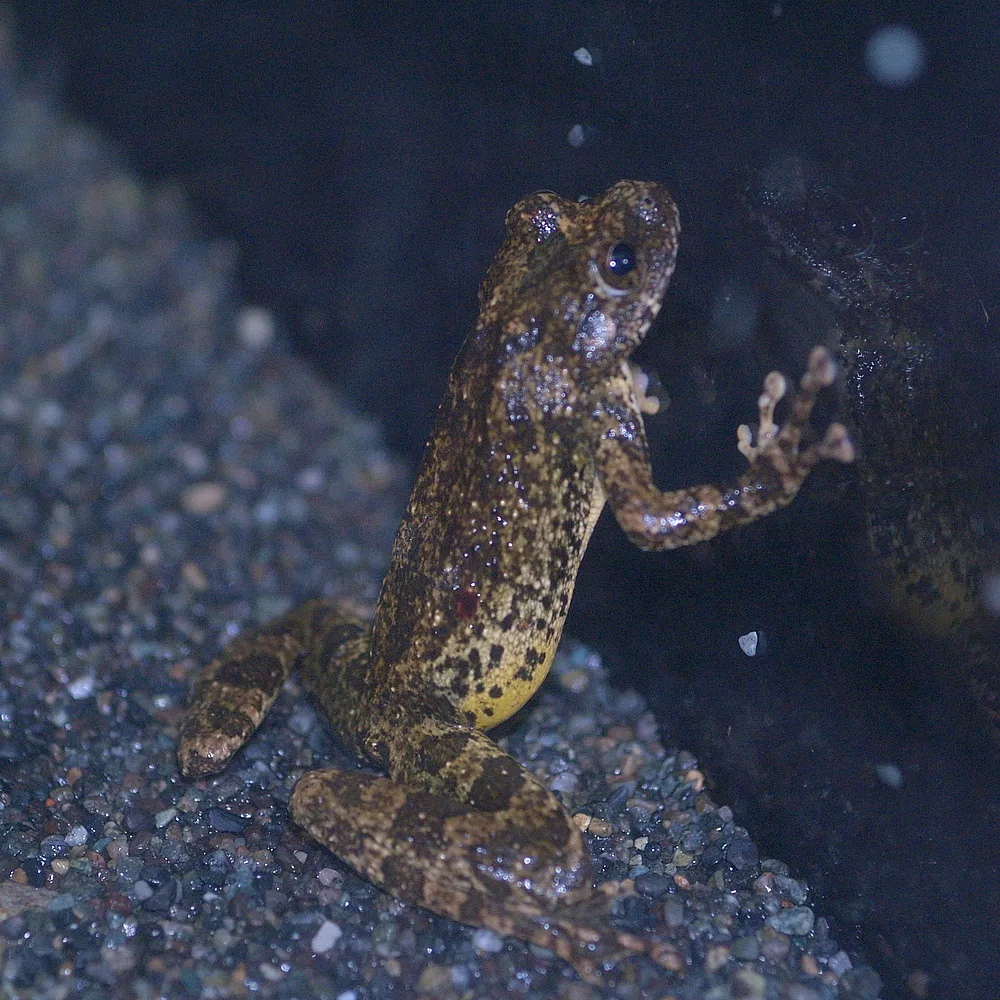
The Kajika frog, Buergeria buergeri, is endemic to Japan, found on the islands of Honshu, Kyushu, and Shikoku, where it lives along fast mountain streams rather than ponds. Its Japanese name means “river deer”: the male’s call is said to resemble the cry of a buck, and in Japan a beautiful singing voice is traditionally compared to the “Kajika” call.
Identification
Males measure 35–44 mm and females 49–85 mm in snout-vent length, with females noticeably the larger sex; the facts box carries the full range. The frog is grayish-brown with speckles that camouflage it against streamside rock, and a dark T-shaped pattern between the eyes is one of its clearest field marks. The body itself is notably flat, helping it press into crevices out of sight, while suction pads on the tips of its fingers and toes, together with a large mouth also lined with suction pads, let it cling to wet rock in a strong current.
Habitat and range
B. buergeri keeps to montane streams, lakes, and the surrounding forests, a habitat shaped by fast-moving water rather than the still ponds many other frogs favour. Its flattened body and grip pads are a direct answer to that current, letting it hold position on wet stone where a less specialised frog would be swept off.
Behaviour and breeding
Males set up territories on riverside rocks and call from there to attract mates, producing the far-carrying call the species is named for. Breeding runs from April to August, when a female lays around 500 eggs across several sessions, usually tucked underneath a rock. The egg mass measures about 5 cm across, and the eggs hatch roughly two weeks later. Adults feed on insects and spiders, while the tadpoles graze on algae in the same streams.
Conservation
The species’ facts box carries its current IUCN Red List category, Least Concern, reflecting its wide range across three of Japan’s main islands. That status is not unconditional: the frog is locally threatened by habitat loss from dam building and the concreting of riverbanks, both of which remove the fast-flowing rock habitat it depends on.
Similar species
Within its genus, B. buergeri is Japan’s most widespread Buergeria, and its flattened, rock-clinging build and T-shaped facial marking set it apart from Japan’s other stream frogs, few of which share the same large suction pads on both mouth and toes. Its restriction to Honshu, Kyushu, and Shikoku, rather than more southerly islands, also helps separate it from Japan’s other Buergeria species.