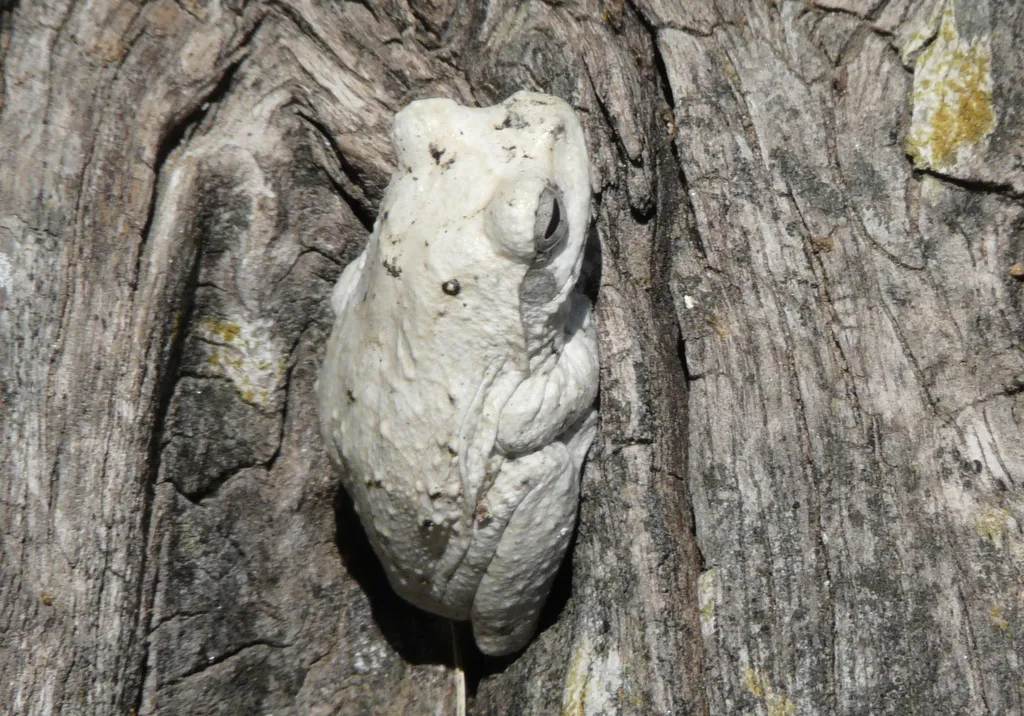
The grey foam-nest treefrog, Chiromantis xerampelina, is a stocky, bark-coloured tree frog best known for the whipped-up foam nests its females build over water. It ranges across southern and eastern Africa, including Kenya, Tanzania, Angola and South Africa, where it is one of the more conspicuous frogs of the dry savanna.
Identification
Adults are sexually dimorphic in size: males measure about 43–75 mm and females about 60–90 mm in snout-vent length. The skin is slightly bumpy and dry rather than moist, an early sign of how well this species tolerates dry air, and colouring ranges from white to brown with a bark-like geometric pattern. The frog actively changes shade with temperature, turning darker below about 36°C to absorb heat and paler to reflect it in hotter conditions. On the hands, the outer two fingers splay out at close to a right angle from the inner two, an unusual grip adapted for gripping branches and for working foam during nest-building.
Habitat and range
The species lives in lightly wooded savanna and dry forest, including miombo and mopane woodland and cultivated land at low altitudes. It is arboreal and shelters under loose bark during dry seasons, and although it tolerates drier zones better than most frogs, it still needs humidity to survive, which is why its dry, relatively impermeable skin — the trait behind its nickname “waterproof frog” — matters so much for where it can live.
Behaviour and breeding
Mating runs through the wet summer months, from October to February. Breeding is communal: more than 90% of females mate with ten or more males at once, and unusually for frogs, males of this species typically do not fight each other over mates. A mated group produces a single foam nest overhanging water: the female releases a thick, mucus-like fluid from her cloaca and whips it into an elastic froth using her hind legs, a job that takes around five to six hours; she typically returns the following day to add a protective outer layer. Each nest holds 500 to 1,250 eggs, which develop inside the foam for about six days before the tadpoles drop into the water below; young frogs reach maturity within six to eight weeks.
Water conservation shapes much of its physiology outside the breeding season. The species is uricotelic to a degree unusual among frogs: 50–75% of its nitrogenous waste is excreted as solid uric acid rather than urea, sparing water that would otherwise be lost flushing liquid waste. During prolonged dry spells it can lose up to 60% of its body weight and, when aestivating, seals small gaps in its shelter with a water-resistant mucus to limit further loss.
Conservation
The facts box carries the species’ current IUCN Red List category, Least Concern. Its wide range across southern and eastern Africa and its tolerance of cultivated and semi-urban land have so far kept it out of serious decline, though clearing of the woodland it shelters in could still affect local populations.
Similar species
The grey foam-nest treefrog’s closest relatives are its own genus-mates, Chiromantis petersii and Chiromantis kelleri. Telling them apart reliably needs closer comparison than a field photo allows; this profile covers C. xerampelina only.