- Pelophryne misera: Revealing the Enigmatic Life of the Black Flathead Toad
- Introduction: Meeting a Secretive Tree-Dweller
- Taxonomy and Classification
- Natural Habitat: A Life in the Rainforest Canopy
- Physical Characteristics: Masters of Subtle Adaptation
- Behavior and Life Cycle: A Life Shaped by Adaptation
- Ecological Role: Guardians of Forest Balance
- Threats and Conservation Status: Battling the Hidden Crisis
- Cultural and Scientific Significance
- Conclusion: Protecting a Hidden Jewel of the Forest
Pelophryne misera: Revealing the Enigmatic Life of the Black Flathead Toad#
Introduction: Meeting a Secretive Tree-Dweller#
Hidden deep within the humid, mist-covered forests of Southeast Asia, the Black Flathead Toad (Pelophryne misera) lives a life of extraordinary subtlety and quiet adaptation. Often overlooked in favor of flashier rainforest inhabitants, this diminutive amphibian embodies the quiet charm and resilience that permeates the Earth’s delicate ecosystems. Known among researchers for its cryptic lifestyle and intriguing biology, Pelophryne misera belongs to a fascinating lineage of tropical toads, whose modest appearance belies remarkable ecological importance.
Despite their discreet appearance, these tiny amphibians possess adaptations that rival those of the rainforest’s most flamboyant inhabitants. Whispered stories from local tribes and anecdotes from field researchers hint at the toad’s subtle yet profound imprint on its environment. Rarely seen and even less often studied, the life and ecological significance of Pelophryne misera deserves a closer look. In uncovering the mysteries of this species, we not only enrich our knowledge of amphibian biodiversity but deepen our understanding of the ecological threads that bind together these tropical forests.
Taxonomy and Classification#
Pelophryne misera is classified within the Bufonidae family—the true toads—characterized by their warty skin, short limbs, and terrestrial or arboreal lifestyles. Within this expansive and diverse group, the genus Pelophryne consists of small to medium-sized species notable for their flattened bodies and preference for humid rainforest habitats. Established scientifically in the late 19th century, P. misera has been documented in scientific literature since its initial description by renowned herpetologist George Albert Boulenger in 1890.
Closely related to other small-bodied rainforest toads within Southeast Asia, P. misera is distinct in both its physical form and its ecological niche. Its closest relatives also dwell in similar habitats, reflecting the group’s specialization in adapting to rainforest environments. Taxonomic studies continuously refine the understanding of these relationships, increasingly highlighting just how evolutionarily specialized and unique Pelophryne misera truly is.
Natural Habitat: A Life in the Rainforest Canopy#
Pelophryne misera finds its natural haven in the lush forests of Southeast Asia, predominantly scattered across Malaysia, Brunei, Indonesia, and southern Thailand. These amphibians thrive in rainforest biomes defined by dense, multilayered vegetation, ever-dripping moisture from cloudy mountaintops, and the familiar hum and bustle of insects, birds, and other wildlife. While many toads prefer terrestrial habitats, this species uniquely prefers the arboreal habitats—specifically the lower canopy and mid-level foliage. Here, amidst tangles of ferns, bromeliads, and orchids, they quietly exist, often mere silhouettes walking the delicate threshold between open visibility and camouflage.
Within the complexity of the rainforest, P. misera particularly favors moist microhabitats such as leaves bearing small pools of collected rain, tree cavities, and humid bark crevices. These locations provide both moisture and optimal hunting grounds, as minute insects inhabit these humid recesses. Their survival hinges upon this specialized arboreal environment—a testament to the species’ remarkable adaptation in both physical form and behavior.
Physical Characteristics: Masters of Subtle Adaptation#
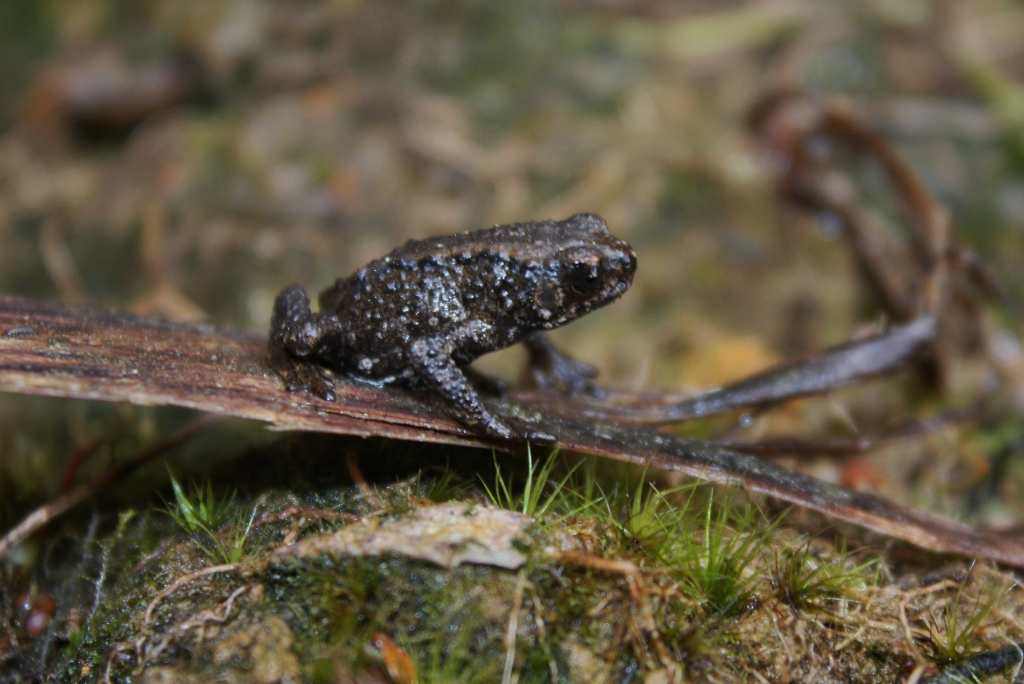
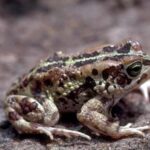
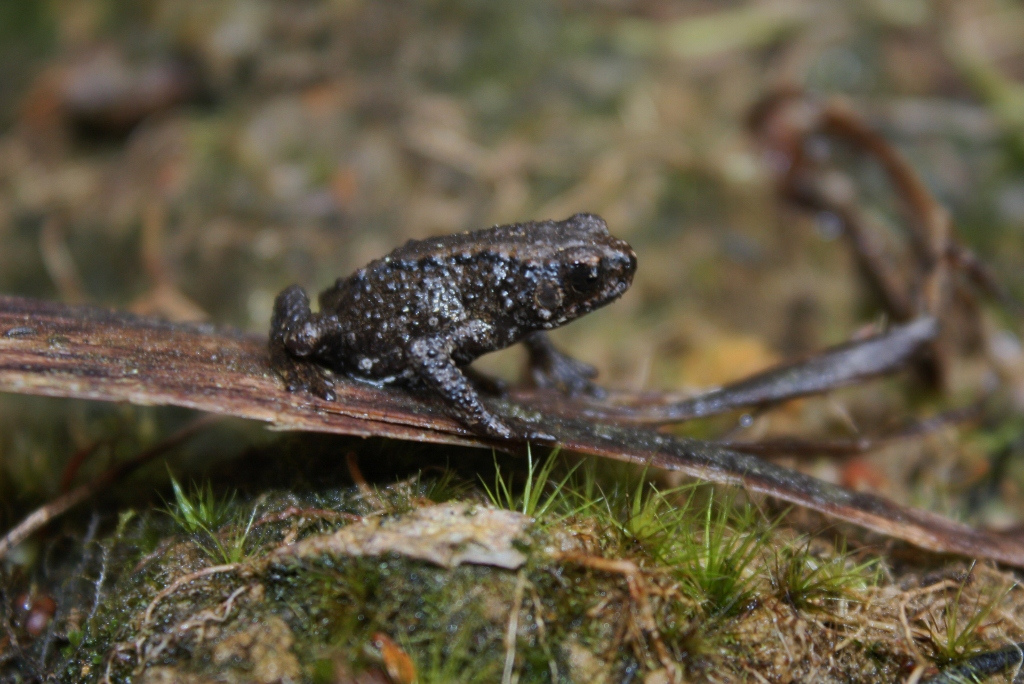
Measuring barely 20–30 millimeters from snout to vent, the Black Flathead Toad may seem unassuming at first glance. Its coloration ranges from grayish-brown to nearly black, punctuated by subtle mottling and irregular patterns that expertly mimic the shadowy patterns of damp bark. Such cryptic appearance allows it to evade the searching eyes of predators, blending seamlessly into the shadows and lichen-laden branches upon which it lives.
What sets P. misera distinctly apart from other toads is its remarkably flattened body and broad, slightly triangular head. This notable physique facilitates movement along narrow branches and within crevices, further aiding camouflage and stealthy hunting. Their skin, textured with minute warty bumps and ridges, helps conserve moisture in their constantly humid yet paradoxically moisture-dependent environment.
Behavior and Life Cycle: A Life Shaped by Adaptation#
Silent Hunters of the Rainforest Night#
Predominantly nocturnal, Pelophryne misera spends its daylight hours hidden, immobile, and virtually indistinguishable from its surroundings. Nightfall brings these silent predators into quiet activity, stealthily pursuing their prey of ants, termites, springtails, and tiny beetle larvae. They hunt primarily through ambush and careful, coordinated movements upon their chosen arboreal perch. Hunting involves meticulous stillness, patience, and rapid ambush—a graceful ballet where even slight miscalculations mean forfeited meals.
Breeding and Reproduction: Shaping Future Generations#
Breeding seasons coincide with wet periods when monsoonal rains dominate Southeast Asia. Male P. misera signal readiness for mating through soft, insect-like calls that lend a subtle yet audible chorus among night-time rainforest sounds. Females, attracted by these gentle calls and courtship behaviors, carefully select males to ensure optimal offspring health and survival.
Egg-laying occurs in moist microhabitats, such as pools of water collected in leaves or hollow tree cavities. The choice of such transient nursery habitats means tadpoles must rapidly mature and emerge before their ephemeral homes evaporate. As tadpoles hatch, their initial developmental stage is accelerated due to nutrient-rich yolk supplies within the eggs, and they soon transition into terrestrial or arboreal juvenile life-forms. Life for young hatchlings remains precarious, dependent upon skillful camouflage techniques and adaptability learned from the first moments outside the water.
Ecological Role: Guardians of Forest Balance#
Pelophryne misera serves as an essential predator within the rainforest food web, significantly influencing insect populations and supporting ecosystem equilibrium. By consuming insects—some of which are agricultural pests—they indirectly benefit surrounding communities. Furthermore, as prey themselves, these toads form vital links within food webs, supporting birds, reptiles, and larger amphibian species.
Additionally, their presence indicates the overall health of forest ecosystems, acting as bioindicators sensitive to air quality, moisture levels, and forest integrity. As an indicator species, monitoring the health of populations provides valuable insight into environmental conditions and ecosystem pressures, alerting conservationists to wider environmental threats.
Threats and Conservation Status: Battling the Hidden Crisis#
While often flying under conservation radars, Pelophryne misera is not exempt from threats that impact global amphibian biodiversity. It is categorized as “Least Concern” by the International Union for Conservation of Nature (IUCN), but local populations increasingly face significant pressures. Deforestation associated with agricultural expansion—particularly palm oil plantations and logging—is fragmenting essential habitats, transforming lush rainforest habitats into isolated ecological islands.
Climate change, too, threatens to fundamentally restructure the delicate balance of rainforest microclimates, altering rainfall, humidity, and temperature patterns upon which these amphibians depend for survival. Within changing climate regimes, the reproductive life-cycle, food availability, and sanctuary habitats all face disruptions, threatening future generations of Pelophryne misera and the creatures dependent upon them.
Cultural and Scientific Significance#
Although rarely prominent in traditional legends, local communities have long respected rainforest amphibians, recognizing their contributions toward ecological health and pest management. Scientifically, P. misera offers valuable insights into amphibian morphology, arboreal adaptation, and ecosystem interactions. Each study of this elusive amphibian enriches our overall understanding of biodiversity, evolutionary processes, and conservation efforts crucial for preserving the world’s rainforests.
Conclusion: Protecting a Hidden Jewel of the Forest#
Educating ourselves and others about the subtle significance and captivating adaptability of Pelophryne misera inspires greater appreciation and action toward conservation. The story of this shy arboreal amphibian invites us all to support preservation efforts, advocate ecological balance, and treasure nature’s overlooked marvels. By championing amphibian habitats, we protect not just individual species, but the very viability of our planet’s richest ecosystems.