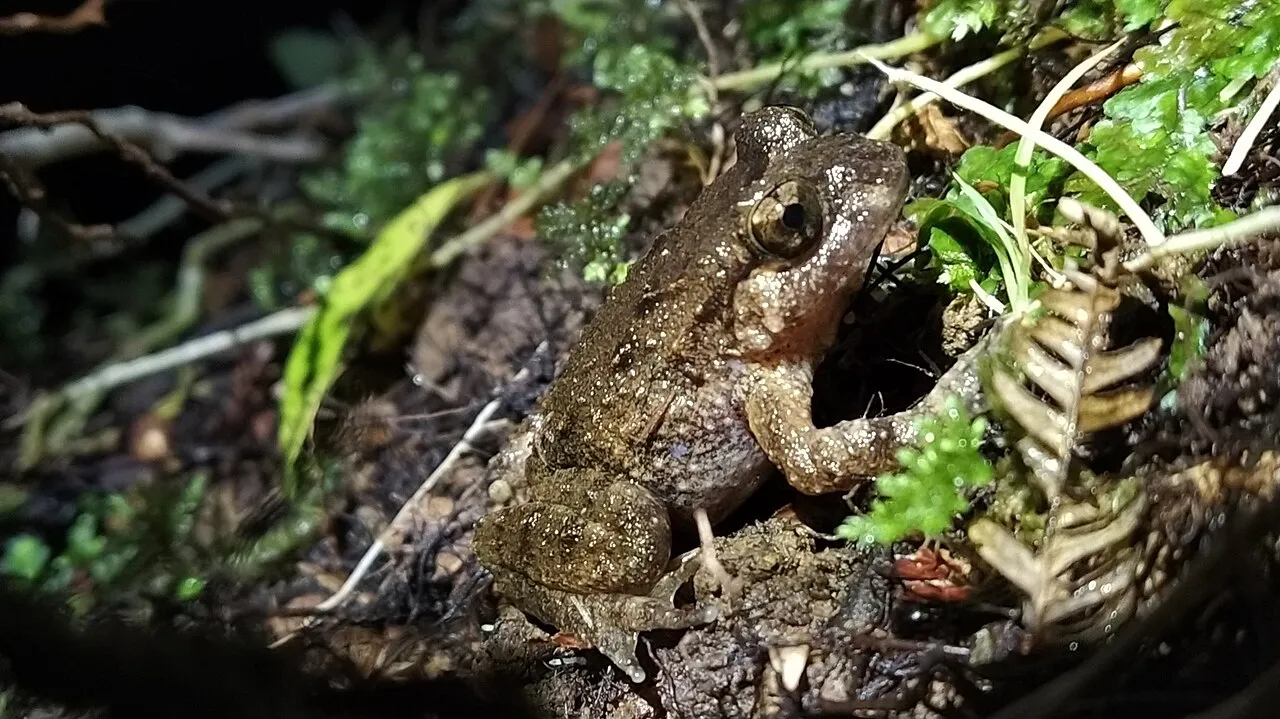
Leiopelma hochstetteri, Hochstetter’s frog, is a small, primitive frog of New Zealand’s archaic family Leiopelmatidae. It is endemic to the upper North Island, with populations scattered across the Waitākere and Hunua Ranges, the Coromandel Peninsula, Great Barrier Island, and coastal areas between Whangārei and the Waikato region, and it stands apart from its three living relatives as the most water-associated member of the genus. It also has the most extensive distribution of any native New Zealand frog, though that range is now fragmented into isolated pockets rather than continuous.
Identification
The species is small and mottled, with a brown-green to brown-red back marked with dark bands and warts, and a yellow-brown belly. Males reach about 38 mm snout-vent length and females grow to about 50 mm, making females the larger sex. Like the rest of its family it has tail-wagging muscles, inscriptional ribs, round pupils, and no external eardrum, eustachian tube or vocal sac. It is nocturnal, spending daylight hours sheltered from view and emerging after dark, which is also when most sightings and surveys take place.
Habitat and range
Hochstetter’s frog favours moist gaps under shaded debris such as rocks and logs, usually along streams and seepages in native temperate rainforest. Its current range spans the upper North Island, with populations in the Waitākere and Hunua Ranges, the Coromandel Peninsula, Great Barrier Island, Maungatautari Ecological Island, and the East Coast, plus coastal areas between Whangārei and the Waikato region; fossil and historical records show a once-wider distribution that introduced predators sharply reduced over the past two centuries. Because it tolerates a wider range of conditions than its three relatives, which are confined to a handful of forest patches, it remains the most widely distributed Leiopelma species today even as its overall population contracts.
Behaviour and breeding
By night, it forages for invertebrates such as spiders, beetles and mites. Its poor hearing matches its silent habits: lacking eardrums, it relies on chemical signals rather than calls to mark habitat and recognise competitors. Adults do not breed until about three years old and lay up to 20 eggs a season, and uniquely among Leiopelma species, its tadpoles develop freely in water rather than under a guarding parent on land. Individuals can live up to 30 years, a long lifespan for so small a frog that likely reflects its slow, low-turnover life history.
Conservation
The IUCN category is shown in the facts box above. New Zealand’s own threat classification lists the species as ‘At Risk – Declining’, reflecting pressure that the global assessment does not fully capture; all native frogs, including this one, carry legal protection under the Wildlife Act 1953. The Polynesian rat (kiore) drove the species to extinction on the South Island and caused large-scale losses on the North Island after its arrival. Today, rats and stoats are confirmed to kill Hochstetter’s frogs, while pigs, cats, hedgehogs and ferrets are also likely to have an impact, and goats and pigs degrade streamside habitat by browsing vegetation, while logging and mining lower stream water quality; the global chytrid fungus is thought to pose a further threat. Sustained predator control is not just theoretical: in the Hunua Ranges’ Kokako Management Area, pest control begun in 1994 lifted the proportion of young frogs in surveyed populations from about 10% to about 30% by 2005, evidence that the species responds well to reduced predation pressure and that on-the-ground pest control, not just habitat protection, drives its recovery.
Similar species
Hochstetter’s frog is one of four living native New Zealand frogs in the family Leiopelmatidae, alongside Archey’s frog, Hamilton’s frog and the Maud Island frog, all sharing the family’s lack of external eardrums and its archaic skeletal traits. It is nonetheless the odd one out in its reproduction: its relatives lay terrestrial eggs that a parent guards through direct development, while Hochstetter’s frog alone keeps a free-swimming, semi-aquatic tadpole stage, a trait that also explains why it is consistently found closer to running water than its stream-independent cousins. A frog seen in the water itself, rather than simply near it, is therefore a strong first clue that it belongs to this species rather than to Archey’s, Hamilton’s or the Maud Island frog.