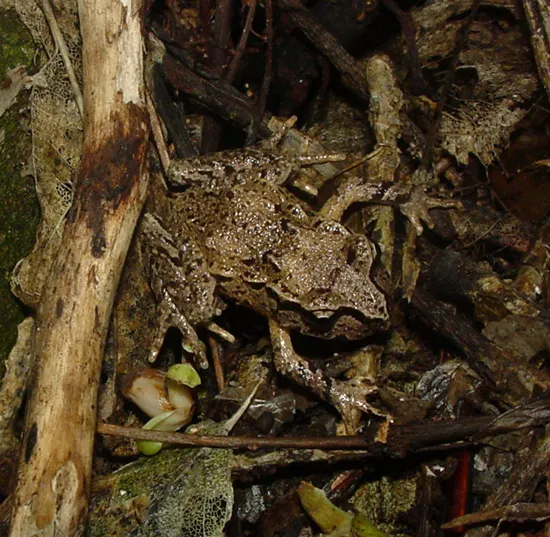
Leiopelma hamiltoni, Hamilton’s frog, is one of the world’s most primitive living frogs, a member of the ancient New Zealand family Leiopelmatidae. It is now confined to Stephens Island and Maud Island in the Cook Strait, a tiny remnant of a range that fossils show once covered the lower North Island and upper South Island.
Identification
Hamilton’s frog is a small, stocky, mottled brown frog, with males reaching up to 43 mm and females up to 49 mm in snout-vent length, making females the larger sex. Like other members of its archaic family, it lacks the external eardrum and the vocal sac of most modern frogs.
Habitat and range
The species lives in rocky, moist, grassy coastal areas, sheltering by day in damp crevices and favouring boulder banks, an environment that keeps the frog’s skin from drying out without ever requiring open water. It is nocturnal and ground-dwelling, and it stays mostly below 300 m elevation. Today its entire wild distribution is Stephens Island and Maud Island in the Cook Strait, New Zealand, both predator-managed island reserves rather than the mainland range its fossils record.
Behaviour and breeding
As in other Leiopelma species, Hamilton’s frog has no free-swimming tadpole stage: it breeds away from standing water, and the terrestrial eggs develop directly into froglets, with the male guarding the clutch. This direct development is shared across the genus and is one of the traits that marks Leiopelmatidae as an early, divergent branch of the frog family tree.
Conservation
The IUCN category is shown in the facts box above. The main pressures on the species are introduced rats, predation by tuatara, habitat loss and chytrid fungus. The two island populations differ enormously in size: roughly 200 to 300 frogs survive on Stephens Island, against up to about 19,000 on Maud Island, the latter population established as an insurance translocation. Both island populations depend on staying free of the mammalian predators that wiped the species from the mainland.
Similar species
Hamilton’s frog belongs to the same small, archaic genus as New Zealand’s three other living native frogs — Archey’s frog, Hochstetter’s frog and the Maud Island frog, all of which share the family’s lack of external eardrums and direct-developing eggs. The Maud Island frog, Leiopelma pakeka, was in fact only recognised as a distinct species in 1998, after allozyme analysis found it genetically distinct from the Stephens Island population of Hamilton’s frog, and the two remain the closest match for each other of any living frogs.