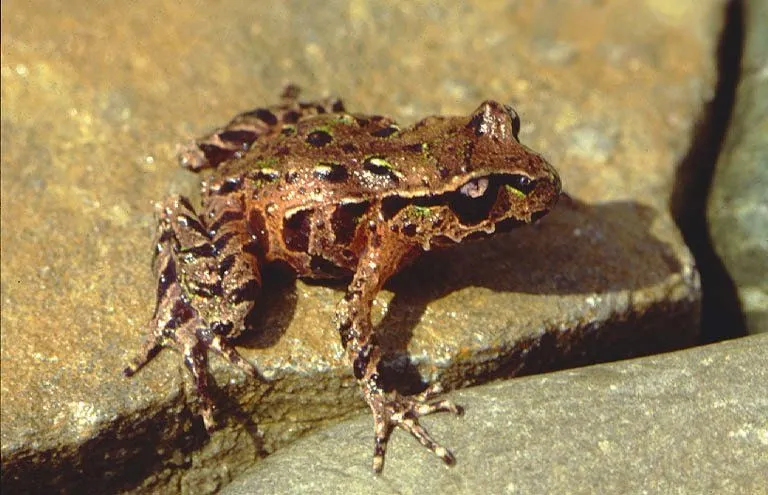
Leiopelma archeyi, Archey’s frog, is a small, primitive frog of New Zealand’s archaic family Leiopelmatidae. It is endemic to New Zealand’s North Island, found only in two disjunct areas: the Coromandel Peninsula and the Whareorino Forest near Te Kūiti, one of the most restricted ranges of any living frog.
Identification
Archey’s frog is small even among its own genus: males reach about 31 mm snout-vent length, while females grow larger, up to about 37 mm, making females the larger sex. Like other members of Leiopelmatidae, it lacks the external eardrum and vocal sac typical of most modern frogs, and its mottled brown colouring helps it disappear into leaf litter and damp bark.
Habitat and range
The species favours native forest at higher elevations, on ridges away from streams, in high-moisture sites. It was historically also found at lower elevations, but populations have shifted to these ridge-top refugia, leaving today’s frogs confined to damp, higher ground away from the running water their relative Hochstetter’s frog depends on.
Behaviour and breeding
Mating occurs from September to November, after which females lay clutches of 4 to 15 eggs, each 8 to 11 mm, between December and February. As in the rest of its genus, development is fully terrestrial rather than aquatic: tadpoles develop inside the egg’s gelatinous capsule, skipping the free-swimming stage entirely. Parental care continues well past hatching — males carry the tailed froglets on their backs for three to four years during metamorphosis, an unusually long period of paternal care for any frog.
Conservation
The IUCN category is shown in the facts box above. New Zealand’s own threat classification has listed the species as ‘Nationally Vulnerable’. An estimated 5,000 to 20,000 individuals remain in the wild, but the trend behind that number is troubling: one intensively monitored population declined by 88% between 1996 and 2001, a drop possibly linked to fungal disease. Ongoing threats include predation by rats, introduced bell frogs, pigs, cats, hedgehogs and ferrets, the same suite of introduced predators that has pushed its island-bound relatives toward similarly precarious numbers.
Similar species
Archey’s frog is one of four living native New Zealand frogs in the family Leiopelmatidae, alongside Hamilton’s frog, Hochstetter’s frog and the Maud Island frog, all sharing the family’s lack of external eardrums and its direct-developing, terrestrial eggs. It can be told apart from Hochstetter’s frog, the only Leiopelma species with free-swimming tadpoles, by its stricter terrestrial development and its ridge-top rather than stream-side habitat, and from Hamilton’s frog, which is confined to just two Cook Strait islands far to the south, by its North Island range on the Coromandel Peninsula and in Whareorino Forest.